
LASIK • Los Angeles
LASIK Risks and Side Effects
Most LASIK side effects are temporary and fade as the eye heals. A few problems are uncommon but serious. Here is how to tell them apart, and how screening lowers your risk.
Request a consultation
What are the risks of LASIK?
The most common side effects are dry eyes and glare, halos or starbursts at night, which usually improve over the first three to six months. Less common problems include leftover prescription and flap complications. Serious complications such as infection or corneal weakening (ectasia) are rare, and careful screening before surgery is the main way to avoid them.
Which side effects are common after LASIK?
Almost everyone has some short-term symptoms while the cornea heals. They are a normal part of recovery, not a sign that something went wrong.
- Dry, scratchy or tired eyes: the flap temporarily affects the nerves that tell your eyes to make tears. This is the most common side effect.
- Glare, halos and starbursts: lights at night may have rings or rays around them for weeks to months.
- Light sensitivity: bright sun may feel uncomfortable for the first few days.
- Changing vision: clarity can shift through the day while the tear film settles.
- Small red spots on the white of the eye: these come from tiny broken blood vessels and fade within a couple of weeks.
The FDA looked at how people feel after modern LASIK in its PROWL studies. Up to 28 percent of participants who had no dry-eye symptoms before surgery reported them at three months, and some developed new glare or halos. In each study, fewer than 1 percent said a single symptom made it hard to do their usual activities.

What less common problems can happen?
- Under- or overcorrection: the eye heals a little differently than planned and some prescription remains. Glasses, contacts or an enhancement may help once vision is stable.
- Regression: some prescription returns over time, more often with higher prescriptions or farsightedness.
- Flap problems: small wrinkles, inflammation under the flap or cells growing under its edge. Most are found at follow-up visits and treated.
- Lasting dry eye or night vision symptoms: a small number of people have symptoms that persist and need ongoing care.
This is one reason follow-up visits matter even when you feel fine. Many of these problems are easier to manage when they are caught early.

What are the rare but serious risks?
Serious complications are uncommon, but you should know about them before choosing any elective eye surgery. FDA consumer guidance notes that some patients lose vision that cannot be fully corrected with glasses, contacts or further surgery.
- Infection: rare, and most likely in the first days. This is why drops, shields and keeping water out of your eyes matter.
- Ectasia: a progressive weakening and bulging of the cornea. It is most closely tied to corneas that were thin, irregular or weak before surgery.
- Flap displacement after injury: a strong blow to the eye can move the flap, even years later. It needs prompt repair.
- Lasting loss of best-corrected vision: rare, but possible with any eye surgery.
Who has a higher risk of problems?
Most serious LASIK problems trace back to who was treated rather than how. FDA guidance lists situations that make LASIK riskier or less predictable:
- A glasses or contact lens prescription that changed in the past year
- Dry eye that has not been treated
- Thin, irregular or weak corneas, including keratoconus
- Large pupils in dim light, which can increase night glare
- Autoimmune disease, diabetes or medications that can slow healing
- Pregnancy or breastfeeding
- Contact sports or work with a high chance of blows to the face
If one of these applies to you, you may still have good options. PRK, EVO ICL and refractive lens exchange work differently and may fit better. Our guides to thin corneas and LASIK and LASIK with dry eyes go into detail.
How does Berg-Feinfield reduce LASIK risks?
Screening is the most important safety step. Your evaluation includes corneal mapping and thickness measurements, a check of your tear film, and a wavefront scan with the iDESIGN 2.0 system, which measures 1,257 points across each eye. These tests look for the corneal patterns, dryness and instability that raise risk.
Berg-Feinfield’s LASIK is 100% bladeless: the flap is made with a femtosecond laser rather than a mechanical blade, and the laser treatment is guided by your eye’s own wavefront measurements. The LASIK technology page explains each platform. If the tests show LASIK is not a safe fit, the team will tell you and talk through alternatives.
What can you do to lower your own risk?
- Share your full health history, medications and how long you have worn contacts.
- Stay out of contact lenses for as long as your team asks before testing.
- Use every prescribed drop on schedule and wear the shields at night.
- Keep your follow-up visits, even if you can see well.
- Wear protective eyewear for sports and yard work, now and after you heal.
Recovery steps are laid out stage by stage in our LASIK recovery timeline.
Is LASIK still worth the risk?
For people who are good candidates, LASIK has a long track record, and most side effects fade with time. The decision is still personal. FDA guidance is direct about this: certain complications are unavoidable in a small percentage of patients, so if you are not comfortable accepting that, refractive surgery may not be right for you. Glasses and contact lenses remain reasonable choices, and a good evaluation should leave you with a clear sense of your own risk either way.
Meet your care team
Who leads refractive care at Berg-Feinfield?
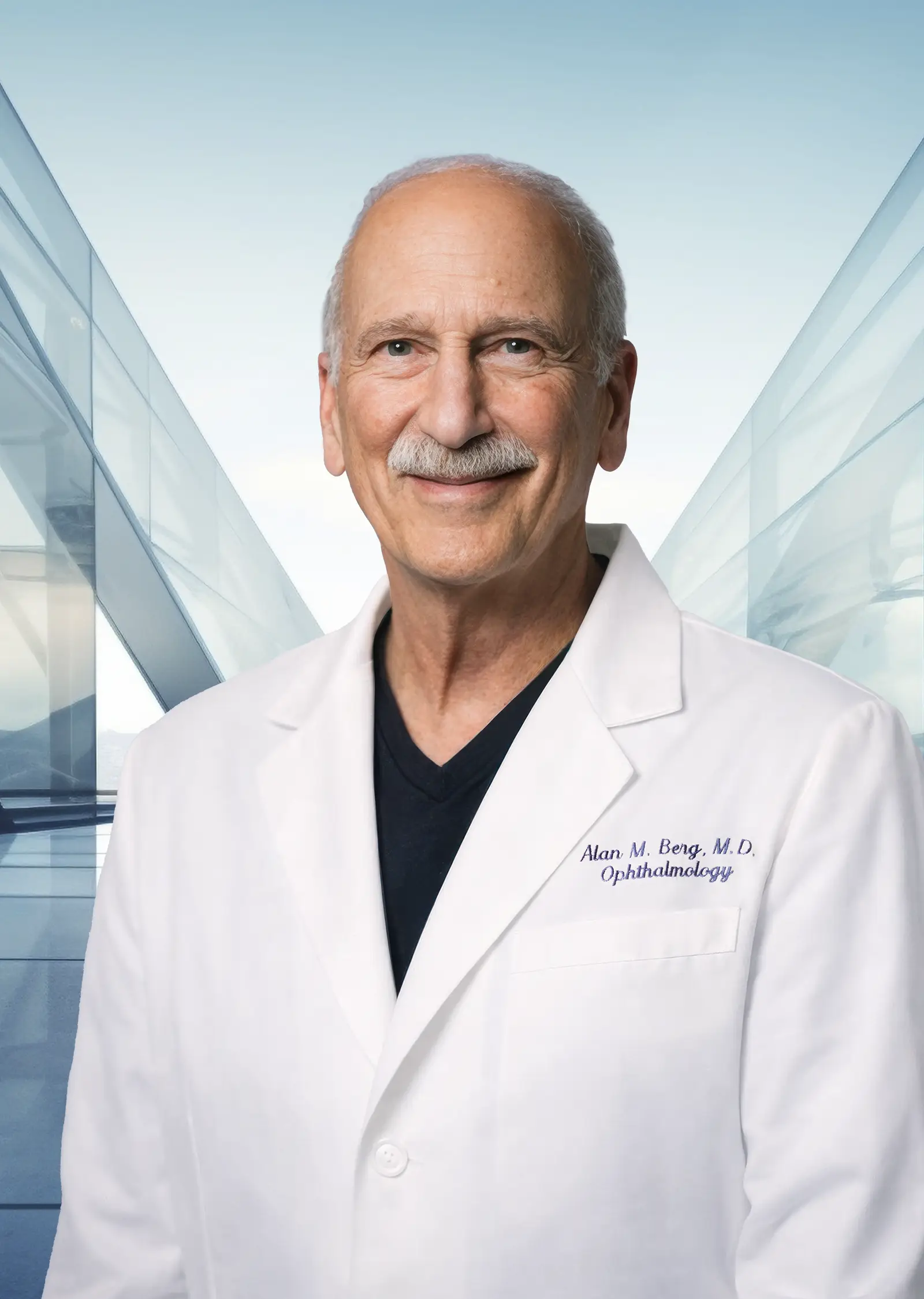
Alan M. Berg, MD
Dr. Berg is a board-certified ophthalmologist who leads LASIK and refractive surgery at Berg-Feinfield. He earned his medical degree at Bowman Gray School of Medicine and finished his ophthalmology residency at the University of Southern California, where he remains on the faculty teaching residents.
He has performed more than 50,000 LASIK procedures. Berg-Feinfield has served Los Angeles since 1980 and offers 100% bladeless LASIK through a practice with five offices. He was one of 50 U.S. surgeons chosen for the clinical trials of the Implantable Collamer Lens (ICL). Your own measurements still decide whether surgery is right for you.
What else do Los Angeles patients ask?
What is the most common side effect of LASIK?
Dry eye. Most people have some dryness in the first weeks, and it usually improves over three to six months. Lubricating drops help, and dry eye that is treated before surgery tends to cause fewer problems afterward.
Do halos and glare go away after LASIK?
For most people they fade over the first few months as the eye heals. If night glare still bothers you after your vision stabilizes, your doctor can look for a treatable cause such as dryness or leftover prescription.
Can LASIK cause permanent vision loss?
It is rare, but serious complications such as infection can cause vision loss that glasses or contacts cannot fully correct. Screening, prescribed drops and follow-up visits are how that risk is kept low. Ask about your personal risk at your evaluation.
What is corneal ectasia?
Ectasia is a weakening of the cornea that lets it bulge and blur vision. It is rare and mostly linked to corneas that were thin, irregular or weak before surgery. Corneal mapping and thickness measurements are the main screening tools.
Can the LASIK flap move years later?
It is uncommon, but a strong, direct blow to the eye can dislodge a flap even long after healing, and it needs prompt repair. Protective eyewear for sports and risky work lowers the chance.
Is bladeless LASIK safer than blade LASIK?
A femtosecond laser creates the flap at a programmed depth and size instead of using a mechanical blade, which removes blade-related flap problems. It does not remove every risk, so screening and aftercare still matter. Berg-Feinfield performs 100% bladeless LASIK.
What if I am not a good LASIK candidate?
You may still qualify for PRK, EVO ICL or refractive lens exchange, depending on your corneas, prescription and age. Glasses and contact lenses also remain good options.
Which Berg-Feinfield office is convenient for you?
Request an evaluation at one of five offices. Confirm the clinician and location for each appointment when scheduling.
Sherman Oaks
13320 Riverside Dr, Ste 114Monday–Friday
8:30 AM–5:30 PM
Serving San Fernando Valley.
Request a consultationBurbank
2625 W Alameda Ave, Ste 208Monday–Friday
8:30 AM–5:30 PM
Serving Burbank, Glendale and the eastern San Fernando Valley.
Request a consultationBeverly Hills
462 N Linden Dr, Ste 441Monday–Friday
8:30 AM–5:30 PM
Serving Beverly Hills, the Westside and nearby Los Angeles neighborhoods.
Request a consultationArcadia
638 W Duarte Rd, Ste 10Monday–Friday
8:30 AM–5:30 PM
Serving San Gabriel Valley, including Arcadia and nearby Pasadena.
Request a consultationValencia (Santa Clarita)
27335 Tourney Rd, Ste 210Monday–Friday
8:30 AM–5:30 PM
Serving Santa Clarita Valley.
Request a consultationFind out what your risk looks like
A complimentary LASIK evaluation measures your corneas, tear film and prescription so you can weigh the benefits and risks for your own eyes.
Request a consultation