
RayOne EMV in Los Angeles
An extended range of vision lens that never splits light. RayOne EMV uses controlled positive spherical aberration to stretch focus from distance into intermediate — with monofocal levels of contrast sensitivity and low dysphotopsia.
RayOne EMV at a Glance
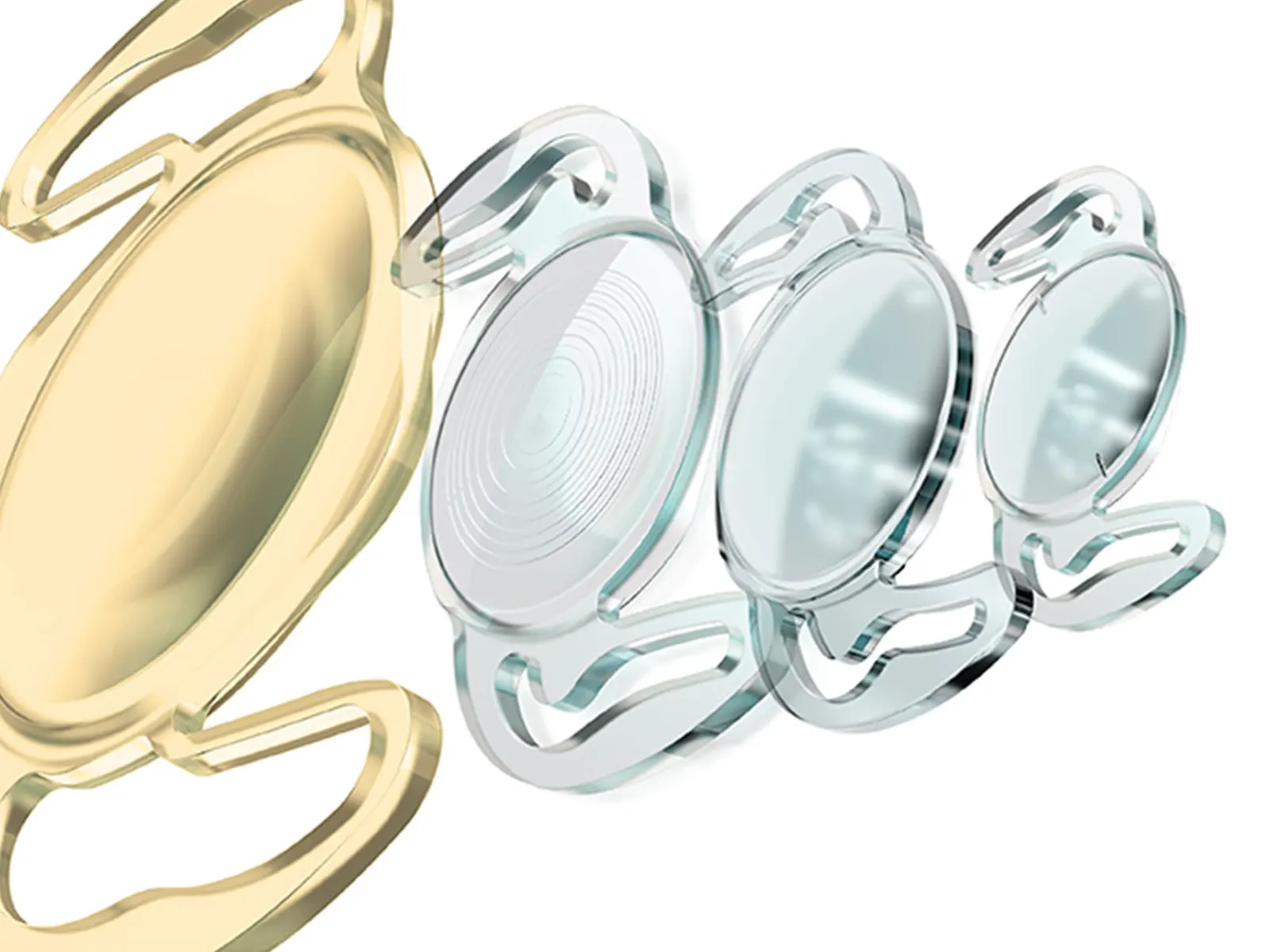
Short answer: RayOne EMV is a non-diffractive intraocular lens from Rayner that extends your range of vision from distance into intermediate without splitting light — so contrast and night vision stay close to a standard monofocal. Berg-Feinfield offers it, including the toric version for astigmatism, with cataract surgery at five Los Angeles-area offices.
What Is the RayOne EMV Lens?
RayOne EMV is Rayner's non-diffractive intraocular lens, developed in collaboration with world-renowned surgeon Professor Graham Barrett. Most presbyopia-correcting lenses use a diffractive optic that divides incoming light into separate focal points — that is what creates a near focus, and it is also what can create halos, starbursts, and reduced contrast at night. RayOne EMV takes a different route entirely. It intentionally builds in controlled positive spherical aberration, which spreads light along the visual axis and elongates the focal range from distance into intermediate.
Because nothing is being split, the optics stay clean. Rayner reports monofocal levels of contrast sensitivity and low dysphotopsia with the EMV platform — meaningful for patients whose priority is a natural-looking night sky, crisp road signs, and detail retention rather than maximum reading independence. The lens comes fully preloaded in a single-piece injector, and the toric version, RayOne EMV Toric, was FDA approved in October 2025 following a multicenter randomized IDE trial.
At Berg-Feinfield, RayOne EMV is one of several premium lens options discussed at your cataract consultation. It is implanted during laser cataract surgery, and your surgeon will confirm whether it suits your measurements and how you use your eyes day to day.
Why Patients Choose RayOne EMV
More range than a monofocal, without trading away the quality of the image.
- Non-diffractive optic — no light splitting, so halos and glare stay minimal
- Monofocal levels of contrast sensitivity, per the manufacturer's clinical data
- Smooth, continuous transition from distance into intermediate vision
- Designed to pair with a blended vision plan for added functional near
- RayOne EMV Toric corrects astigmatism with proven rotational stability
- A strong option for eyes where a diffractive lens is not the right choice
Two Ways to Plan RayOne EMV
The same lens, targeted two different ways — your surgeon will recommend the plan that fits your eyes and your priorities.
Matched for distance
Both eyes are targeted for distance. You get the lens's extended range in each eye, excellent depth perception, and readers for close work. The most conservative, most predictable option.
Blended vision
The dominant eye is set for distance and the second eye is set slightly nearer. Because each lens already carries extended range, the two overlap instead of competing — which is what makes blended vision comfortable here.
Astigmatism handled
If you have corneal astigmatism, RayOne EMV Toric corrects it in the same procedure. Correcting astigmatism is what allows the extended range to actually show up in your day-to-day vision.
RayOne EMV vs. PureSee vs. Vivity
Three non-diffractive lenses, three different ways of extending range.
| RayOne EMV | TECNIS PureSee | Clareon Vivity | |
|---|---|---|---|
| Manufacturer | Rayner | Johnson & Johnson Vision | Alcon |
| How it extends range | Controlled positive spherical aberration | Purely refractive surface | Wavefront-shaping non-diffractive optic |
| Splits light? | No | No | No |
| Typical strength | Clean optics plus flexible blended vision planning | Only EDOF FDA approved with no contrast-sensitivity warning | Long track record on Clareon material |
| Reading glasses | Usually for small print | Usually for small print | Usually for small print |
| Toric option | RayOne EMV Toric | PureSee Toric II | Vivity Toric |
| Learn more | This page | TECNIS PureSee | Clareon Vivity |
Is RayOne EMV Right for You?
Who tends to do best with this lens — and when another option may fit better.
RayOne EMV may be a great fit if you:
- Drive at night and want to protect contrast and night vision
- Want more range than a monofocal but are wary of diffractive optics
- Have done well with monovision in contact lenses, or are open to trying it
- Are comfortable using readers for the smallest print
Consider another lens if you:
- Want full reading independence → PanOptix Pro or TECNIS Odyssey
- Want to fine-tune your prescription after surgery → Light Adjustable Lens
- Want both eyes matched with a wider extended range → TECNIS PureSee or Vivity
Content reviewed by the board-certified ophthalmologists of Berg-Feinfield Vision Correction. This page is for information only and is not a substitute for a personal evaluation.
Where to Have RayOne EMV Surgery in Los Angeles
Cataract consultations and follow-up care at five offices across the greater Los Angeles area.
Not sure which office?
Patients travel to us from across the San Fernando Valley, the San Gabriel Valley, and the Santa Clarita Valley.
See all locationsRayOne EMV: Your Questions, Answered
Explore Other Premium Lenses
Compare RayOne EMV with the other premium IOLs at Berg-Feinfield.
TECNIS PureSee
Purely refractive extended range with monofocal-quality contrast.
EDOFClareon Vivity
Non-diffractive extended range on Clareon material.
AdjustableLight Adjustable Lens
The only lens you can fine-tune after surgery.
TrifocalClareon PanOptix Pro
Full-range vision including true reading distance.
Full RangeTECNIS Odyssey
Continuous vision with strong near performance.
CompareAll IOL Options
See every premium lens side by side in one table.
Ask About RayOne EMV at Your Consultation
Schedule a comprehensive cataract consultation at Berg-Feinfield Vision Correction — serving Los Angeles, the San Fernando Valley, the San Gabriel Valley, and the Santa Clarita Valley from five convenient offices in Burbank, Sherman Oaks, Beverly Hills, Arcadia, and Valencia.