
LASIK • Los Angeles
LASIK Over 40: Is It Worth It?
After 40, LASIK can still give you sharp distance vision, but on its own it won't stop the need for reading glasses. Here is how to decide whether it's worth it for you.
Request a consultation
Is LASIK worth it if you're over 40?
Often, yes, if your eyes are healthy and your prescription is stable. LASIK can clear your distance vision for many years, but it does not prevent presbyopia, the age-related loss of near focus that usually starts in the 40s. Many people over 40 choose LASIK plus reading glasses, or monovision to cut down on readers. If your natural lens is already starting to change, refractive lens exchange may be the better long-term choice.
What changes in your eyes after 40?
Two parts of the eye focus light. The cornea at the front does most of the work, and LASIK reshapes it. The lens behind the iris fine-tunes focus for close objects by changing shape. Starting in the early to mid-40s, that lens gets stiffer and close-up focus fades. This is presbyopia. It is why people start holding their phone farther away, and it happens to everyone.
LASIK can correct the cornea at any adult age, but it does not make the lens flexible again. That one fact shapes every decision about LASIK after 40.

What can LASIK do for you after 40?
If you are nearsighted, farsighted or have astigmatism, LASIK can still give you clear distance vision for driving, sports, the TV and faces across the room. For people who have worn glasses or contacts for decades, that is often the change they notice most. Berg-Feinfield's LASIK is 100% bladeless and wavefront-guided, and Dr. Berg has performed more than 50,000 LASIK procedures.
What you need to plan for is near vision. After standard distance LASIK, most people over 40 use reading glasses for small print, and that need grows over time. Nearsighted people often notice it more, because before LASIK they could simply take their glasses off to read.
Option 1: Distance LASIK plus reading glasses
Both eyes are corrected for distance. You get the sharpest possible distance vision and normal depth perception, and you keep a pair of readers for menus, labels and your phone. This is a good fit if you drive a lot at night, play sports or do detailed distance work, and readers don't bother you.
Option 2: Monovision LASIK
Your dominant eye is corrected for distance and the other is left slightly nearsighted for close work. The brain learns to use each eye for what it does best, and many people can read most everyday things without glasses. The trade-offs are some loss of depth perception and slightly softer vision at each distance. The American Academy of Ophthalmology recommends trying monovision with contact lenses before committing to surgery. Our monovision LASIK guide walks through how to decide.
Option 3: Refractive lens exchange
Refractive lens exchange replaces your natural lens with an implant. It is the same procedure as cataract surgery, done before a cataract forms. It can correct distance vision and, with a premium lens, near and intermediate vision too. Because the natural lens is removed, a cataract can never form in it later.
It is a bigger step than LASIK, with the risks of surgery inside the eye, and it is usually considered for people in their mid-40s and older, people with high prescriptions, or anyone whose lens already shows early changes. Compare the two in LASIK vs. refractive lens exchange.
Option 4: EVO ICL in your early 40s
EVO ICL places a thin lens inside the eye, in front of your natural lens, without removing corneal tissue. It can suit high nearsightedness or corneas that are not right for LASIK. FDA approval for EVO ICL covers adults 21 to 45, so it is mainly an option at the younger end of this age group, and it does not treat presbyopia. See LASIK vs. EVO ICL.
How do you know which choice is worth it?
- Your natural lens: if testing shows early cataract changes, LASIK may only buy a few years before your vision changes again. Lens-based surgery may be the better investment.
- Your eye surface: dry eye becomes more common with age and after menopause, and it should be treated before LASIK. See LASIK with dry eyes.
- How you use your eyes: night driving, sports, computer work and reading all weigh differently.
- How much reading glasses bother you: if they don't, distance LASIK is simple. If they do, monovision or lens exchange deserve a closer look.
If you have LASIK now and cataract surgery years from now, keep your LASIK records. They make it easier to choose the right lens power later; our guide to cataract surgery after LASIK explains why. For a broader look at timing, see what is the best age for LASIK.
Meet your care team
Who leads refractive care at Berg-Feinfield?
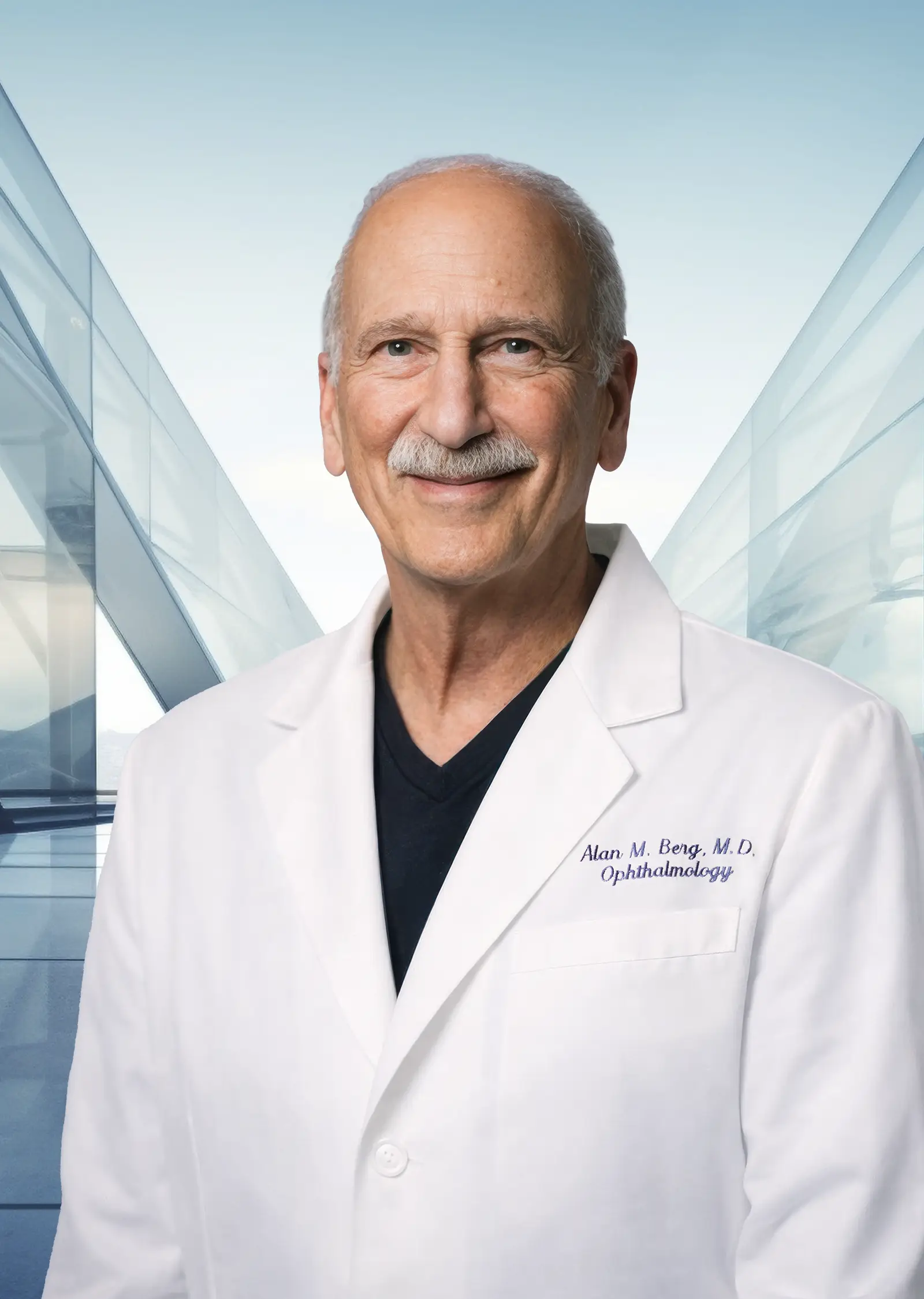
Alan M. Berg, MD
Dr. Berg is a board-certified ophthalmologist who leads LASIK and refractive surgery at Berg-Feinfield. He earned his medical degree at Bowman Gray School of Medicine and finished his ophthalmology residency at the University of Southern California, where he remains on the faculty teaching residents.
He has performed more than 50,000 LASIK procedures. Berg-Feinfield has served Los Angeles since 1980 and offers 100% bladeless LASIK through a practice with five offices. He was one of 50 U.S. surgeons chosen for the clinical trials of the Implantable Collamer Lens (ICL). Your own measurements still decide whether surgery is right for you.
What else do Los Angeles patients ask?
Am I too old for LASIK?
There is no upper age limit for LASIK. What matters is healthy corneas, a stable prescription, a healthy tear film and a clear natural lens. If early cataract changes are present, lens-based surgery is often the better choice.
Will I need reading glasses after LASIK at 45?
Most likely, for small print, unless you choose monovision. Presbyopia comes from the lens inside the eye, which LASIK does not change, and it keeps progressing into your 50s and 60s.
Can LASIK correct presbyopia?
Not directly. Monovision LASIK works around it by setting one eye for near, which reduces the need for reading glasses for many people. Refractive lens exchange with a presbyopia-correcting lens is another option.
Is monovision a good idea?
For many people it works well, especially for everyday reading and phone use. Some never adapt to it. Try monovision with contact lenses first, and see our monovision LASIK guide for the trade-offs.
Should I choose LASIK or refractive lens exchange at 50?
It depends on your natural lens. If it is clear and you mainly want distance vision, LASIK may be the simpler choice. If the lens is starting to change or you want help with near vision, refractive lens exchange often makes more sense long term.
Does LASIK affect future cataract surgery?
You can have cataract surgery after LASIK. Choosing the lens power takes extra care because the cornea was reshaped, so keep your LASIK records and bring them to that evaluation.
Is the LASIK consultation free?
Berg-Feinfield offers complimentary LASIK consultations at its five Los Angeles-area offices. The evaluation includes corneal mapping, thickness measurements, wavefront testing and a full candidacy review.
Which Berg-Feinfield office is convenient for you?
Request an evaluation at one of five offices. Confirm the clinician and location for each appointment when scheduling.
Sherman Oaks
13320 Riverside Dr, Ste 114Monday–Friday
8:30 AM–5:30 PM
Serving San Fernando Valley.
Request a consultationBurbank
2625 W Alameda Ave, Ste 208Monday–Friday
8:30 AM–5:30 PM
Serving Burbank, Glendale and the eastern San Fernando Valley.
Request a consultationBeverly Hills
462 N Linden Dr, Ste 441Monday–Friday
8:30 AM–5:30 PM
Serving Beverly Hills, the Westside and nearby Los Angeles neighborhoods.
Request a consultationArcadia
638 W Duarte Rd, Ste 10Monday–Friday
8:30 AM–5:30 PM
Serving San Gabriel Valley, including Arcadia and nearby Pasadena.
Request a consultationValencia (Santa Clarita)
27335 Tourney Rd, Ste 210Monday–Friday
8:30 AM–5:30 PM
Serving Santa Clarita Valley.
Request a consultationFind out what makes sense for your eyes after 40
A complimentary evaluation checks your corneas, tear film and natural lens, then lays out LASIK, monovision and lens-based options side by side.
Request a consultation