Under About 45
If your natural lens still focuses well up close, there's usually no reason to replace it — LASIK corrects the cornea and preserves it.

LASIK reshapes your cornea with a laser. Refractive Lens Exchange (RLE) replaces the eye's natural lens with an advanced artificial lens — correcting reading vision and preventing cataracts in the process. They suit very different ages and goals. Berg-Feinfield offers both in Los Angeles, so your recommendation is matched to your eyes, not to the one procedure a clinic happens to sell.

LASIK reshapes the cornea to correct nearsightedness, farsightedness, and astigmatism. It's the go-to for healthy corneas and low-to-moderate prescriptions — usually people in their 20s, 30s, and early 40s who don't yet need reading glasses.
Refractive Lens Exchange replaces the eye's natural lens with a premium artificial lens — the same technique as cataract surgery, done before a cataract forms. Because it swaps the lens itself, RLE can correct the full range of vision including presbyopia (reading vision), and it means you'll never develop cataracts. It's typically the better choice from the mid-40s onward, for high farsightedness, or for people who aren't LASIK candidates. The right choice comes down mostly to your age, your prescription, and whether reading vision is part of the picture.
Compare Side by SideTwo very different procedures for two different stages of life. Here's how they compare — and what each difference means for you.
| LASIK | Refractive Lens Exchange | |
|---|---|---|
| How it works | A laser reshapes the cornea | The eye's natural lens is replaced with an artificial lens (IOL) |
| What's changed | The cornea (front surface) | The lens inside the eye |
| Corrects | Nearsightedness, farsightedness & astigmatism | The same — plus presbyopia (reading vision) with a premium lens |
| Reading vision (presbyopia) | Limited — monovision only | Yes — with a multifocal or extended-depth-of-focus lens |
| Future cataracts | Still possible later in life | Eliminated — the natural lens is removed |
| Typical age | 18 to early 40s | Usually mid-40s and older |
| Best for | Healthy corneas, low-to-moderate prescriptions | Presbyopia, high farsightedness, early cataract, non-LASIK candidates |
| Procedure | Corneal laser, about 15 minutes | Lens replacement, one eye at a time, about 15–20 minutes each |
| Recovery | Sharp for most by the next morning | Functional in days; vision settles over one to a few weeks |
| Long-term results | Both excellent — RLE additionally removes the need for future cataract surgery | |
The single biggest factor is usually age and reading vision. If you're under about 45 with healthy corneas, LASIK is often ideal; from the mid-40s on, RLE's ability to correct reading vision and prevent cataracts frequently makes it the smarter long-term choice. Learn more about RLE.
For younger patients with healthy corneas who don't yet need reading correction, LASIK is fast, minimally invasive, and highly effective.
If your natural lens still focuses well up close, there's usually no reason to replace it — LASIK corrects the cornea and preserves it.
With adequate corneal thickness and a low-to-moderate prescription, LASIK offers a quick, corneal-only solution.
LASIK works on the surface of the eye rather than inside it, with a next-day recovery for most patients.
RLE solves problems LASIK can't — especially reading vision and cataract prevention. Learn more about RLE.
Once presbyopia sets in (mid-40s+), a premium multifocal or extended-depth-of-focus lens can restore both distance and near vision — something LASIK alone can't do.
For strong hyperopia beyond the range LASIK treats well, replacing the lens is often the more effective and stable correction.
If a cataract is beginning, RLE addresses your vision and the cataract in one step — you won't need separate cataract surgery later.
Because the natural lens is removed and replaced, a cataract can never form in that eye.
If thin corneas or a very high prescription rule out LASIK, RLE can still deliver a full range of clear vision.
Toric, multifocal, and extended-depth-of-focus lenses let us tailor your result. Compare premium lenses.
Berg-Feinfield's refractive and lens surgery is led by co-founder Dr. Alan M. Berg, who has performed corneal, refractive, and lens-based surgery in Southern California for more than 30 years — and offers both LASIK and Refractive Lens Exchange.
Because we perform LASIK, RLE, PRK, and EVO ICL, our recommendation is driven by your eyes and your stage of life — not by the one procedure a clinic is set up to sell.
Co-founder of Berg-Feinfield, with decades of corneal, refractive, and cataract-lens surgery experience, and a surgical educator who has trained ophthalmologists nationally.
Toric, multifocal, and extended-depth-of-focus lenses, matched to your eyes and your visual goals for the clearest possible result.
We'll tell you honestly which procedure suits your eyes and your age — or if you're better served by waiting.
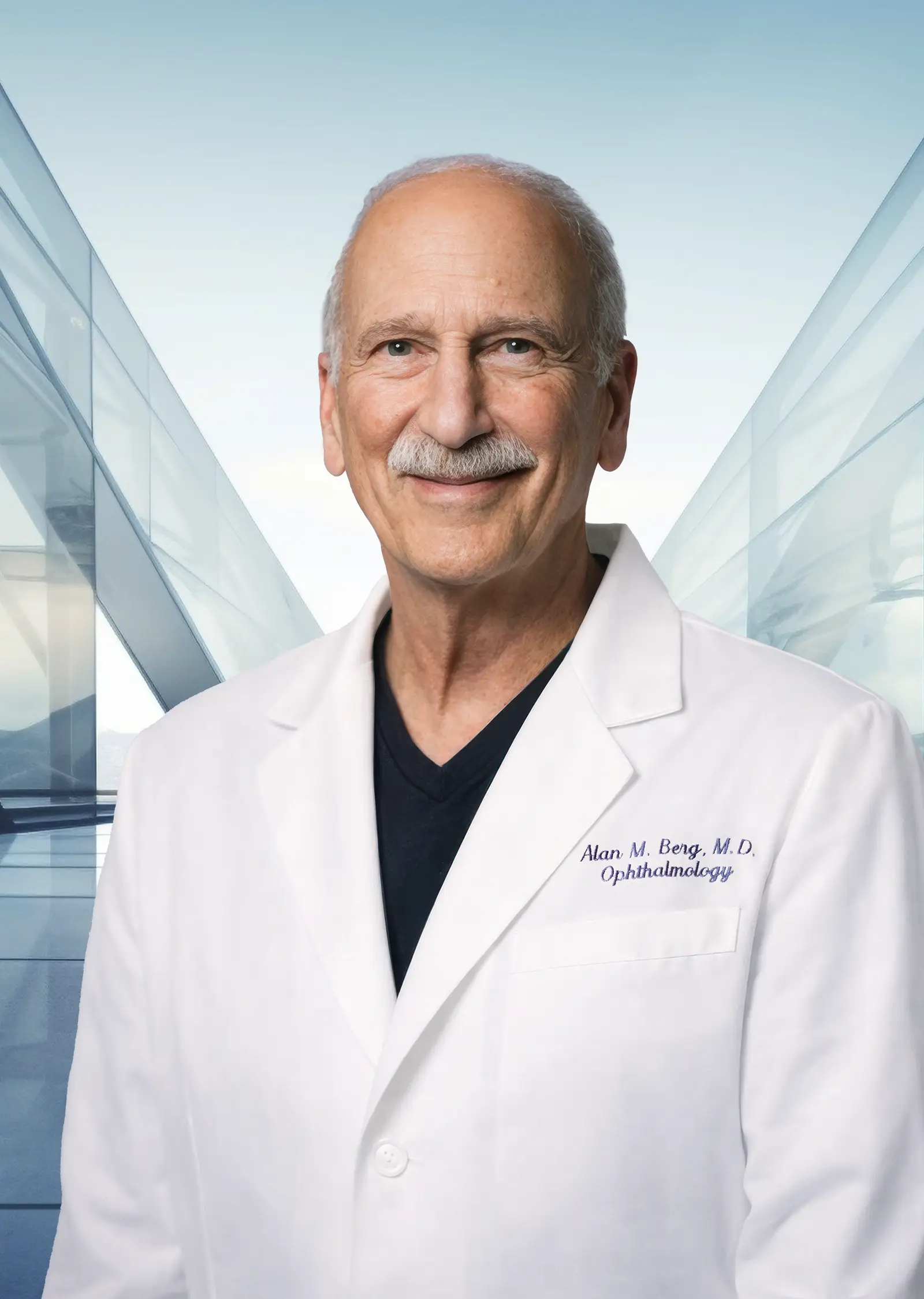
A Berg-Feinfield evaluation measures your eyes and takes your age and goals into account, then gives you an honest recommendation — LASIK, Refractive Lens Exchange, or another option. Five Los Angeles-area locations, one straight answer.
BERG-FEINFIELD · AFTER HOURS
Questions about your vision? Talk with our AI assistant about LASIK, cataract surgery, or general eye care.
Talk with ClaireAI assistant for general information, not medical advice or emergency care. AI can make mistakes. Confirm medical information with your eye care professional.