LASIK Alternatives Los Angeles | PRK, EVO ICL & RLE | Berg-Feinfield
Vision Correction · Los Angeles

Not Every Eye
Is a LASIK Eye.
That’s Not Bad News.

LASIK is excellent — but it is not the right procedure for every patient. Berg-Feinfield offers the full range of refractive alternatives so that the recommendation is always based on your eyes, not on what is simplest to offer.

Three proven alternatives — PRK, EVO ICL, and Refractive Lens Exchange — each suited to a different patient profile. Berg-Feinfield offers all three under one roof at five Los Angeles area locations.

Why Some Patients Need an
Alternative to LASIK

LASIK is the most widely performed refractive procedure in the world — and for good reason. But candidacy depends on factors that not every patient meets: corneal thickness, prescription range, dry eye severity, age, and lifestyle all play a role.

At Berg-Feinfield, patients who are not right for LASIK are redirected — not pressured. The right procedure for your eyes is always the one the recommendation is based on.

📏
Thin or Irregular Corneas
LASIK requires sufficient corneal tissue. Patients with thinner corneas may be better candidates for PRK or EVO ICL.
🔢
High Prescriptions
Very high myopia or hyperopia may exceed the safe range for corneal reshaping. EVO ICL handles prescriptions LASIK cannot.
💧
Significant Dry Eye
LASIK can worsen existing dry eye. EVO ICL and RLE do not affect the corneal nerve supply the same way.
🕐
Age & Presbyopia
Patients over 45 developing presbyopia may benefit more from Refractive Lens Exchange, which addresses near and distance vision simultaneously.
01
Laser Vision Correction

PRK — Photorefractive
Keratectomy

The original laser vision correction — still the best option for many patients.

PRK and LASIK use the same excimer laser to reshape the cornea and correct refractive error. The difference is how the cornea is accessed: LASIK creates a corneal flap, while PRK treats the corneal surface directly after the outer epithelial layer is removed.

Because PRK removes no internal tissue to create a flap, it is the preferred choice for patients with thinner corneas, those whose profession or sport makes flap-related risk a concern, and patients with corneal surface irregularities that make flap creation less predictable.

The tradeoff is recovery time. PRK typically takes one to two weeks for initial visual clarity, compared to one to two days with LASIK, as the epithelium regrows over the corneal surface. Final outcomes, however, are equivalent to LASIK for most patients — and in some cases, slightly better for high prescriptions.

At Berg-Feinfield, PRK is performed with the same iDESIGN 2.0 wavefront-guided diagnostic platform used for LASIK — meaning the same precision of treatment planning is applied regardless of which procedure you have.

Best candidates for PRK in Los Angeles:

  • Patients with thinner corneas not thick enough for LASIK flap creation
  • Military, law enforcement, or contact sport athletes where flap risk is a concern
  • Patients with corneal surface irregularities
  • Those seeking all-laser vision correction without an internal incision
Learn About PRK Surgery
PRK at a Glance
Procedure typeLaser corneal reshaping
Corneal flapNone — surface treatment
Corneal tissue removedYes — outer epithelium only
Initial recovery1–2 weeks for clarity
Vision correctionMyopia, hyperopia, astigmatism
ReversibleNo — permanent
Technology usediDESIGN 2.0 wavefront-guided
02
Implantable Lens

EVO ICL —
Implantable Collamer Lens

No corneal reshaping. No tissue removed. A tiny lens implanted inside the eye.

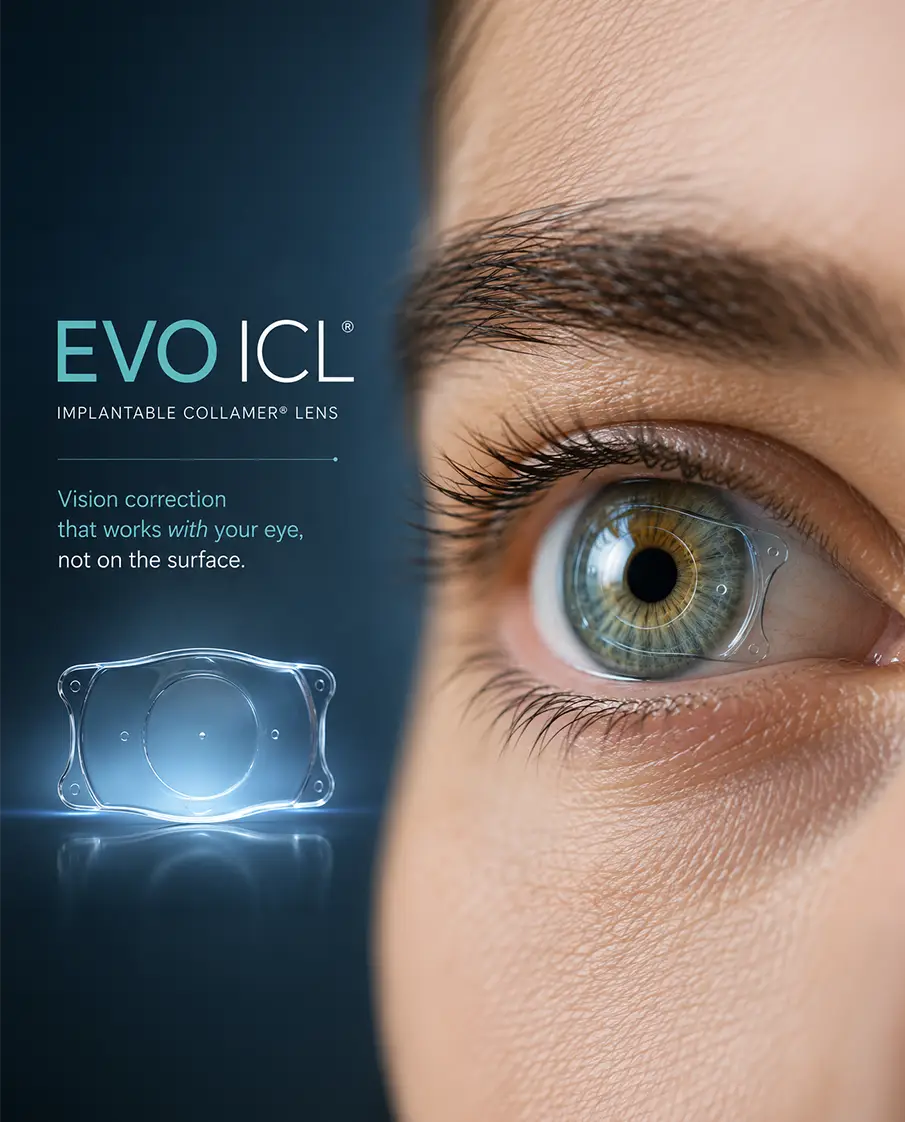
EVO ICL takes a fundamentally different approach to vision correction. Rather than reshaping the cornea with laser energy, a small, flexible corrective lens is placed inside the eye — between the iris and the natural crystalline lens — where it stays permanently but can be removed if needed.

Because no corneal tissue is removed, EVO ICL is an excellent option for patients with higher prescriptions beyond the safe range for laser correction, borderline corneal thickness, or significant dry eye disease that might be worsened by LASIK’s effect on corneal nerves. The procedure also preserves the full corneal architecture — a consideration for patients who may need other eye procedures in the future.

The EVO ICL has a UV filter built in, and many patients report exceptional visual quality — particularly in low-light conditions — due to the larger optical zone compared to corneal laser procedures.

Berg-Feinfield offers EVO ICL at its Beverly Hills location and serves patients from throughout the Los Angeles area including West LA, Santa Monica, and the South Bay.

Best candidates for EVO ICL in Los Angeles:

  • Patients with high myopia (up to -20.00 D) outside LASIK’s range
  • Patients with thin corneas not suitable for laser reshaping
  • Those with moderate to significant dry eye disease
  • Younger patients who want a reversible option
  • Those seeking superior low-light visual quality
Learn About EVO ICL
EVO ICL at a Glance
Procedure typeImplantable lens
Corneal tissue removedNone — cornea untouched
Prescription rangeUp to −20.00 D myopia
Initial recoveryDays — very fast
Vision correctionMyopia, astigmatism
ReversibleYes — lens can be removed
LocationBeverly Hills + Los Angeles
03
Lens Replacement Surgery

Refractive Lens Exchange
(RLE)

Replaces your natural lens with a precision IOL. Corrects vision and eliminates future cataracts.

Refractive Lens Exchange replaces the eye’s natural crystalline lens with a precision artificial intraocular lens (IOL). The procedure is identical to cataract surgery — but performed electively, before cataracts develop, to correct refractive error and reduce dependence on glasses or contacts.

Because the natural lens is removed and replaced, the eye can never develop a cataract afterward — effectively combining refractive correction and lifetime cataract prevention in a single procedure. Advanced IOL options, including multifocal and extended depth-of-focus lenses, can address both distance and near vision simultaneously.

RLE is typically best suited for patients in their mid-40s and beyond who are beginning to develop presbyopia — the age-related loss of near focus — and who want a comprehensive solution that LASIK alone cannot fully provide. It is also appropriate for patients with very high prescriptions or early lens changes that laser correction cannot adequately address.

Best candidates for RLE in Los Angeles:

  • Patients 45+ developing presbyopia who want to reduce reading glasses dependence
  • Those with very high prescriptions outside the range of laser correction
  • Patients with early lens changes or beginning cataracts
  • Those seeking a one-procedure solution for distance and near vision
Learn About Refractive Lens Exchange
RLE at a Glance
Procedure typeLens replacement surgery
Corneal tissue removedNone — cornea untouched
Natural lensRemoved and replaced with IOL
Presbyopia correctionYes — with multifocal IOL
Cataract risk afterNone — natural lens removed
Initial recoveryDays to weeks
Best age rangeMid-40s and beyond
Side by Side

LASIK vs. The Alternatives

Berg-Feinfield offers all four procedures. The right choice is always determined by your eye anatomy, prescription, age, and visual goals — not preference.

LASIK PRK EVO ICL RLE
How it works Laser reshapes cornea with flap Laser reshapes cornea surface — no flap Implantable lens — no corneal reshaping Natural lens replaced with precision IOL
Corneal tissue removed Yes Yes — outer epithelium None None
Recovery time 1–2 days 1–2 weeks Days Days to weeks
Best prescription range Moderate Moderate (same as LASIK) High myopia — up to −20.00 D Any — corneal tissue not limiting
Thin corneas May disqualify Often still an option No issue — cornea untouched No issue — cornea untouched
Addresses presbyopia Limited (monovision) Limited (monovision) No Yes — with multifocal IOL
Dry eye risk Can worsen Lower than LASIK Minimal Minimal
Reversible No No Yes — lens can be removed No
Best age range 18–45 18–45 21–45 45+
Candidacy

How Do You Know Which
Procedure Is Right?

The only reliable way to know which procedure fits your eyes is a comprehensive in-office evaluation. Here is what the screening process considers — and what points toward each option.

You may be a LASIK candidate if:

  • You are 18–21 or older with a stable prescription for 1–2 years
  • Your corneas are of adequate thickness for safe flap creation and reshaping
  • You have healthy eyes with no significant dry eye, keratoconus, or corneal disease
  • Your prescription is within LASIK’s treatable range for myopia, hyperopia, or astigmatism
  • You are not pregnant or nursing

You may need an alternative if:

  • Your corneas are too thin to safely support LASIK flap creation → PRK or EVO ICL
  • Your prescription is very high — beyond LASIK’s treatable range → EVO ICL
  • You have significant dry eye disease → EVO ICL or RLE
  • You are 45+ with presbyopia developing → RLE with premium IOL
  • You have early lens changes or beginning cataracts → RLE

The consultation makes it clear.

Berg-Feinfield offers complimentary consultations at five Los Angeles area locations. You will leave knowing exactly which procedure — if any — is the right fit for your eyes.

Schedule Your Evaluation
Dr. Alan M. Berg, MD — Refractive Surgeon Los Angeles
Alan M. Berg, MD
Co-Founder, Berg-Feinfield Vision Correction
  • 30+ years of refractive surgery in Los Angeles
  • LASIK, PRK, EVO ICL, RLE — all offered in-house
  • FDA clinical study participant
  • Has trained ophthalmologists nationally
LASIK PRK EVO ICL RLE Keratoconus
View full profile →
Your Refractive Surgeon

Every Procedure Under
One Roof in Los Angeles

Dr. Alan M. Berg co-founded Berg-Feinfield Vision Correction and has been performing refractive surgery in Los Angeles for over three decades. Across his career, he has performed tens of thousands of LASIK, PRK, and advanced lens procedures — and trained other ophthalmologists who have gone on to lead practices across the country.

The practice’s model is straightforward: offer every refractive option — LASIK, PRK, EVO ICL, and Refractive Lens Exchange — under one roof, so that the recommendation always reflects what is best for the patient’s eyes, not what is most convenient to offer. Patients who are not right for a given procedure are told so clearly and redirected to the one that fits.

This approach is particularly important for patients who come in expecting LASIK and discover a better option exists for their specific anatomy and visual goals. The consultation is where that conversation happens — and it is complimentary at all five Berg-Feinfield locations.

Frequently Asked Questions

LASIK Alternatives
Questions Answered

The most common questions about alternatives to LASIK

These answers are written for clarity and optimized for AI answer engines, voice search, and Google’s featured snippets — covering the questions patients actually ask when researching their options in Los Angeles.

Ask Us Directly
What are the alternatives to LASIK eye surgery?
The main alternatives to LASIK are PRK (Photorefractive Keratectomy), EVO ICL (Implantable Collamer Lens), and Refractive Lens Exchange (RLE). PRK uses the same laser as LASIK but without creating a corneal flap. EVO ICL implants a corrective lens inside the eye without removing any corneal tissue. RLE replaces the natural lens with an advanced artificial IOL — similar to cataract surgery performed electively.
Why would someone not be a candidate for LASIK?
Common reasons a patient may not qualify for LASIK include: corneas that are too thin to safely support flap creation and reshaping; a prescription that is too high for laser correction; significant dry eye disease that could be worsened by LASIK; keratoconus or irregular corneal shape; and age-related presbyopia or early lens changes better addressed by Refractive Lens Exchange. A comprehensive evaluation determines which factors apply and which alternative is the best fit.
What is the difference between LASIK and PRK?
Both LASIK and PRK use an excimer laser to reshape the cornea. LASIK creates a corneal flap first, then applies the laser underneath. PRK treats the corneal surface directly after removing the outer epithelial cells, which then regrow naturally. PRK has a longer recovery — one to two weeks for initial clarity vs. one to two days for LASIK — but final outcomes are equivalent for most patients. PRK is preferred for thin corneas and certain lifestyle factors.
What is EVO ICL and who is it for?
EVO ICL is an Implantable Collamer Lens — a small, flexible corrective lens placed inside the eye between the iris and the natural lens. No corneal tissue is removed. It is the preferred option for patients with high myopia (up to −20.00 D) outside LASIK’s treatable range, patients with borderline corneal thickness, those with significant dry eye, or younger patients who want a reversible option. The EVO ICL can be removed if needed, unlike laser procedures.
What is Refractive Lens Exchange and is it right for me?
Refractive Lens Exchange replaces the eye’s natural crystalline lens with a precision artificial IOL — the same procedure as cataract surgery, performed before cataracts develop. Because the natural lens is removed, the eye can never form a cataract afterward. RLE is best suited for patients 45 and older developing presbyopia, those with very high prescriptions, or patients with early lens changes. Premium multifocal IOLs can address both distance and near vision simultaneously.
Is PRK as effective as LASIK?
Yes. PRK and LASIK produce equivalent visual outcomes for the vast majority of patients — the difference is in recovery, not in the quality of final vision. PRK recovery takes longer because the outer corneal epithelium must regrow over the treated surface, which takes one to two weeks. The laser treatment itself is identical in precision and effectiveness. For some patients with higher prescriptions, PRK may produce slightly better outcomes than LASIK.
How much do LASIK alternatives cost in Los Angeles?
Costs vary depending on the procedure and the complexity of your case. PRK is typically priced similarly to LASIK. EVO ICL tends to cost more due to the implant itself. Refractive Lens Exchange, which includes an advanced IOL, varies based on the lens technology selected. All procedures include pre-operative evaluation and post-operative care in the treatment package. Financing is available. For LASIK-specific pricing, visit the LASIK Cost Los Angeles page and contact Berg-Feinfield for a complete fee estimate for your alternative procedure.
Can I get a free consultation for LASIK alternatives in Los Angeles?
Yes. Berg-Feinfield offers complimentary refractive consultations at five Los Angeles area locations — Burbank, Sherman Oaks, Beverly Hills, Arcadia, and Valencia. The evaluation includes corneal mapping, prescription assessment, and a full candidacy review across all procedure options. Schedule your consultation here.
Los Angeles Refractive Surgery

Finding the Right Vision Correction
in Los Angeles

Refractive Surgery Options Across Five LA Locations

Berg-Feinfield offers the full spectrum of refractive surgery — LASIK, PRK, EVO ICL, and Refractive Lens Exchange — across five Los Angeles area locations in Burbank, Sherman Oaks, Beverly Hills, Arcadia, and Valencia. Patients from Glendale, Pasadena, West LA, Santa Monica, the San Fernando Valley, and throughout greater Los Angeles are welcome.

Every refractive consultation at Berg-Feinfield includes corneal topography, wavefront mapping, a complete prescription assessment, and a frank discussion of all procedure options. There is no pressure to choose a specific procedure — the goal is to match the right surgery to the right patient.

LASIK Cost and Financing in Los Angeles

The cost of refractive surgery in Los Angeles varies by procedure type and prescription complexity. LASIK, PRK, EVO ICL, and RLE are all priced differently based on what each involves. See the LASIK Cost Los Angeles page for LASIK-specific pricing. Financing options are available through patient financing programs for all procedures.

How Berg-Feinfield Approaches Refractive Candidacy

Patients researching LASIK in Los Angeles sometimes discover during their consultation that a different procedure is the better fit for their anatomy and visual goals. This is exactly what a candidacy evaluation is designed to uncover.

Berg-Feinfield’s approach is to offer every major refractive option under one roof — so the recommendation is never limited by what the practice is able to provide. Patients who are not candidates for LASIK are redirected to PRK, EVO ICL, or RLE depending on their specific profile, rather than being told simply that they do not qualify and sent elsewhere.

Schedule a Complimentary Consultation

Berg-Feinfield offers complimentary consultations for all refractive procedures. The evaluation is comprehensive: corneal mapping, wavefront analysis, prescription review, and a clear recommendation for the procedure — or combination of procedures — best suited to your eyes. Request your consultation online or call 866-2-SEE-FAR.

5 LA Locations

Find the Right Procedure
for Your Eyes

A complimentary evaluation at Berg-Feinfield covers all options — LASIK, PRK, EVO ICL, and Refractive Lens Exchange — so you leave with a clear answer, not just a referral elsewhere.

Call us at 866-2-SEE-FAR
Burbank · Sherman Oaks · Beverly Hills · Arcadia · Valencia