
DMEK · DSEK · PKP — performed by Dr. Bonnie Sklar
Expert DMEK, DSEK, and PKP corneal transplant surgery by fellowship-trained specialist Dr. Bonnie Sklar — at five Los Angeles area locations.
Modern corneal transplantation has evolved dramatically — today, most procedures replace only the diseased layer, resulting in faster recovery, better vision, and lower rejection rates. Dr. Sklar will determine which approach is right for your diagnosis and anatomy.
DMEK replaces only the innermost corneal layer — the layer most affected in Fuchs’ dystrophy. It offers the fastest visual recovery, lowest rejection risk, and best long-term outcomes of any corneal transplant technique.
DSEK replaces inner corneal layers with a slightly thicker donor graft than DMEK. An excellent option for endothelial disease with recovery faster than full-thickness PKP.
PKP replaces the entire cornea and remains the procedure of choice when disease affects multiple layers — advanced keratoconus, corneal scarring from infection, or trauma.
Corneal transplant surgery becomes necessary when medical management, cross-linking, or other interventions can no longer restore adequate vision or comfort.
Gradual failure of corneal endothelial cells causing swelling and cloudy vision. DMEK is the preferred treatment and delivers excellent outcomes.
DMEK preferredWhen cross-linking and contact lenses can no longer correct vision, PKP or DMEK may be required for advanced or scarred keratoconus.
PKP or DMEKDense scarring from infection or injury that cannot be corrected with glasses or contact lenses may require transplantation.
Usually PKPPainful corneal blistering caused by endothelial failure — often following prior intraocular surgery. DMEK or DSEK are typically most appropriate.
DMEK or DSEKSevere infections that leave permanent corneal opacity may require transplantation to restore functional vision.
Usually PKPCorneal grafts can fail months or years after surgery. Re-grafting is often possible and may use a different technique than the original.
Depends on caseCorneal tomography, pachymetry, endothelial cell count, and anterior segment imaging. Dr. Sklar uses this data to determine which procedure is best and what outcomes to realistically expect.
Donor tissue is obtained through an accredited eye bank and carefully screened for quality. DMEK tissue requires specialized preparation. Dr. Sklar coordinates surgery in alignment with tissue availability.
Performed on an outpatient basis under local anesthesia with sedation. DMEK and DSEK take approximately 1–2 hours. You will need someone to drive you home.
You will be seen the following day and frequently in the weeks and months after surgery. DMEK requires face-down positioning for 24 hours. Long-term steroid drops prevent rejection.
Vision improves gradually as the graft heals. DMEK patients often see meaningful improvement within weeks. PKP patients typically stabilize over 12–18 months.
The right procedure depends entirely on your diagnosis, corneal anatomy, and disease severity. Dr. Sklar will evaluate your specific case and recommend the approach most likely to deliver the best outcome.
Before recommending any transplant procedure, Dr. Sklar performs comprehensive corneal tomography, topography, and pachymetry — creating a 3D map of your cornea that determines which procedure will produce the best outcome for your specific anatomy.
Corneal transplant surgery — particularly DMEK — is among the most technically demanding procedures in ophthalmology. The surgeon’s training, case volume, and experience with each technique directly affect outcomes. Not all corneal surgeons perform the full spectrum of transplant procedures.
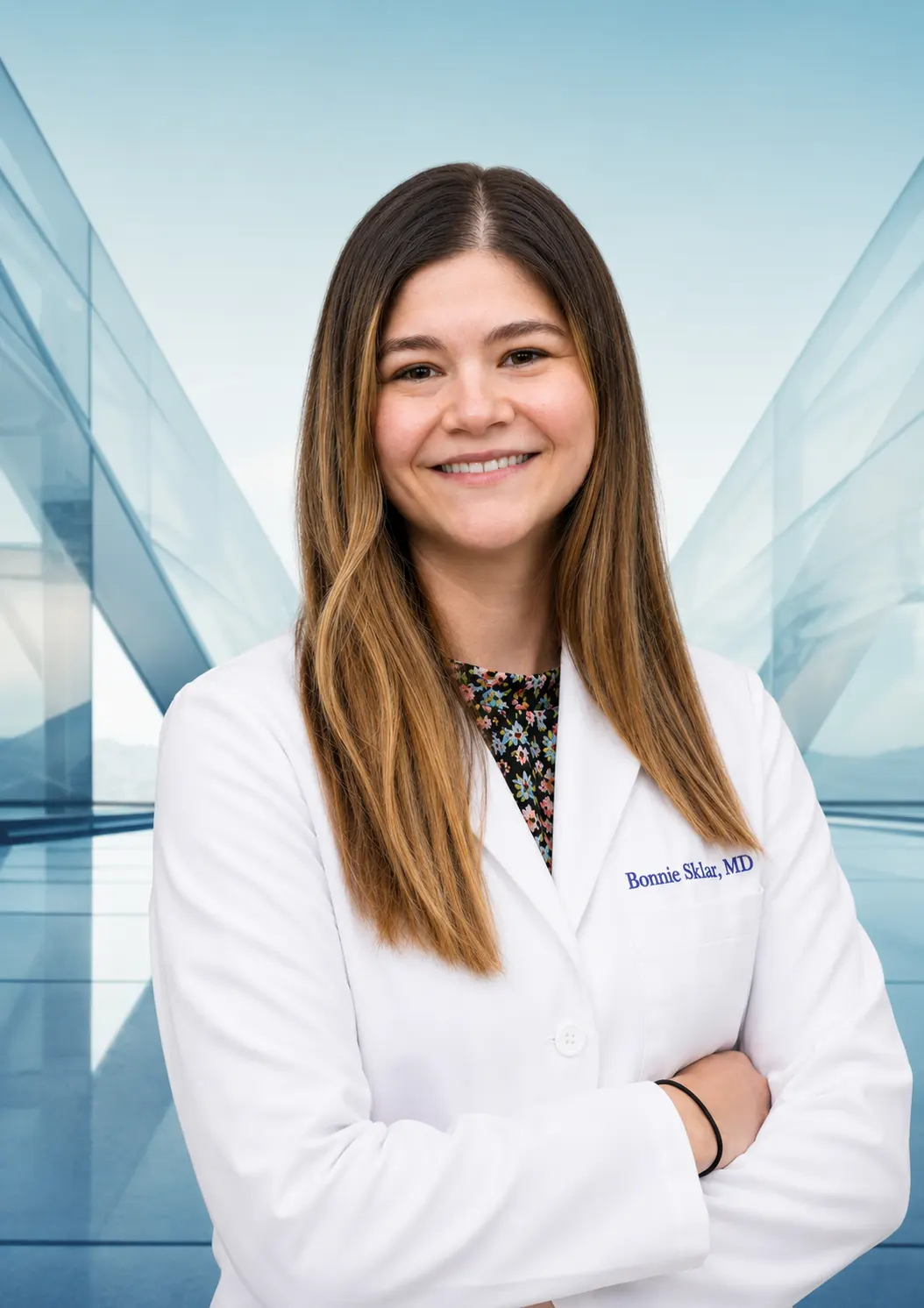
Dr. Bonnie Sklar completed her cornea fellowship at Duke University Eye Center, one of the nation’s foremost training programs in Cornea, External Disease, and Refractive Surgery. She completed her ophthalmology residency at Wills Eye Hospital in Philadelphia — consistently ranked among the top programs in the world. Her surgical training covers DMEK, DSEK, PKP, and the full range of anterior segment corneal procedures.
In addition to her transplant work, Dr. Sklar performs Epioxa epi-on corneal cross-linking for keratoconus, pterygium excision, and complex cataract surgery — giving patients with corneal disease access to a true specialist across all stages of their care.
Modern corneal transplantation has transformed outcomes for patients with Fuchs’ dystrophy and endothelial disease. DMEK gives patients a realistic expectation of excellent vision with a fraction of the recovery burden of older techniques.Dr. Bonnie Sklar, MD — Fellowship-Trained Cornea Specialist, Berg-Feinfield Vision Correction
Berg-Feinfield serves patients across the Los Angeles metropolitan area from five locations — in the San Fernando Valley, the Westside, the San Gabriel Valley, and the Santa Clarita Valley.
Berg-Feinfield’s primary location, home to both Dr. Berg and Dr. Sklar. Conveniently located near the 5, 101, and 134 freeways. Serves patients from Burbank, Glendale, Toluca Lake, North Hollywood, Studio City, and the greater San Fernando Valley.
Located on Riverside Drive near the 101 and 405 interchange. Serves patients from Sherman Oaks, Encino, Van Nuys, Tarzana, Woodland Hills, and the western San Fernando Valley.
Located near the Cedars-Sinai medical corridor on N. Linden Drive. Serves Beverly Hills, West Hollywood, Bel Air, Brentwood, Century City, Culver City, and Santa Monica.
Berg-Feinfield’s SGV location on W. Duarte Road. Serves patients from Arcadia, Pasadena, Monrovia, Temple City, San Marino, El Monte, and Rosemead — fellowship-level corneal care without a cross-town drive.
On Tourney Road serving Valencia, Stevenson Ranch, Saugus, Newhall, Canyon Country, and communities along the I-5 corridor north of Los Angeles. Dr. Sklar sees corneal patients here.
Berg-Feinfield provides DMEK, DSEK, and PKP corneal transplant surgery to patients throughout Los Angeles County. Communities served include Los Angeles, Burbank, Glendale, Pasadena, Sherman Oaks, Encino, Studio City, North Hollywood, Van Nuys, Tarzana, Beverly Hills, West Hollywood, Bel Air, Brentwood, Santa Monica, Culver City, Arcadia, Monrovia, Temple City, San Marino, Valencia, Stevenson Ranch, Santa Clarita, Saugus, Newhall, Canyon Country, and surrounding communities throughout the greater Los Angeles metropolitan area.
Yes — corneal transplant surgery is generally covered by medical insurance including Medicare when medically necessary. Coverage applies to the surgeon’s fee, facility, anesthesia, and donor tissue. Our team verifies your benefits and handles prior authorization before scheduling. Your out-of-pocket cost depends on your plan’s deductible and co-insurance.
DMEK and DSEK procedures typically take 1–2 hours. PKP may take 2–3 hours depending on complexity. All are performed on an outpatient basis — you go home the same day. Plan to spend several hours at the surgery center including pre-op preparation and post-op monitoring. You will need someone to drive you home.
DMEK patients often notice meaningful visual improvement within weeks and can return to most activities in 1–2 weeks. DSEK has a similar but slightly longer recovery. PKP requires the most patience — vision stabilizes over 12–18 months as sutures are gradually removed. All procedures require long-term steroid drops and regular follow-up throughout recovery.
Rejection occurs when the immune system attacks donor tissue. DMEK has the lowest rejection risk; PKP the highest over time. Rejection is treatable if caught early. Key warning signs: sudden vision loss, redness, light sensitivity, or pain. If you develop these symptoms, contact us immediately — do not wait for a scheduled visit. This is why lifelong monitoring matters.
In many cases yes, but it requires careful evaluation. After PKP, PRK (rather than LASIK) may be possible once vision has fully stabilized — which can take 18+ months. Cataract surgery is also possible after transplantation, though IOL power calculations require extra care given the altered corneal geometry. Dr. Sklar evaluates graft health and stability before recommending any additional procedure.
Graft failure does not mean vision is permanently lost. Re-grafting is possible in most cases, using the same or an alternative technique depending on the cause of failure. Success rates for re-grafting are somewhat lower than primary transplants, but meaningful visual recovery remains achievable for many patients. Dr. Sklar will evaluate the cause and recommend the most appropriate next step.
Whether you’ve been recently diagnosed with Fuchs’ dystrophy, referred for a keratoconus transplant evaluation, or are seeking a second opinion — Dr. Sklar and the Berg-Feinfield cornea team are ready to see you.
Call 866-2-SEE-FAR | Burbank · Sherman Oaks · Beverly Hills · Arcadia · Valencia