FDA-Approved & Proven
The first refractive procedure approved by the FDA — a safe, tried-and-true laser vision correction option.

As the first refractive procedure approved by the FDA, PRK is a tried-and-true vision correction alternative that continues to help patients reach their full vision potential.
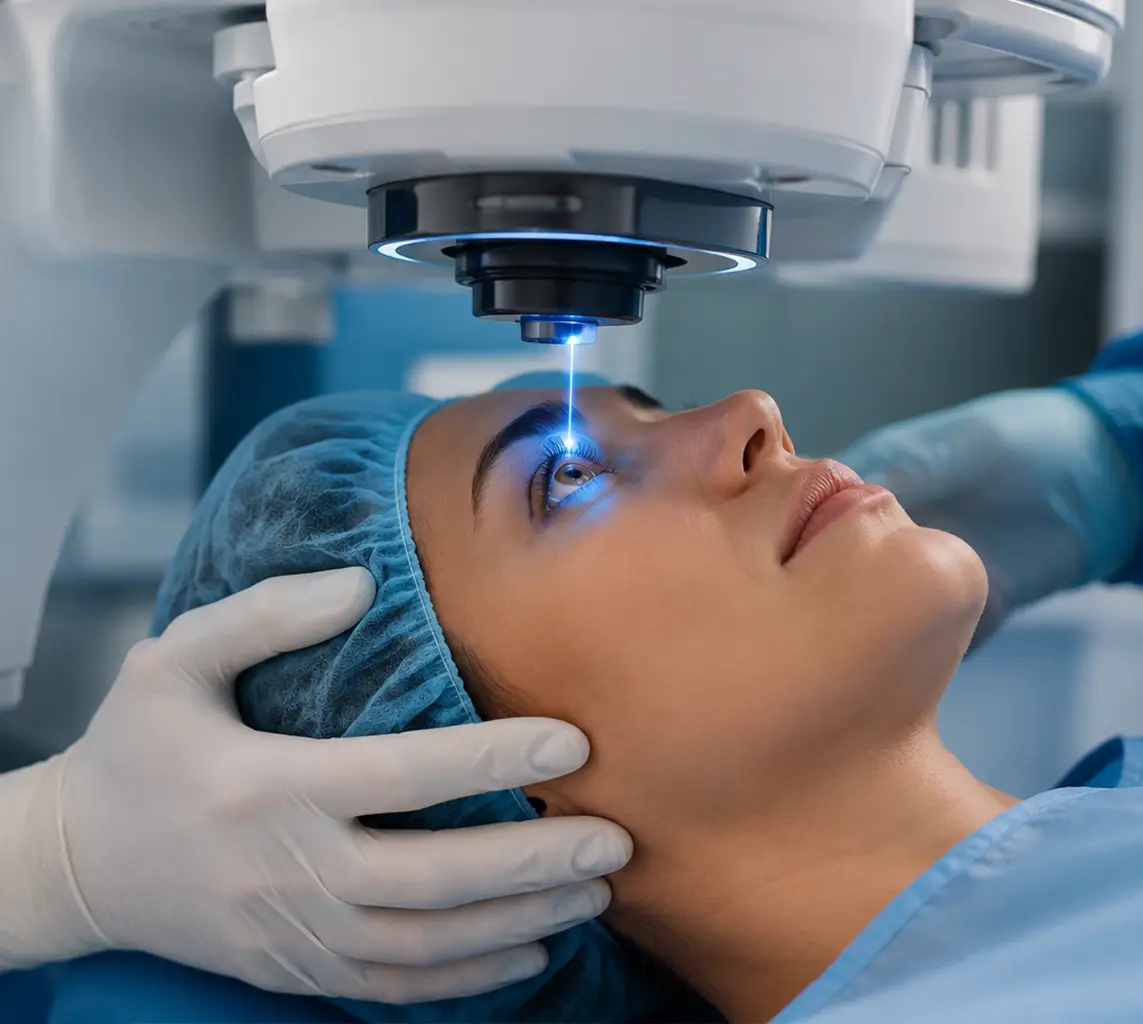
PRK (photorefractive keratectomy) is a proven laser vision correction procedure that reshapes the cornea to reduce your dependence on glasses and contacts — without creating a corneal flap.
The first refractive procedure approved by the FDA — a safe, tried-and-true laser vision correction option.
Unlike LASIK, PRK creates no corneal flap; the excimer laser is applied directly to the cornea’s outer layer.
Your surgeon gently reshapes the cornea using CustomVue Wavefront-guided treatment for a personalized correction.
PRK may be recommended to treat nearsightedness, farsightedness, and astigmatism.
Your doctor administers anesthetic, then the laser reshapes each eye’s cornea in very little time.
Before LASIK, PRK was the refractive procedure doctors and patients trusted — and it remains a safe, effective option, especially for patients who may not qualify for LASIK.
Creates a thin corneal flap and reshapes the inner layer of the cornea. Its healing time is typically a little more rapid than PRK.
Both PRK and LASIK use the excimer laser to reshape the cornea and deliver comparable visual results.
A safe, effective alternative for patients who may not qualify for LASIK.
Request a ConsultationPRK has a slightly longer healing time than LASIK, but recovery is straightforward — here is what most patients can expect.
Anesthetic is administered and the laser reshapes each eye in very little time — with no corneal flap created.
The eye’s protective layer generally heals in about 5–7 days, and most patients regain natural vision within 5–7 days.
Most PRK patients return to work within a few days and resume exercise and other activities as directed by their doctor.
Vision continues to stabilize over the following months; PRK is designed to be a permanent correction of the cornea.
Your healing time and progress depend on your overall health, medical history, and how closely you follow your post-operative instructions — your Berg-Feinfield team will guide you every step of the way.
Your outcome depends on the hands and the technology behind your procedure. For more than four decades, ours have set the standard in Los Angeles.

Our board-certified ophthalmologists pair FDA-approved, all-laser technology with personalized treatment planning and attentive follow-up care — the combination that delivers exceptional, lasting results.
PRK may be the right choice for patients who want proven laser vision correction — especially those who aren’t ideal candidates for LASIK.
Find out whether PRK is right for you. Request your complimentary one-on-one vision consultation with the team at Berg-Feinfield Vision Correction today.
BERG-FEINFIELD · AFTER HOURS
Questions about your vision? Talk with our AI assistant about LASIK, cataract surgery, or general eye care.
Talk with ClaireAI assistant for general information, not medical advice or emergency care. AI can make mistakes. Confirm medical information with your eye care professional.