
LASIK • Los Angeles
LASIK with Dry Eyes in Los Angeles
Burning, fluctuating vision or uncomfortable contacts deserve attention before LASIK. Start with a dry-eye evaluation and a plan for your eye surface.
Request a consultation
Can you have LASIK if you already have dry eyes?
Dry eye must be evaluated and controlled before LASIK is considered. Some patients qualify after treatment, while others should avoid corneal laser surgery. Berg-Feinfield evaluates the cause of dryness, treats the eye surface and repeats measurements when appropriate; symptom relief alone does not establish candidacy.
Why does the tear film matter before LASIK?
Your tear film creates the first smooth focusing surface that light meets. An unstable tear film can cause blur that changes between blinks, burning or a gritty sensation. That instability can also affect the repeatability of measurements used to plan vision correction. Clearer vision with a fresh drop does not prove the cornea is ready for surgery.
LASIK can worsen existing dry eye or cause new symptoms, and some symptoms persist. The FDA identifies dry eye as a LASIK candidacy concern. The decision includes both the current health of the surface and the likely impact of surgery.
How can Los Angeles conditions affect dry-eye symptoms?
Dry San Fernando Valley heat and Santa Ana winds can make tear evaporation more noticeable. Air-conditioning aimed at your face during a commute can add discomfort. Screen-heavy work may reduce full blinking, whether you work from a home office in Valencia or spend the day at a desk in Burbank.
These exposures are useful clues, not a diagnosis. Note whether symptoms worsen outdoors, late in the workday or while wearing contacts. Tell your clinician about burning during the drive home, fluctuating computer vision and any relief from blinking. Avoid directing vents at your eyes and discuss practical changes alongside medical treatment.

What does a Berg-Feinfield dry-eye evaluation assess?
The Los Angeles Dry Eye Center evaluates the tear film, cornea and eyelids. Testing can include a slit-lamp examination, TearLab tear osmolarity testing and a meibomian gland assessment. Your clinician selects the tests needed for your presentation; not every test is necessary at every visit.
- Symptoms and history: list drops, medications, contact-lens wear, prior eye procedures and conditions that can affect tear production.
- Oil-gland function: meibomian glands supply the tear film’s oily component. Poor oil flow can let tears evaporate too quickly.
- Tear production and surface health: low tear volume, inflammation and mixed causes require different treatment choices.
- Measurement stability: fluctuating results may require treatment and repeat testing before a surgical decision.
Symptoms and signs do not always match. An eye can feel comfortable during one appointment and still show an unstable surface. The NEI explains tests used to evaluate dry eye.
Which in-office treatments are available, including Tixel i?
Berg-Feinfield offers Tixel i for evaporative dry eye caused by meibomian gland dysfunction. This FDA-cleared treatment applies localized heat and pressure to the eyelid area. It targets gland-related evaporation; it is not a universal treatment for all dry eye and is not a required step for every LASIK patient.
Berg-Feinfield’s dry-eye treatment program also offers iLux, IPL, BlephEx and prescription therapies. Selection depends on the diagnosis and clinical suitability. Lubrication, eyelid care, environmental changes and prescription treatment may form part of the plan. Confirm the recommended treatment and its availability at your chosen office before scheduling.
Treating dry eye is worthwhile even if LASIK never becomes appropriate. Ask what improvement the clinician will measure, when reassessment should occur and what costs are separate from a refractive consultation. Read the FDA Tixel i clearance summary.
What happens after dry-eye treatment?
The team reassesses the surface and, when needed, repeats vision and corneal measurements. A stable prescription, healthy enough tissue and acceptable corneal maps still matter. Less burning after treatment does not erase the possibility of postoperative dryness.
Most Berg-Feinfield surgical patients receive preoperative and postoperative care from their own optometrist through co-management. Share your existing dry-eye plan so the clinicians can coordinate. Patients who are not co-managed use the in-house MD/OD team. Ask who will manage ongoing dryness and whom to contact if symptoms change.
Could PRK or EVO ICL be a better option?
PRK avoids a LASIK flap but still reshapes the cornea and requires healing of the surface. It can also affect comfort and tear function. Comparing LASIK and PRK is useful only after the ocular surface is evaluated; neither is a treatment for dry-eye disease.
EVO ICL places a lens inside the eye without removing corneal tissue for refractive correction. It may suit selected patients, but eye anatomy, prescription limits and intraocular risks must be considered. It does not cure dry eye. Read LASIK versus EVO ICL and ask whether continued glasses are the better choice for your eyes.
How should you plan your consultation and recovery?
Bring the bottles or names of every eye drop you use, previous treatment dates and your optometrist’s records. Ask whether your first appointment should focus on dry eye before laser candidacy testing. Choose one of the five offices below and confirm contact-lens instructions when booking.
If surgery is recommended, review the complete risk discussion, including glare, halos, incomplete correction, infection and rare vision loss. Recovery instructions should address drops, follow-up, driving and work. Increasing pain or sudden vision changes after surgery need prompt contact with your treating team rather than waiting for a routine visit.

Meet your care team
Who leads refractive care at Berg-Feinfield?
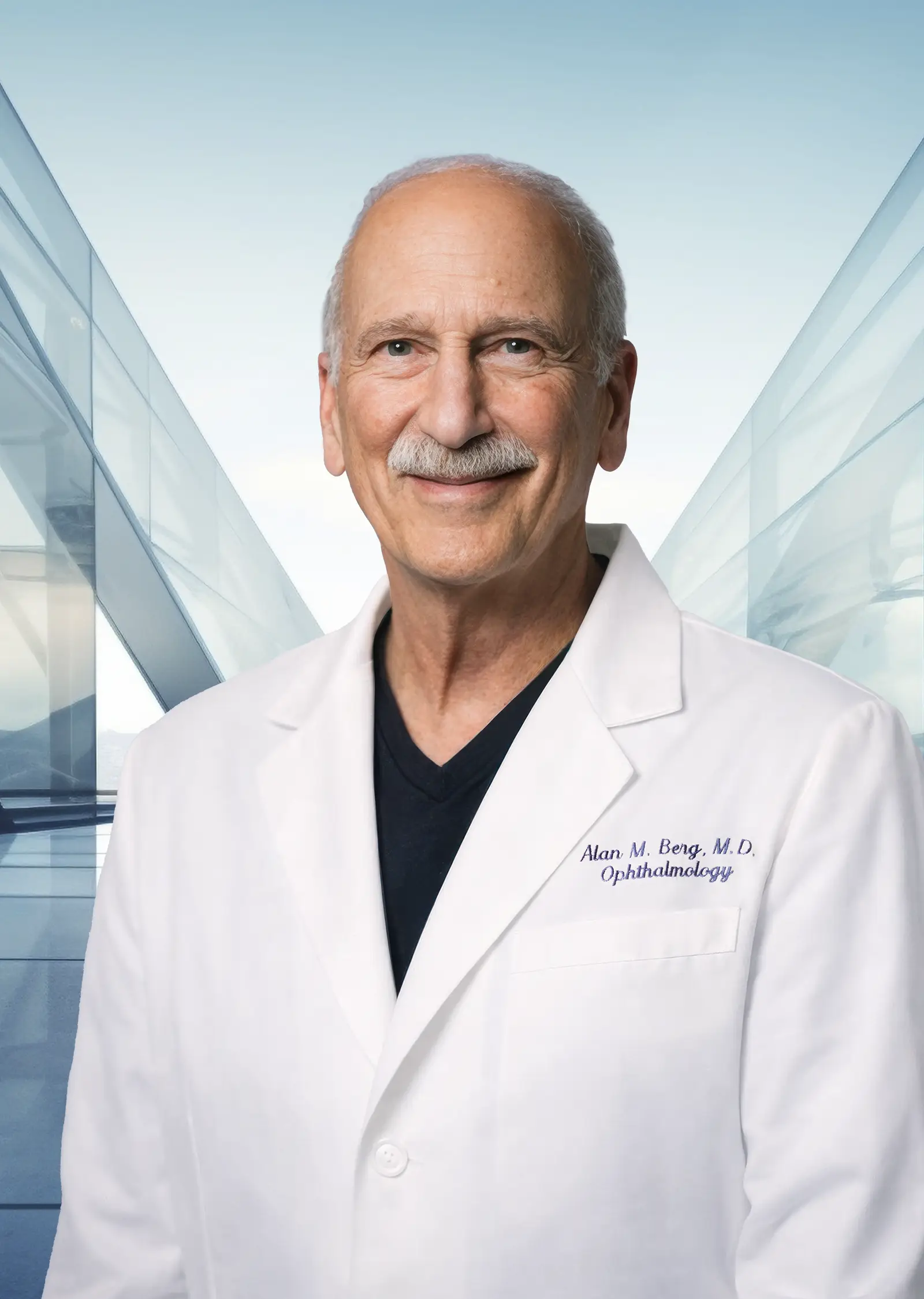
Alan M. Berg, MD
Dr. Berg is a board-certified ophthalmologist who leads LASIK and refractive surgery at Berg-Feinfield. He earned his medical degree at Bowman Gray School of Medicine and finished his ophthalmology residency at the University of Southern California, where he remains on the faculty teaching residents.
He has performed more than 50,000 LASIK procedures. Berg-Feinfield has served Los Angeles since 1980 and offers 100% bladeless LASIK through a practice with five offices. He was one of 50 U.S. surgeons chosen for the clinical trials of the Implantable Collamer Lens (ICL). Your own measurements still decide whether surgery is right for you.
What else do Los Angeles patients ask?
Can artificial tears make me eligible for LASIK?
No. Artificial tears can improve comfort for some patients, but relief alone does not establish LASIK candidacy. Your clinician must assess surface health, measurement stability and the rest of your eye examination. If dryness remains significant, the recommendation may be further treatment, a different correction method or no surgery.
How long must dry eye be treated before LASIK?
There is no single treatment interval that makes every eye ready for LASIK. The cause, severity and response determine when Berg-Feinfield should repeat the examination or measurements. Ask what findings need to improve. A planned surgery date should not take priority over unresolved surface disease or unstable results.
Is PRK always better when you have dry eyes?
No. PRK also treats the cornea and has its own effects on the eye surface, healing requirements and risks. Avoiding a flap does not remove the need for a healthy surface. Your surgeon can compare procedures after the cause of dryness and your other candidacy measurements are understood.
Does having no symptoms mean I have no dry eye?
No. Symptoms and examination findings can differ, so comfortable eyes on the day of your visit do not rule out dry-eye disease. Mention past irritation, fluctuating vision, contact-lens discomfort and previous treatments. Examination of the tear film and eyelids helps identify concerns that symptoms alone may miss.
Does Berg-Feinfield offer Tixel i before LASIK?
Yes. Berg-Feinfield offers Tixel i for evaporative dry eye associated with meibomian gland dysfunction. It may be considered when that diagnosis fits your examination; it is not required for every LASIK candidate. Confirm treatment availability at your chosen office. Improvement with Tixel does not guarantee that LASIK will become appropriate.
Is dry-eye treatment covered by insurance in Los Angeles?
Coverage depends on the service and your medical plan. A medically necessary evaluation and a particular in-office treatment can have different benefits or exclusions. Ask Berg-Feinfield to verify the recommended services and provide an estimate. Elective LASIK is generally separate from medical coverage for dry-eye disease.
Can my own optometrist coordinate dry-eye care and LASIK follow-up?
Yes. Most Berg-Feinfield surgical patients remain with their own optometrist for care before and after surgery through co-management. Share the treatments you have tried and ask the teams to coordinate the plan. Patients without a co-managing optometrist receive care from Berg-Feinfield’s in-house MD/OD team across the practice.
Which Berg-Feinfield office is convenient for you?
Request an evaluation at one of five offices. Confirm the clinician and location for each appointment when scheduling.
Sherman Oaks
13320 Riverside Dr, Ste 114Monday–Friday
8:30 AM–5:30 PM
Serving San Fernando Valley.
Request a consultationBurbank
2625 W Alameda Ave, Ste 208Monday–Friday
8:30 AM–5:30 PM
Serving Burbank, Glendale and the eastern San Fernando Valley.
Request a consultationBeverly Hills
462 N Linden Dr, Ste 441Monday–Friday
8:30 AM–5:30 PM
Serving Beverly Hills, the Westside and nearby Los Angeles neighborhoods.
Request a consultationArcadia
638 W Duarte Rd, Ste 10Monday–Friday
8:30 AM–5:30 PM
Serving San Gabriel Valley, including Arcadia and nearby Pasadena.
Request a consultationValencia (Santa Clarita)
27335 Tourney Rd, Ste 210Monday–Friday
8:30 AM–5:30 PM
Serving Santa Clarita Valley.
Request a consultationStart with the cause of your dry eyes
Bring your treatment history and optometrist’s information to a dry-eye and vision correction consultation.
Request a consultation