
LASIK • Los Angeles
LASIK for Astigmatism in Los Angeles
A clear plan starts with the shape of your cornea. Compare bladeless LASIK and alternatives with a Los Angeles practice serving the community since 1980.
Request a consultation
Can LASIK correct astigmatism?
Yes. LASIK can correct regular astigmatism in eligible eyes by reshaping the cornea. Berg-Feinfield offers 100% bladeless LASIK, with candidacy based on your prescription, corneal maps, thickness and eye-surface health. Irregular astigmatism or corneal disease requires a different assessment.
What does astigmatism mean for your vision?
Astigmatism means light does not focus evenly on the retina. The cornea or natural lens has different focusing power in different directions, which can blur distance and near vision. It often occurs alongside nearsightedness or farsightedness. A cylinder number and axis on your glasses prescription describe its amount and direction.
You may have heard that an eye with astigmatism is shaped like a football instead of a basketball. That comparison describes the curve of the cornea, not the shape of the whole eye. Regular astigmatism follows a relatively consistent pattern. Irregular astigmatism can reflect scars, keratoconus or another corneal problem. That distinction matters more for surgery than the prescription number alone. The National Eye Institute explains astigmatism and its causes.

How does Berg-Feinfield evaluate LASIK candidacy?
Your evaluation connects the prescription you want corrected with the tissue needed to correct it. Bring prior prescriptions, any eye-surgery records and details about night-driving difficulties. Mention changing vision, contact-lens intolerance and dry-eye treatment. These details help identify issues that a glasses prescription cannot show.
- Stable prescription: compare current and previous measurements; changing vision needs an explanation before elective treatment.
- Corneal maps and thickness: assess regularity, tissue distribution and signs of weakening, rather than relying on a single central thickness.
- Tear film and eye health: evaluate dryness, eyelid problems and other conditions that could affect measurements or healing.
- Your goals: discuss freeway driving after dark, computer work and near vision, including the possibility of reading glasses as you age.
Your optometrist’s records can support this process. Most Berg-Feinfield surgical patients continue seeing their own optometrist before and after surgery through co-management. Patients who are not co-managed receive care through the in-house MD/OD team.
Which laser and treatment range apply to your astigmatism?
Bladeless LASIK uses a laser to create the flap and an excimer laser to reshape tissue beneath it. The approved treatment range depends on the exact excimer model, software and combination of nearsightedness or farsightedness with astigmatism. The laser brand alone does not tell you whether you qualify.
Ask the team to connect your measurements to that specific treatment indication. Review the Berg-Feinfield LASIK technology page and FDA candidacy guidance before your visit.
When might PRK, EVO ICL or lens exchange fit better?
PRK treats the corneal surface without making a LASIK flap. It may fit selected eyes when avoiding a flap is useful, but it still removes corneal tissue. Thin or abnormal corneas can rule out both procedures. Recovery is different; compare LASIK versus PRK before making plans around work or travel.
EVO ICL places an implant inside the eye while retaining your natural lens. It may suit certain prescriptions and eye anatomy when corneal laser treatment is unsuitable. It has separate eligibility limits and intraocular risks, including cataract, pressure and infection concerns. Read LASIK versus EVO ICL; it is not an automatic substitute for LASIK.
Refractive lens exchange with a toric lens may enter the discussion for selected patients age 40 and older, especially when near-vision changes or lens-related concerns matter. It replaces the natural lens and is irreversible. Age alone does not justify it; retinal risk, loss of natural focusing ability and lens trade-offs matter. Explore refractive lens exchange. Glasses remain a reasonable option.
What should you expect after treatment?
Vision can fluctuate as the eye heals. Follow your prescribed drops, eye-protection instructions and follow-up schedule. Arrange a driver for surgery and wait for clearance before driving yourself. Discuss your commute and screen-heavy work with the team rather than assuming a fixed return date.
Dry eye, glare, halos, residual prescription, flap problems and infection are possible; rare complications can cause lasting vision loss. LASIK does not prevent presbyopia or cataracts. Ask how remaining astigmatism would be evaluated and whether glasses or further treatment might be appropriate. Read the FDA’s LASIK risk information.
How can you prepare for a Los Angeles consultation?
Start with the vision correction self-test to organize your questions, not to diagnose candidacy. Use the LASIK cost guide for Los Angeles to ask for a written estimate covering the proposed procedure, follow-up arrangements and any separate services.
Choose a convenient evaluation office below and tell the scheduler if your optometrist is referring you. Confirm where each appointment will occur; an office visit and surgery are separate scheduling decisions. Ask when to stop wearing contacts so corneal measurements can settle before testing.

Meet your care team
Who leads refractive care at Berg-Feinfield?
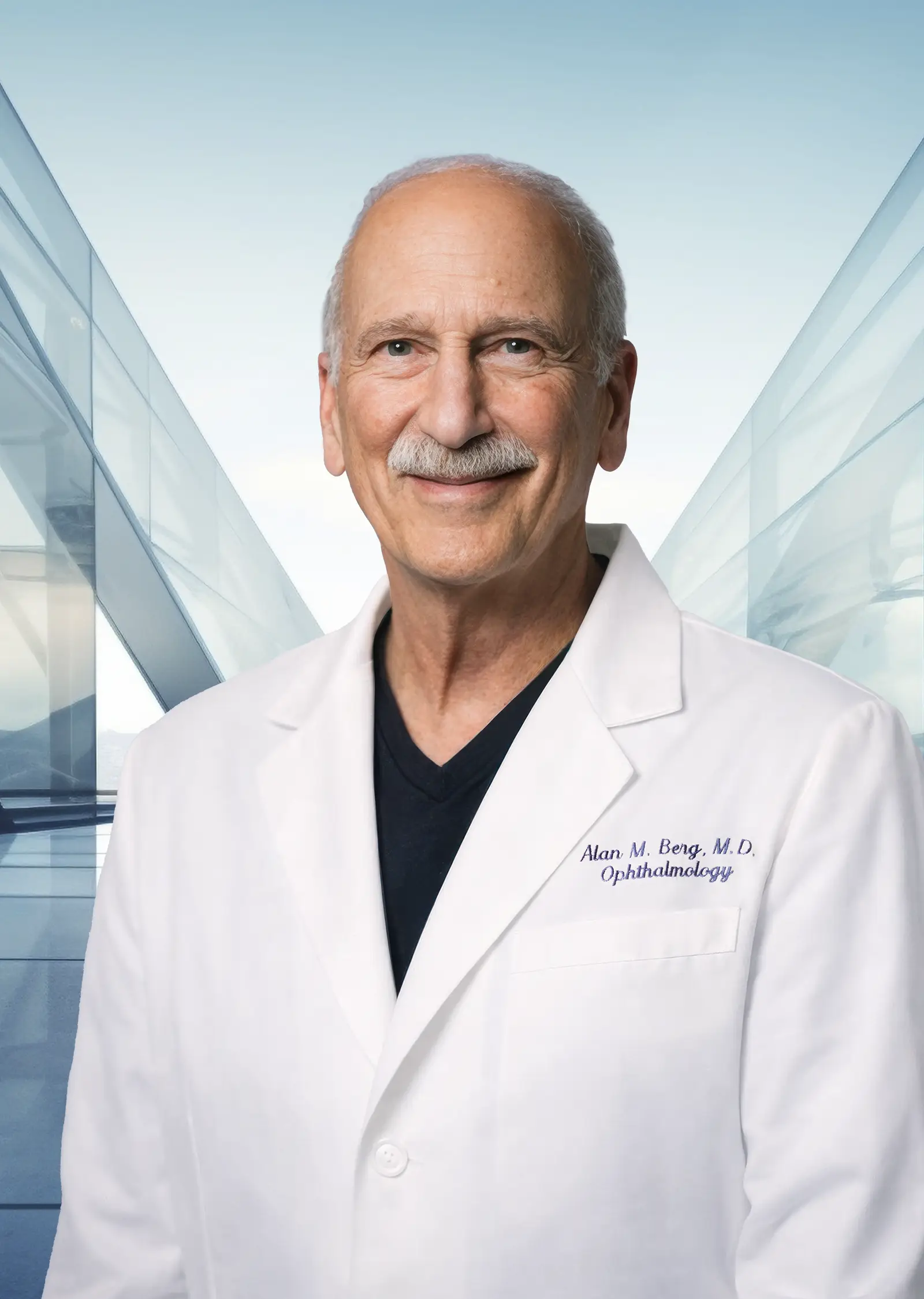
Alan M. Berg, MD
Dr. Berg is a board-certified ophthalmologist who leads LASIK and refractive surgery at Berg-Feinfield. He earned his medical degree at Bowman Gray School of Medicine and finished his ophthalmology residency at the University of Southern California, where he remains on the faculty teaching residents.
He has performed more than 50,000 LASIK procedures. Berg-Feinfield has served Los Angeles since 1980 and offers 100% bladeless LASIK through a practice with five offices. He was one of 50 U.S. surgeons chosen for the clinical trials of the Implantable Collamer Lens (ICL). Your own measurements still decide whether surgery is right for you.
What else do Los Angeles patients ask?
Can LASIK treat both nearsightedness and astigmatism?
Yes. LASIK can treat both during one procedure when your prescription falls within the proposed laser’s approved range and your eyes meet the other candidacy requirements. Berg-Feinfield evaluates corneal shape, thickness, stability and tear-film health before recommending a plan. A combined prescription does not establish eligibility by itself.
Does a high astigmatism prescription rule out LASIK?
No. A high prescription does not answer the question by itself, although device limits and the amount of tissue required may rule out treatment. Your surgeon must evaluate the full prescription and corneal maps. PRK, an implantable lens or glasses may be discussed when LASIK is unsuitable.
Will astigmatism be completely gone after LASIK?
No result is guaranteed. Some astigmatism can remain after LASIK, and your prescription can change later. Glasses may still be useful for particular activities. Once healing stabilizes, your treating team can assess residual blur and explain whether further treatment is appropriate; an enhancement is not suitable for every eye.
Should I stop wearing contacts before the evaluation?
Yes, if instructed by the practice. Contact lenses can temporarily alter corneal shape and affect measurements used to plan LASIK. Ask for instructions specific to your lens type when scheduling. Do not choose your own stopping interval, and tell the team when you last wore your lenses.
How much does LASIK for astigmatism cost in Los Angeles?
Your cost requires an individual written estimate from Berg-Feinfield. The treatment plan and services included affect the total; our Los Angeles LASIK cost guide explains pricing factors and financing options. Ask whether the estimate covers both eyes, follow-up care and possible additional treatment. Elective LASIK is generally not covered by medical insurance.
Which Berg-Feinfield office should I visit for an evaluation?
Choose among Sherman Oaks, Burbank, Beverly Hills, Arcadia and Valencia when requesting your consultation. Tell the scheduler where you live or work and whether your optometrist referred you. The team can confirm the right clinician and appointment location; testing, surgery and follow-up may involve different scheduling arrangements.
Can I keep my own optometrist before and after LASIK?
Yes. Most Berg-Feinfield surgical patients see their own optometrist before and after surgery through co-management. Bring the optometrist’s contact information and relevant records so care can be coordinated. Patients who are not co-managed are cared for by the practice’s in-house MD/OD team. Confirm your individual follow-up schedule before surgery.
Which Berg-Feinfield office is convenient for you?
Request an evaluation at one of five offices. Confirm the clinician and location for each appointment when scheduling.
Sherman Oaks
13320 Riverside Dr, Ste 114Monday–Friday
8:30 AM–5:30 PM
Serving San Fernando Valley.
Request a consultationBurbank
2625 W Alameda Ave, Ste 208Monday–Friday
8:30 AM–5:30 PM
Serving Burbank, Glendale and the eastern San Fernando Valley.
Request a consultationBeverly Hills
462 N Linden Dr, Ste 441Monday–Friday
8:30 AM–5:30 PM
Serving Beverly Hills, the Westside and nearby Los Angeles neighborhoods.
Request a consultationArcadia
638 W Duarte Rd, Ste 10Monday–Friday
8:30 AM–5:30 PM
Serving San Gabriel Valley, including Arcadia and nearby Pasadena.
Request a consultationValencia (Santa Clarita)
27335 Tourney Rd, Ste 210Monday–Friday
8:30 AM–5:30 PM
Serving Santa Clarita Valley.
Request a consultationBring your astigmatism prescription into focus
Request an evaluation and bring your prescription history, contact-lens details and optometrist’s information.
Request a consultation