

The short version: the best LASIK result in Los Angeles comes from four things, in this order: an honest candidacy evaluation that is willing to say no, treatment of dry eye before surgery rather than after, measurements taken with wavefront-guided mapping so the laser corrects your eye rather than an average eye, and a surgeon who has done this long enough to recognize the exceptions. Technology matters — all-laser, bladeless, custom treatment is the standard I hold — but it is the last of the four, not the first. At Berg-Feinfield we quote one all-inclusive fee, offer a free consultation, and tell you plainly when LASIK is not the right procedure for your eyes.
People who search for the best LASIK in Los Angeles usually get a page of advertisements back. I understand the impulse behind the search. This is your eyesight, the procedure is elective, and Los Angeles has a great many places offering LASIK, at prices that range from suspiciously low to eye-watering. What follows is not a ranking. It is what I have learned matters, written for the patient trying to make this decision well.
Some background so you can weigh what I say. I started in refractive surgery with radial keratotomy, before laser vision correction was available, and I have performed more than 50,000 LASIK procedures since — including on my partner, Dr. Feinfield. I was one of 50 surgeons in the United States chosen for the clinical trials of the Implantable Collamer Lens, I teach ophthalmology residents at USC, and I have taught LASIK to surgeons abroad as medical director of the Kobe Laser Center in Japan. I mention this not to impress you but because the single most useful thing experience gives a surgeon is pattern recognition: knowing which eye in front of you is the exception.
Lesson one: the best LASIK starts with the patients we turn away
The outcome of LASIK is decided at the evaluation, not in the laser suite. Most of the LASIK problems I have seen, or been asked to help with, trace back to a decision made before surgery: a cornea that was too thin for the amount of tissue removed, a prescription that had not finished changing, an early keratoconus that a cursory screening missed, or dry eye that was never treated.
So the first thing I would tell any Los Angeles patient is this: judge a practice by how carefully it tries to disqualify you. At Berg-Feinfield, the pre-operative workup includes corneal topography, pachymetry to measure corneal thickness, wavefront analysis, pupil measurement, and a careful look at the tear film, and it ends with one of three answers. LASIK is right for you. LASIK is not right for you, but PRK, the EVO ICL, or a lens-based procedure is. Or no laser procedure is a good idea for your eyes, and here is why.
A practice that offers only LASIK can only give the first answer. That is not a knock on any particular surgeon; it is arithmetic. Because I have implanted the ICL since its clinical trials and perform lens exchange as well as laser correction, I have no reason to talk anyone into a procedure their eyes are not built for.
Lesson two: Los Angeles is a dry-eye city, and LASIK has to respect that
This is the part that is specific to where we live. Los Angeles is dry for most of the year, the Santa Ana winds arrive every fall, air conditioning runs in every office and car, and a very large share of my patients spend eight to twelve hours a day looking at screens, which cuts the blink rate roughly in half. A remarkable number of people who walk in for a LASIK consultation have untreated dry eye and do not know it, because they have never known anything else.
LASIK temporarily reduces corneal sensation, which reduces tear production while the eye heals. On a healthy tear film that is a minor, self-limited nuisance. On an eye that was already dry, it is the difference between a delighted patient and a frustrated one. So we test the tear film at the evaluation, treat dry eye first when we find it, and for some patients — those with significant dryness and a high prescription — recommend the EVO ICL instead, since it does not touch the corneal nerves at all. In my experience, dry eye is the most common reason a LASIK patient in this city is unhappy after surgery, and most of it is preventable with a proper workup.
Lesson three: the measurements matter more than the laser
Every practice advertises its laser. Fewer talk about the map the laser is following. A standard LASIK treatment corrects your glasses prescription — sphere and cylinder, the same numbers on the box your contacts come in. A custom, wavefront-guided treatment corrects your eye: the higher-order aberrations that no pair of glasses can measure and that account for much of the difference between seeing 20/20 on a chart and seeing crisply at night.
At Berg-Feinfield we map each eye with the iDesign 2 Advanced WaveScan, which captures more than 1,200 measurements across the eye and builds the treatment from that profile, and we deliver the correction with Alcon WaveLight excimer laser technology. The corneal flap is created by a femtosecond laser, never a blade. I have used a blade — every surgeon my age has — and I would not go back. The all-laser approach makes the flap more predictable, which makes the result more predictable, and predictability is what you are paying for.

Lesson four: what “the best LASIK in Los Angeles” should actually mean
There is no official ranking of LASIK surgeons, and the lists you find online are, with rare exceptions, paid placements. Here is what I would verify instead, and what I would be comfortable being judged on:
- Board certification. Verify it yourself, free, through the American Board of Ophthalmology. It takes two minutes.
- Volume and longevity together. A surgeon who has done a great deal of LASIK over a long time in the same community has been judged continuously by patients who can tell their neighbors. Ask how many procedures, and over how many years.
- The full range of alternatives. Ask what the practice recommends for patients who are not LASIK candidates. If the answer is a referral elsewhere, the evaluation has a built-in bias.
- All-laser, custom treatment as the standard — not an upgrade offered at a higher price.
- Who does the consultation and who does the surgery. At Berg-Feinfield, the surgeon who evaluates you performs your procedure. At some high-volume centers, you meet the surgeon in the laser suite. Ask, too, who handles your follow-up: many of our patients are seen afterward by their own optometrist through our co-management program, and the rest by our in-house team.
- A written, all-inclusive price and a stated enhancement policy before you commit to anything.
Notice what is not on the list: the lowest price, the biggest billboard, and the celebrity endorsement.
Lesson five: on cost, and the $299 advertisement
LASIK in Los Angeles is advertised at anything from $299 per eye to $3,500 per eye, and that range is not noise. It reflects different technology, different amounts of care included, and different amounts of surgeon time. The very low advertised prices apply to mild prescriptions, usually with older, non-custom technology, and typically exclude the evaluation, the follow-up visits, and any enhancement. Most patients who go in for that price do not qualify for it.
Our fee is one all-inclusive number that covers the complete pre-operative workup, the custom all-laser procedure, every post-operative visit, and our enhancement policy. It is confirmed at a free consultation before you decide anything. LASIK is eligible for FSA and HSA funds, and CareCredit and Alphaeon financing are available; the details are on our LASIK cost page. Compare quotes on what they include, not on the headline number.
Lesson six: the day itself is the easy part
After all that preparation, the procedure is almost anticlimactic. About ten minutes per eye in the laser suite. Numbing drops, no needles, no stitches. Most patients see clearly within 24 hours and are back at work and on screens within a day or two. Follow-up visits the next day, at one week, one month, and three months are part of your fee, whether they happen with our team or with your own optometrist through co-management. The step-by-step is on our Los Angeles LASIK page.
Why I still do this
Forty-plus years in, the part of this work I still enjoy most is the day-after visit, when someone who has worn glasses since childhood reads the bottom line of the chart and goes quiet for a moment. That happens because of the evaluation, the honesty about candidacy, the attention to the tear film, and the quality of the map — in that order. The laser is the easy part. If you are considering LASIK in Los Angeles, start with a consultation that is willing to tell you no. Ours is free, at any of our five offices in Burbank, Sherman Oaks, Beverly Hills, Arcadia, and Valencia.
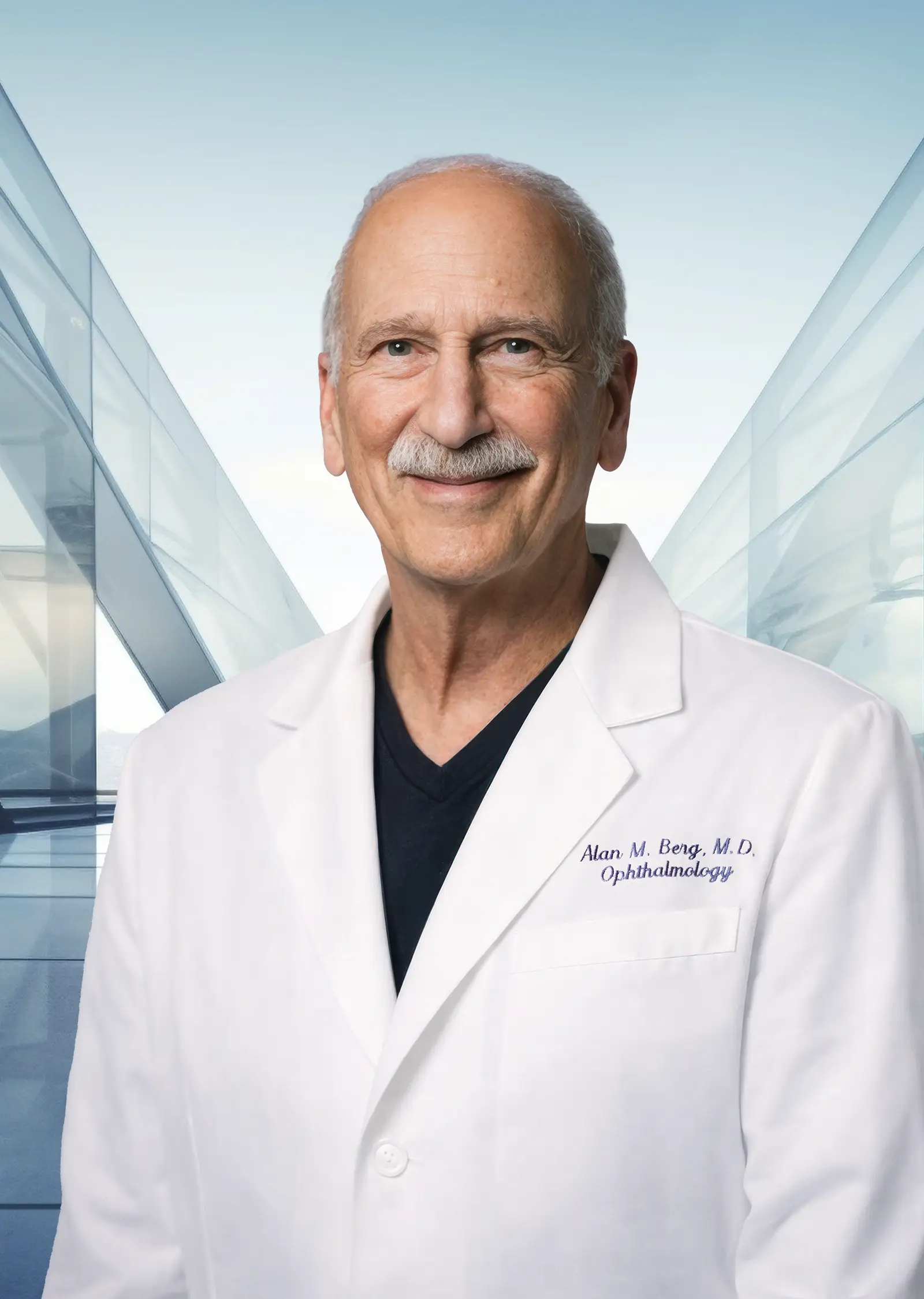
Alan M. Berg, MD
Board-Certified Ophthalmologist & Refractive Surgeon
Dr. Berg has practiced ophthalmology in Los Angeles since 1980 and has performed more than 50,000 LASIK procedures. He was named a VISX Star Surgeon, an honor given to the top 5% of LASIK surgeons in the United States, and was one of 50 U.S. surgeons selected for the Implantable Collamer Lens clinical trials. He earned his MD at Bowman Gray School of Medicine, completed his ophthalmology residency at USC, where he teaches residents, and serves as medical director of the Kobe Laser Center in Japan.