
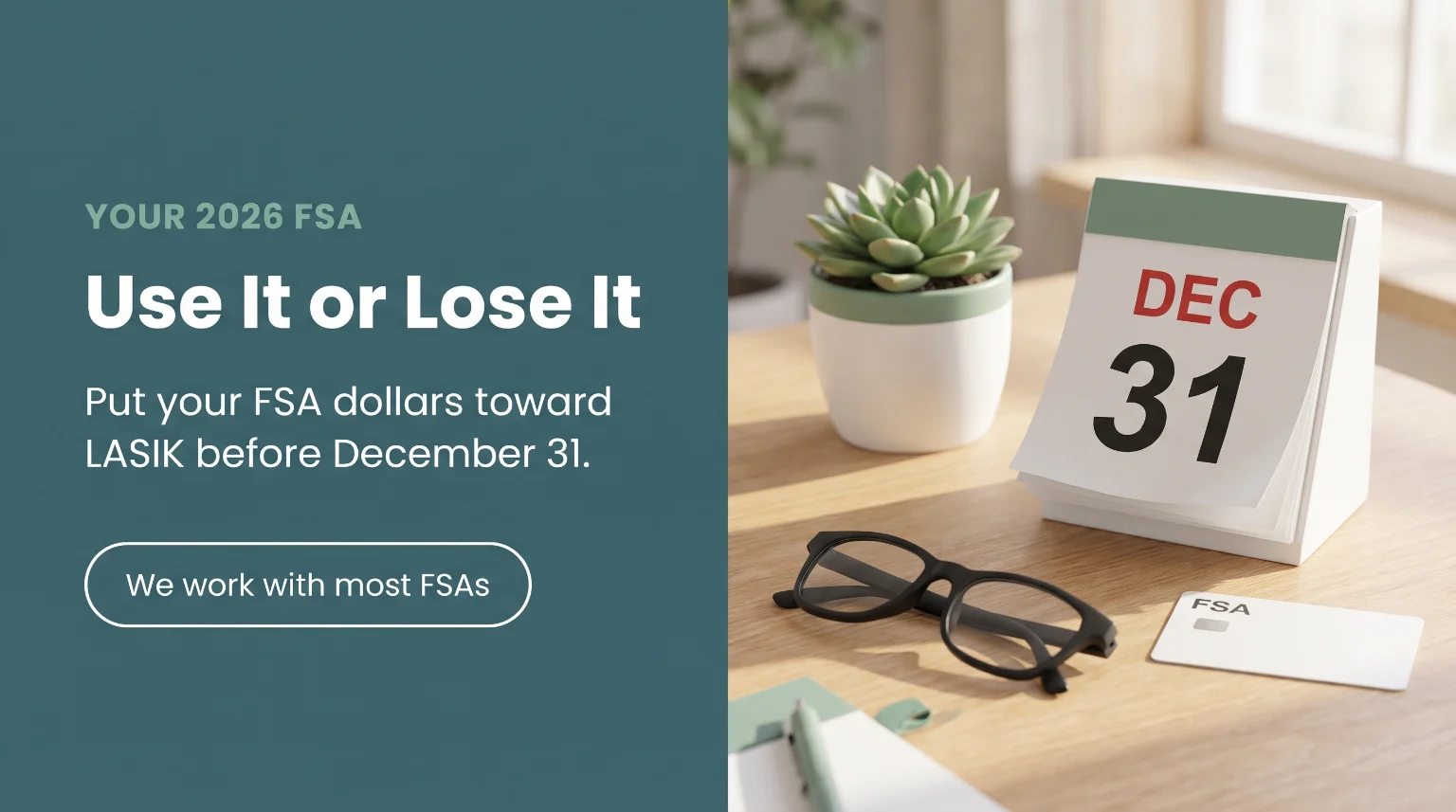
The short version: money left in a health flexible spending account (FSA) at the end of the plan year is generally forfeited. For most plans that run on the calendar year, the deadline to use 2026 funds is December 31, 2026, unless your employer offers a carryover (up to $680 into 2027) or a grace period (up to two and a half months). The IRS lists eye surgery to correct vision, including laser eye surgery, as an eligible medical expense, so LASIK generally qualifies. The procedure itself has to take place before your deadline; booking it or paying a deposit is not enough. Berg-Feinfield works with most FSAs, and our counselors will review your benefits with you.
Every fall, many people realize they set aside pre-tax money for health care in January and haven’t spent it. A few hundred dollars might go to new glasses or a supply of contact lenses. A larger balance often goes unused and returns to the plan.
If you have been thinking about LASIK, that balance can do more. I would rather see that money improve your vision than disappear on December 31. Here is how the rule works, what qualifies, and the timing details that decide whether your 2026 dollars count.
How “use it or lose it” works in 2026
A health FSA lets you set aside part of your paycheck before taxes to pay for eligible medical, dental and vision costs. For 2026, the IRS allows up to $3,400 per employee, and your employer can set a lower cap.
The trade-off is the deadline. Whatever you don’t use by the end of the plan year is generally forfeited. Employers can soften that rule in one of two ways, but not both:
- Carryover: up to $680 of unused 2026 money can roll into your 2027 plan year. Anything above that is lost.
- Grace period: up to two and a half extra months to spend the balance. For a calendar-year plan, that usually means March 15, 2027.
- Neither: some plans offer no extension at all, and December 31 is the hard stop.
Plans also have a run-out period, a window after the deadline to submit claims for care you already received. That is a paperwork deadline, not extra time to schedule care. Your benefits portal or plan summary will tell you which rules apply to you.
LASIK is an FSA-eligible expense
IRS Publication 502, which defines eligible medical expenses for FSAs and HSAs, specifically includes eye surgery to treat defective vision, such as laser eye surgery. That covers LASIK, and generally the other procedures used to correct nearsightedness, farsightedness and astigmatism:
- PRK, laser vision correction without a corneal flap
- EVO ICL, an implantable lens for higher prescriptions or thinner corneas
- Refractive lens exchange, which replaces the natural lens with a lens implant
- The elective portion of cataract surgery, such as an upgraded lens implant (see cataract surgery cost)
Cosmetic treatments are a different category. Publication 502 excludes cosmetic procedures, so services such as Botox for wrinkles or dermal fillers generally can’t be paid for with FSA funds. If you’re unsure about a specific service, your plan administrator has the final word.
The detail most people miss: the procedure date
For FSA purposes, an expense is incurred when you receive the care, not when you’re billed and not when you pay. A deposit in December for a procedure in January is a January expense, and it comes out of next year’s account.
LASIK also isn’t a same-day decision. You’ll have a full evaluation first to confirm that you’re a good candidate and which procedure fits your eyes. If you wear contact lenses, you may be asked to switch to glasses for a period before your measurements. If you want to use 2026 funds, start with the consultation now so there is time for the evaluation and for scheduling before the holidays.
Your full election is available now
Health FSAs follow what’s called the uniform coverage rule: the full amount you elected for the year is available at any point in the plan year, even if you haven’t contributed all of it yet. If you elected $3,400 and about $2,800 has come out of your paychecks by November, the full $3,400 can still be used for eligible care, minus anything you’ve already been reimbursed.
That makes a single larger expense, like vision correction, one of the most efficient ways to use an FSA balance late in the year.
What pre-tax dollars are worth
Because FSA contributions come out before income and payroll taxes, every dollar you spend from the account is a dollar you didn’t pay tax on. As a simple illustration, if your combined federal, state and payroll tax rate is 30 percent, a $3,400 FSA balance spent on LASIK represents about $1,020 in taxes you didn’t pay. Your actual rate depends on your income and filing situation.
There is also the longer view. Our LASIK cost page compares the one-time cost of LASIK with ongoing eyewear costs, which add up to $7,000–$12,000 or more over ten years for many contact lens and glasses wearers.
Using your FSA at Berg-Feinfield
We work with most FSAs. Here is how the process goes:
- Check your balance and your deadline. Log in to your benefits portal and note your remaining 2026 balance and whether your plan has a carryover or a grace period.
- Schedule a consultation. A full evaluation confirms whether you’re a candidate and which procedure fits your eyes. Not everyone is a LASIK candidate, and some patients are better served by PRK, EVO ICL or lens exchange. Our procedure comparison explains the differences.
- Review the cost and your benefits. LASIK at Berg-Feinfield is one all-inclusive fee, and our counselors will review your specific FSA or HSA benefits with you.
- Pay the way your plan allows. Many plans issue a debit card you can use at checkout; others reimburse you after you submit your receipt. If the procedure costs more than your balance, CareCredit and Alphaeon Credit can cover the rest, including a 12-month no-interest CareCredit option for qualified applicants.
Planning ahead for 2027
If your employer’s open enrollment is happening now and you’re considering vision correction next year, set your 2027 election with it in mind. On November 5, 2026, the IRS announced that the 2027 health FSA limit rises to $3,500, with a maximum carryover of $700 into 2028. Because of the uniform coverage rule, the full election is typically available from the first day of your plan year, so you don’t have to wait until next December to schedule.
FSA vs. HSA
If you have a health savings account (HSA) instead, the year-end deadline doesn’t apply. HSA balances roll over from year to year and stay with you, and LASIK is an eligible HSA expense too, so you can schedule whenever it suits you. A dependent care FSA is a separate account and can’t be used for medical care.
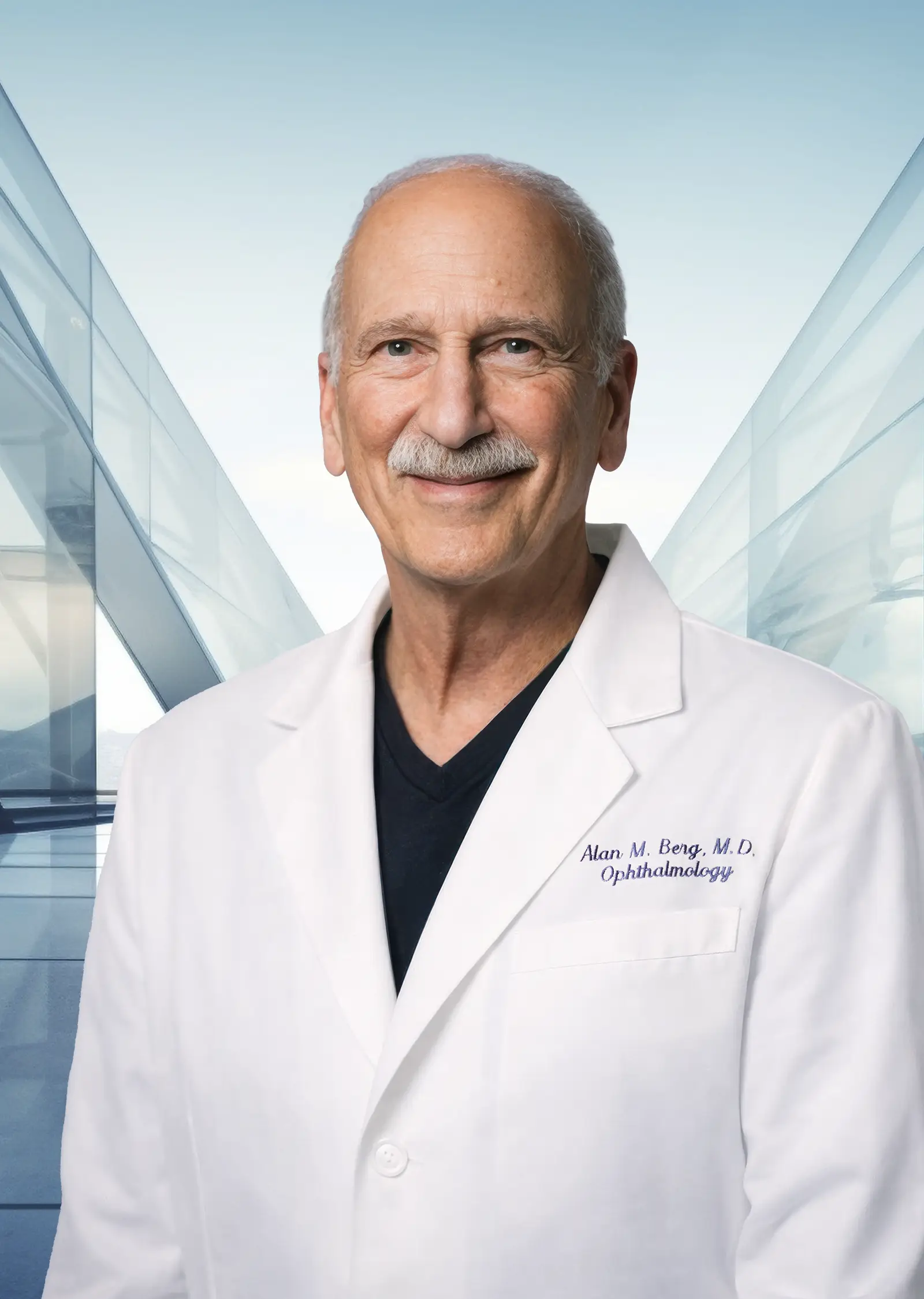
Alan M. Berg, MD
Board-Certified Ophthalmologist & Refractive Surgeon
Dr. Berg has practiced ophthalmology in Los Angeles since 1980 and has performed more than 50,000 LASIK procedures. He was named a VISX Star Surgeon, an honor given to the top 5% of LASIK surgeons in the United States, and was one of 50 U.S. surgeons selected for the Implantable Collamer Lens clinical trials. He earned his MD at Bowman Gray School of Medicine, completed his ophthalmology residency at USC, where he teaches residents, and serves as medical director of the Kobe Laser Center in Japan.