

The short version: it is time to talk about cataract surgery when cloudy vision, night glare and halos, faded colors, or a prescription that keeps changing start limiting what you do — not at a particular age, and not when someone tells you a cataract is “ripe.” The surgery removes your clouded natural lens and replaces it with an intraocular lens you choose beforehand: a monofocal, an extended-depth-of-focus lens such as Clareon Vivity or TECNIS PureSee, a trifocal such as Clareon PanOptix Pro, a full-range lens such as TECNIS Odyssey, or the Light Adjustable Lens, which is fine-tuned after surgery. At Berg-Feinfield the procedure takes minutes per eye at our AAAHC-accredited Pacific Surgery Center in Burbank, and you go home the same day.
A cataract is not a growth or a film over the eye. It is your own natural lens becoming cloudy. Proteins inside it break down and clump together, scattering light before it reaches the retina. The result is vision that is dim, hazy, and slightly yellowed — and, critically, vision that a new pair of glasses stops being able to fix.
Nearly everyone develops cataracts eventually. What varies enormously is when they start to matter, and that is the part patients get the least useful advice about. Below is how I think about it after four decades of cataract and refractive surgery in Los Angeles.
Six symptoms worth an evaluation
Cataracts come on slowly enough that most people adapt without noticing. These are the changes patients describe most often:
- Cloudy or blurry vision that new glasses do not sharpen. This is the one that sends most people in.
- Trouble seeing at night. Many patients quietly stop driving after dark and do not mention it until asked directly.
- Glare and light sensitivity. Bright sun, oncoming headlights, and overhead lighting become uncomfortable rather than merely bright.
- Halos around lights. Rings or starbursts around headlights and streetlamps at night.
- Faded or yellowed colors. Whites look ivory, blues look muted. Patients usually notice this only after the first eye is done and the two no longer match.
- Double vision in one eye that persists when the other eye is covered — different from double vision caused by eye alignment.
A prescription that needs updating unusually often is another signal. As a cataract develops it can shift the eye’s focusing power, and a run of frequent prescription changes in your sixties or seventies is frequently a cataract announcing itself.

“Wait until it’s ripe” is decades out of date
Older patients often arrive having been told to wait until the cataract is mature. That advice belongs to an era of larger incisions and longer recoveries, when waiting genuinely made sense. It no longer does. A denser cataract is harder to remove, not easier, and waiting means years of degraded vision you do not get back.
The modern threshold is functional, not anatomical. If your vision is limiting what you want to do — driving at night, reading, working, recognizing faces across a room, playing your sport — that is the conversation. If it is not limiting you, there is usually no urgency. The exception is when a cataract is interfering with the treatment or monitoring of another eye condition, in which case timing is medical rather than personal.
What actually happens during the surgery
Cataract surgery is among the most frequently performed and most successful operations in medicine, and the mechanics are simpler than most patients expect. Through a micro-incision, the clouded lens is broken up and removed, and a clear artificial intraocular lens is placed in the same capsule that held your natural lens. The IOL stays there permanently and requires no maintenance.
You are awake but sedated and comfortable. The eye is numbed with drops. The surgery itself takes only minutes per eye. Eyes are treated on separate days, usually a week or two apart, so that one eye is always functioning while the other settles.
At Berg-Feinfield we perform laser-assisted cataract surgery using the Alcon UNITY Cataract System and the LenSx femtosecond laser, with detailed 3D imaging guiding lens selection and placement. The laser performs the most delicate steps under computer guidance rather than by hand, and each incision is tailored to your eye’s individual measurements. More on the technology is on our laser cataract surgery page.
The lens is the decision that is actually yours
Here is what surprises most patients: the surgical technique is largely settled. The choice that shapes how you will see for the rest of your life is which lens goes in — and that choice is made before surgery day, based on how you actually use your eyes.
Monofocal
A single, excellent focal distance — usually distance vision — with reading glasses for near work. Sharp, predictable, and the option covered as standard by most insurance plans. For patients who do not mind readers, it is a genuinely good choice, not a consolation prize.
Clareon Vivity — extended depth of focus
Non-diffractive X-WAVE technology stretches light into an expansive range of vision rather than splitting it into focal points, which keeps halos and glare low. It is a strong fit for computer work, golf, pickleball, and night driving. More on Vivity →
Clareon PanOptix Pro — trifocal
Distinct focal points for near, intermediate, and distance vision — the option for patients who want the most freedom from glasses across everyday tasks and accept that some night-time halos may come with it. More on PanOptix Pro →
TECNIS Odyssey — full visual range
Continuous vision from reading distance out to far, with particularly strong near performance and a design intended to minimize halos and glare. More on Odyssey →
TECNIS PureSee — purely refractive EDOF
The newest extended-range lens, built to deliver monofocal-quality contrast and strong night vision alongside an extended range of focus. More on PureSee →
Light Adjustable Lens
The only IOL that can be fine-tuned after it is implanted. Once the eye has healed, a series of painless light treatments adjusts the lens power while you live with the result — so you can preview your vision in the real world and refine it before it is locked in. It is the answer for patients who want to be certain rather than to estimate, and for eyes that are harder to calculate, such as those with previous LASIK. More on the Light Adjustable Lens →
How to think about the choice
Do not start from the lens. Start from your day. What do you want to do without reaching for glasses — read a phone, see a computer, drive at night, read music, work on a bench? Bring that list to your consultation. Measurements narrow the field; how you live picks the winner. Our premium lens comparison table lays the options side by side.
Where your surgery happens

Your procedure is performed at Pacific Surgery Center, our AAAHC-accredited ambulatory surgery center at 2829 W. Burbank Blvd. in Burbank. AAAHC accreditation is not automatic — it means the facility has been surveyed against national standards for outpatient surgical care.
Surgery day is shorter than most patients expect. You arrive at your scheduled time with your ID, insurance card, medication list, and a companion who will drive you home. You receive numbing and dilating drops and a light sedative, and final measurements are confirmed. The procedure itself takes minutes, performed by the same Berg-Feinfield surgeon who met you in consultation. After a short rest in recovery you go home with written aftercare instructions, and most patients notice clearer vision within a day or two.
Follow-up happens at whichever Berg-Feinfield office is convenient for you — Burbank, Sherman Oaks, Beverly Hills, Arcadia, or Valencia — or with your own optometrist through our co-management program, so ongoing care stays close to home.
What it costs, and what insurance covers
Cataract surgery is a medical procedure, and when it meets medical necessity criteria, Medicare and most insurance plans cover the surgery itself along with a standard monofocal lens. What is generally not covered is the upgrade: premium lenses such as Vivity, PanOptix Pro, Odyssey, PureSee, and the Light Adjustable Lens, along with the additional testing and laser technology associated with them, are typically an out-of-pocket cost above the covered procedure.
That distinction is worth understanding before your consultation, because it means the lens conversation and the cost conversation are the same conversation. Our team verifies your specific benefits and gives you the numbers in writing before you schedule anything. Detail is on our cataract surgery cost page, and financing options are available for the premium portion.
Choosing a cataract surgeon in Los Angeles
Searches for the best cataract surgeon in Los Angeles return ranked lists that are, with few exceptions, advertising. Judge on what you can actually check:
- Board certification, verifiable free of charge through the American Board of Ophthalmology.
- The full lens portfolio. A surgeon who offers two lenses will recommend one of two. Ask which IOLs the practice implants, and how often.
- Who does your measurements, and on what. Lens power calculations are where outcomes are won or lost. Ask what imaging the practice uses.
- Where the surgery is performed, and whether that facility is accredited.
- What happens if the result is not quite right. Ask about enhancement and lens exchange policies before surgery, not after.
Berg-Feinfield has cared for Los Angeles eyes since 1980. Our surgeons implant the full range of premium lenses, operate at our own accredited surgery center, and see you personally from consultation through recovery. If you are wondering whether it is time, the honest way to find out is a dilated exam and a conversation about what your vision is keeping you from doing.
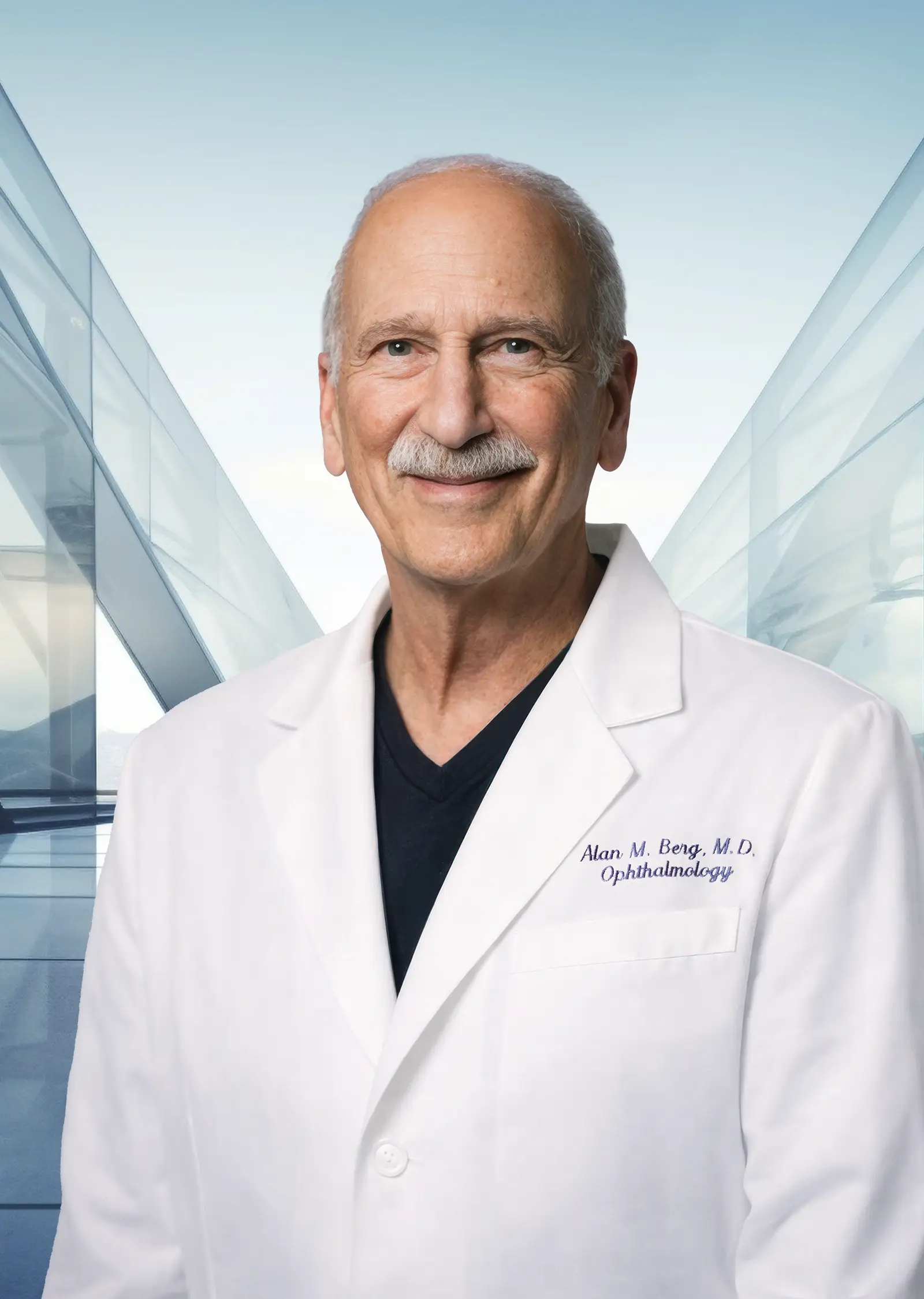
Alan M. Berg, MD
Board-Certified Ophthalmologist & Refractive Surgeon
Dr. Berg has practiced ophthalmology in Los Angeles since 1980 and has performed more than 50,000 LASIK procedures. He was named a VISX Star Surgeon, an honor given to the top 5% of LASIK surgeons in the United States, and was one of 50 U.S. surgeons selected for the Implantable Collamer Lens clinical trials. He earned his MD at Bowman Gray School of Medicine, completed his ophthalmology residency at USC, where he teaches residents, and serves as medical director of the Kobe Laser Center in Japan.