

The short version: choose a Los Angeles cataract surgeon on what you can verify, not on advertising. Confirm board certification through the American Board of Ophthalmology. Ask how many cataract procedures the surgeon performs and how long they have practiced here. Ask which intraocular lenses the practice implants and listen for whether the counseling covers the full range or steers you to one. Ask what imaging is used to calculate your lens power, whether laser assistance is available and honestly explained, where the surgery is performed and whether that facility is accredited, who sees you afterward, and whether you get the cost in writing before you commit. A surgeon who is comfortable with all of those questions is the one you want.
I have performed thousands of cataract and lens implant procedures in Los Angeles since 1980, and I have watched a great many patients and their families work through the decision of whom to trust with it. Most people pick a cataract surgeon the way they pick a contractor: a referral from a friend, a convenient office, whoever their insurance lists first. That works often enough. But this is an operation you have once per eye, the lens that goes in stays there for the rest of your life, and there are things worth checking that take less time than reading this article.
What follows is the checklist I would use myself. None of it requires medical knowledge. All of it can be verified with a phone call or a few minutes online.
Why this choice is different from most medical decisions
Cataract surgery is one of the safest and most successful operations in medicine, and that is exactly why patients underestimate the decision. Removing the cloudy lens is the routine part. The parts that vary enormously from practice to practice are the measurements that determine your lens power, the counseling that determines which lens you receive, the technology used to place it, and the facility it happens in. Those are what decide whether you see well at every distance or spend the next thirty years reaching for glasses — and whether a small refractive miss gets corrected or shrugged off.
Eight things to verify before you book anywhere
1. Board certification
The American Board of Ophthalmology lets you verify any surgeon’s certification online, free, in about two minutes. Do it. It is the floor, not the ceiling, but a surgeon who has not maintained it has told you something.
2. Volume and longevity, together
Ask how many cataract procedures the surgeon performs and how long the practice has been in this community. Either number alone can mislead: a very high-volume center can be an assembly line, and a long-tenured surgeon can be doing a handful of cases a month. You want both — a surgeon who does a great deal of this and has been judged on it, continuously, by Los Angeles patients who talk to their neighbors. Berg-Feinfield has operated here since 1980.
3. The lens portfolio — and how it is discussed
This is the single most revealing question you can ask. Which intraocular lenses does the practice implant? A surgeon who offers two lenses will recommend one of two. Berg-Feinfield implants the full range: standard monofocals, extended-depth-of-focus lenses, trifocals, full-range lenses, toric lenses for astigmatism, and the Light Adjustable Lens, which is fine-tuned after surgery. Just as important is how the conversation goes. The right counseling starts with how you use your eyes — reading, screens, night driving, golf, music — and narrows the lenses from there. If the conversation starts with a lens and works backward to you, be careful. Our lens comparison shows what the choices actually are.
4. Who takes your measurements, and with what
Lens power is calculated from measurements of your eye’s length and corneal curvature, and the accuracy of those measurements is where outcomes are won or lost — especially for premium lenses and for eyes that have had LASIK, which are harder to calculate. Ask what imaging the practice uses and whether the surgeon reviews the measurements personally. At Berg-Feinfield, high-resolution 3D imaging maps the eye before surgery and every incision is planned in software before an instrument touches it.
5. Laser assistance, explained honestly
Laser-assisted cataract surgery uses a femtosecond laser for the most delicate steps — the corneal incisions, the circular opening in the lens capsule, and the softening of the cataract itself — under computer guidance rather than by hand. It is an elective upgrade to an otherwise covered procedure, and it is not necessary for every eye. What you want is a surgeon who offers it, explains where it adds value (precise capsulotomy for premium lenses, astigmatism correction, less ultrasound energy in the eye), and tells you plainly when it will not change your outcome. Our laser cataract surgery page covers the technology in detail.
6. Where the surgery happens
Ask where your operation will be performed and whether that facility is accredited. Berg-Feinfield operates at Pacific Surgery Center in Burbank, an ambulatory surgery center accredited by AAAHC, which means it has been surveyed against national standards for outpatient surgical care. Accreditation is not automatic and not universal. A facility that has earned it will say so readily.
7. Who sees you afterward
A large majority of our surgical patients see their own optometrist before and after surgery through our co-management program, so follow-up care stays close to home with a doctor who already knows their eyes. Patients who are not co-managed are followed by our in-house team of ophthalmologists and optometrists at whichever Berg-Feinfield office is convenient. Either way, ask the question: if something needs attention at two weeks, who do I call, and where do I go? The answer should be specific.
8. The cost, in writing, before you decide
When a cataract is medically significant, Medicare and most insurance plans cover standard cataract surgery with a monofocal lens; laser assistance and premium lenses are elective and paid out of pocket. Any practice worth choosing verifies your benefits and gives you a written breakdown — what is covered, what each lens option costs, what financing looks like monthly — before you schedule. Ours is on the cataract surgery cost page. A practice that is vague about money before surgery will not be clearer afterward.

Ten questions to ask at the consultation
- Are you board certified, and may I verify it?
- How many cataract procedures do you perform, and for how long have you practiced in Los Angeles?
- Which intraocular lenses do you implant, and which would you recommend for how I use my eyes?
- What imaging do you use to calculate my lens power, and do you review it yourself?
- Do you offer laser-assisted surgery, and would it change my outcome specifically?
- Where will my surgery be performed, and is that facility accredited?
- Will you personally perform my surgery, and will I see you at follow-up?
- Can my own optometrist manage my post-operative care if I prefer?
- What happens if my vision is not quite right afterward — what is your enhancement or lens-exchange policy?
- Can I have the full cost in writing, including what insurance covers, before I decide?
Red flags worth walking away from
- Every patient is a candidate for the premium lens. Some eyes — with macular disease, significant corneal irregularity, or certain visual demands — do better with a monofocal. A surgeon who never recommends one is selling, not counseling.
- You meet the surgeon for the first time on surgery day.
- “Wait until it is ripe.” That advice is decades out of date; a denser cataract is harder to remove, not easier, and the threshold is whether your vision limits your life.
- No written estimate, or a price that changes after the exam.
- Pressure to decide on the lens in the room. This is a once-in-a-lifetime choice. Take it home.
What “best cataract surgeon in Los Angeles” should mean
There is no official ranking, and the “top doctor” lists that fill the first page of search results are largely advertising. The best cataract surgeon for you is the one who passes the checklist above, counsels you across the whole range of lenses, operates in an accredited facility with modern imaging and laser technology, sees you personally before and after, and puts the cost in writing. Berg-Feinfield’s surgeons — five board-certified ophthalmologists, several of whom have participated in FDA clinical studies for emerging ophthalmic technologies — have practiced under that standard in Los Angeles for more than four decades.
Where we see cataract patients
Consultations and follow-up visits are available at all five Berg-Feinfield offices — Beverly Hills, Burbank, Sherman Oaks, Arcadia, and Valencia — which puts us within a short drive of Encino, Studio City, Glendale, Pasadena, Santa Clarita, and the Westside. Surgery itself is performed at Pacific Surgery Center in Burbank. If you are not sure whether your symptoms are a cataract at all, start with the symptoms that mean it is time, then bring this checklist to the consultation.
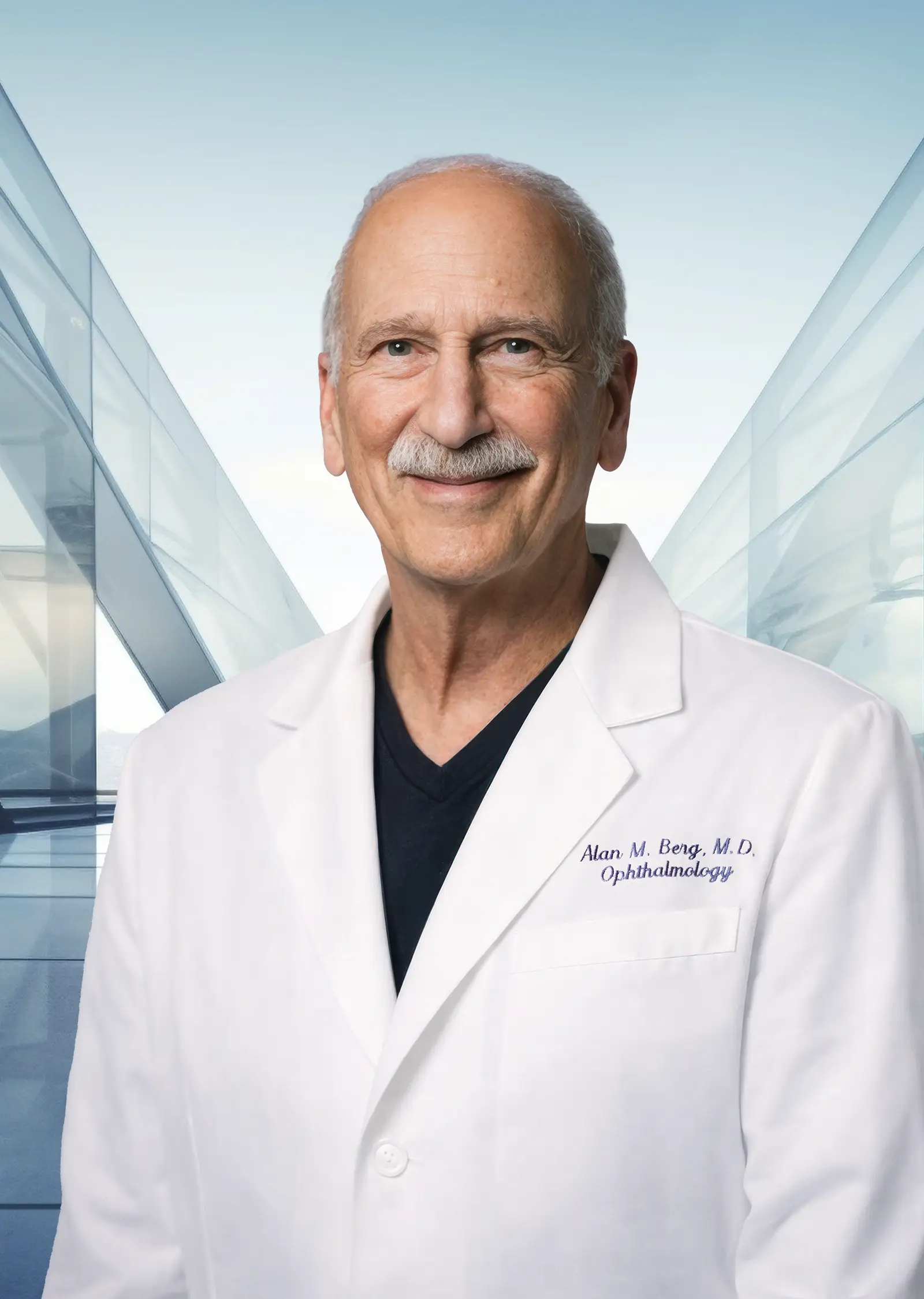
Alan M. Berg, MD
Board-Certified Ophthalmologist & Refractive Surgeon
Dr. Berg has practiced ophthalmology in Los Angeles since 1980 and has performed more than 50,000 LASIK procedures. He was named a VISX Star Surgeon, an honor given to the top 5% of LASIK surgeons in the United States, and was one of 50 U.S. surgeons selected for the Implantable Collamer Lens clinical trials. He earned his MD at Bowman Gray School of Medicine, completed his ophthalmology residency at USC, where he teaches residents, and serves as medical director of the Kobe Laser Center in Japan.