
The short version: LASIK fits most people with a stable prescription and healthy corneas of adequate thickness. PRK fits thinner or irregular corneas and careers where a corneal flap is a liability. EVO ICL fits high prescriptions beyond LASIK’s safe range, borderline corneal thickness, or significant dry eye. Refractive lens exchange fits patients past their mid-40s whose real complaint is reading vision. Which one is yours is decided by measurements — corneal thickness and shape, prescription, pupil size, tear film, and the age of your natural lens — not by preference or by what a billboard is advertising this month.
Almost every patient who sits down in my office asks the same question: “Am I a candidate for LASIK?” It is the wrong question, and I say that as someone who has performed more than 50,000 LASIK procedures. The right question is which vision correction procedure fits the eyes you actually have.
That distinction matters because the answer changes the outcome. A patient with corneas too thin for LASIK who is talked into it anyway is a patient with a problem. That same patient with an EVO ICL can see beautifully for decades. A 52-year-old who gets flawless LASIK and then discovers he still needs readers was never told that LASIK does not treat presbyopia. The procedure was fine. The match was wrong.
At Berg-Feinfield we perform all four procedures in-house, which is the only reason I can write this honestly. A practice that offers one procedure will find a way to make you a candidate for it. Here is how the four actually differ, and what decides between them.
LASIK: the default when the cornea allows it
LASIK reshapes the cornea with an excimer laser so light focuses correctly on the retina. It corrects nearsightedness, farsightedness, and astigmatism. A femtosecond laser — not a blade — creates a thin corneal flap, the excimer laser reshapes the tissue beneath it in seconds, and the flap is laid back into position, where it seals without stitches.
The reason LASIK is the default is recovery. Because the surface layer of the cornea is preserved under the flap, most patients see clearly by the next morning and are back at work within a day or two. Nothing else on this list recovers that fast.
What we look for: a prescription that has been stable for at least a year, age 18 or older, adequate corneal thickness, a regular corneal shape on topography, and a healthy ocular surface. At our practice the treatment is planned on iDESIGN 2 Advanced WaveScan, which captures more than 1,200 measurements of each eye, and delivered on the Alcon WaveLight Pro — so the treatment is mapped to your individual optical fingerprint, not to your glasses prescription alone.

PRK: the same laser, without the flap
PRK uses the identical excimer laser and the identical wavefront-guided treatment plan as LASIK. The only difference is access: instead of lifting a flap, we remove the thin outer epithelial layer and treat the corneal surface directly. That layer regrows over the following days.
Because no tissue is used to create a flap, PRK preserves more corneal thickness — which is exactly why it exists. I recommend it for patients with corneas too thin for a LASIK flap, for corneal surface irregularities, and for people whose work or sport makes flap displacement a genuine concern: law enforcement, military, firefighters, boxers, martial artists, and full-contact athletes.
The trade-off is honest and worth stating plainly: initial clarity takes roughly one to two weeks with PRK versus one to two days with LASIK, and the first three or four days involve real discomfort. Final visual outcomes for well-selected patients are equivalent. You are trading two weeks of your life for a structurally safer procedure in a cornea that needs it.
If a surgeon offers you only LASIK
Ask what they would recommend if your corneas turned out to be too thin — and whether they perform that procedure themselves or refer it out. The answer tells you whether you are getting a recommendation or a sales pitch.
EVO ICL: when the cornea is not the right place to work
EVO ICL takes a different approach entirely. Rather than removing corneal tissue, we place a small, flexible collamer lens inside the eye, between the iris and your natural lens. Nothing is removed, and the lens can be taken out if your needs change — which is why patients sometimes hear it described as reversible.
This is the procedure for prescriptions that outrun laser correction. EVO ICL treats myopia up to roughly −20.00 D, well beyond LASIK’s safe range. It is also the better answer for borderline corneal thickness and for patients with moderate to significant dry eye, because it does not cut corneal nerves the way a flap does. Many of these patients report exceptional night vision, helped by a larger effective optical zone than corneal laser procedures provide, and the lens carries a built-in UV filter.
I have a particular history with this technology: I was one of only 50 surgeons in the United States selected for the original Implantable Collamer Lens clinical trials. We perform EVO ICL at our Beverly Hills office and treat patients from across Los Angeles there.
Refractive lens exchange: when reading vision is the real complaint
Somewhere in your mid-40s, the natural lens inside your eye stiffens and stops focusing up close. That is presbyopia, and it is why people who have never worn glasses suddenly hold a menu at arm’s length. No corneal laser procedure fixes it, because the problem is not in the cornea.
Refractive lens exchange replaces the natural lens with a precision intraocular lens (IOL). It is the same procedure as cataract surgery, performed electively before a cataract develops. Modern extended-depth-of-focus and trifocal IOLs can deliver distance and near vision together, and because the natural lens is gone, you will never develop a cataract in that eye.
I recommend it for patients in their mid-40s and beyond who want a comprehensive answer, for prescriptions far outside laser range, and for anyone whose evaluation already shows early lens changes — in which case treating the cornea would mean doing the wrong operation on the wrong structure.
The four, side by side
| Procedure | Best suited to | Recovery | Treats reading vision? |
|---|---|---|---|
| LASIK | Stable prescription, healthy corneas of adequate thickness, typically under 45 | Clear vision usually by the next morning; most back to work in 1–2 days | No |
| PRK | Thin or irregular corneas; contact sports, military, law enforcement | 1–2 weeks for initial clarity; several days of discomfort | No |
| EVO ICL | High myopia to about −20.00 D, borderline corneal thickness, significant dry eye | Most see well within a day or two | No |
| Refractive lens exchange | Mid-40s and up, presbyopia, very high prescriptions, early lens changes | Days for functional vision; several weeks to fully settle | Yes, with the right IOL |
Ranges reflect typical candidacy and recovery. Your evaluation decides your case — these are starting points, not promises.
What actually decides it: five measurements
A complete refractive evaluation takes about ninety minutes, and by the end of it the decision is usually obvious. Five things drive it:
- Corneal thickness. There is a floor below which no responsible surgeon creates a flap. Thin corneas point toward PRK or EVO ICL.
- Corneal shape. Topography reveals irregularity and early keratoconus — findings that rule out laser reshaping entirely and are the single most important reason to have real diagnostics, not a quick screening.
- Your prescription, and how stable it is. High myopia beyond laser range points to EVO ICL. A prescription still changing year over year means waiting.
- Tear film and ocular surface. Significant untreated dry eye makes for a miserable LASIK recovery and unstable measurements. We usually treat the surface first, then re-measure — and sometimes that changes the recommendation.
- The age and clarity of your natural lens. Past 45, the lens is part of the conversation whether or not the patient came in expecting it to be.
If you want a rough sense of where you may land before you come in, our 60-second vision correction self-test asks the same questions I would start with. It is not a diagnosis. It is a reasonable first sort.
Why the surgeon matters more than the procedure name
Patients search for the best LASIK surgeon in Los Angeles and find rankings that are, almost without exception, paid placements. There is no official list. What there is, and what you can verify yourself, is this:
- Board certification. The American Board of Ophthalmology publishes a free verification tool. Check the name yourself.
- Volume, in numbers. Ask how many procedures the surgeon has personally performed, and over how many years.
- Who performs your evaluation. In some Los Angeles practices the surgeon meets you for the first time on surgery day. Ask directly.
- Whether they offer the full range. A surgeon who performs LASIK, PRK, EVO ICL, and lens-based surgery can recommend the right one. A surgeon who performs one can only recommend that one.
- What happens if you need an enhancement. Ask what it costs and who pays.
Our full checklist for evaluating any Los Angeles refractive surgeon — including the questions worth asking out loud — is in this guide.
What it costs in Los Angeles
Advertised LASIK pricing in Los Angeles is frequently a per-eye figure that applies to a prescription almost nobody has, with the diagnostics, follow-up care, and any enhancement billed separately. Ask what a quoted price excludes before you compare it to anything.
We quote one all-inclusive price per eye at your consultation, and it covers the complete evaluation, the custom all-laser treatment itself, every post-operative visit, and our enhancement policy. Consultations are free. CareCredit and Alphaeon financing are accepted, as are FSA and HSA funds. Full detail is on our LASIK cost in Los Angeles page, and financing options are here.
How to find out which one is yours
You cannot determine this from an article, including this one. You can only determine it from measurements. What you can do is arrive knowing that there are four real options, that a good practice performs all of them, and that the honest answer to “which one” sometimes turns out to be “none yet” — a prescription that has not settled, or a dry eye to treat first.
Berg-Feinfield has cared for Los Angeles eyes since 1980, with offices in Burbank, Sherman Oaks, Beverly Hills, Arcadia, and Valencia. Come in, get measured, and leave knowing which procedure fits your eyes — and what it will cost.
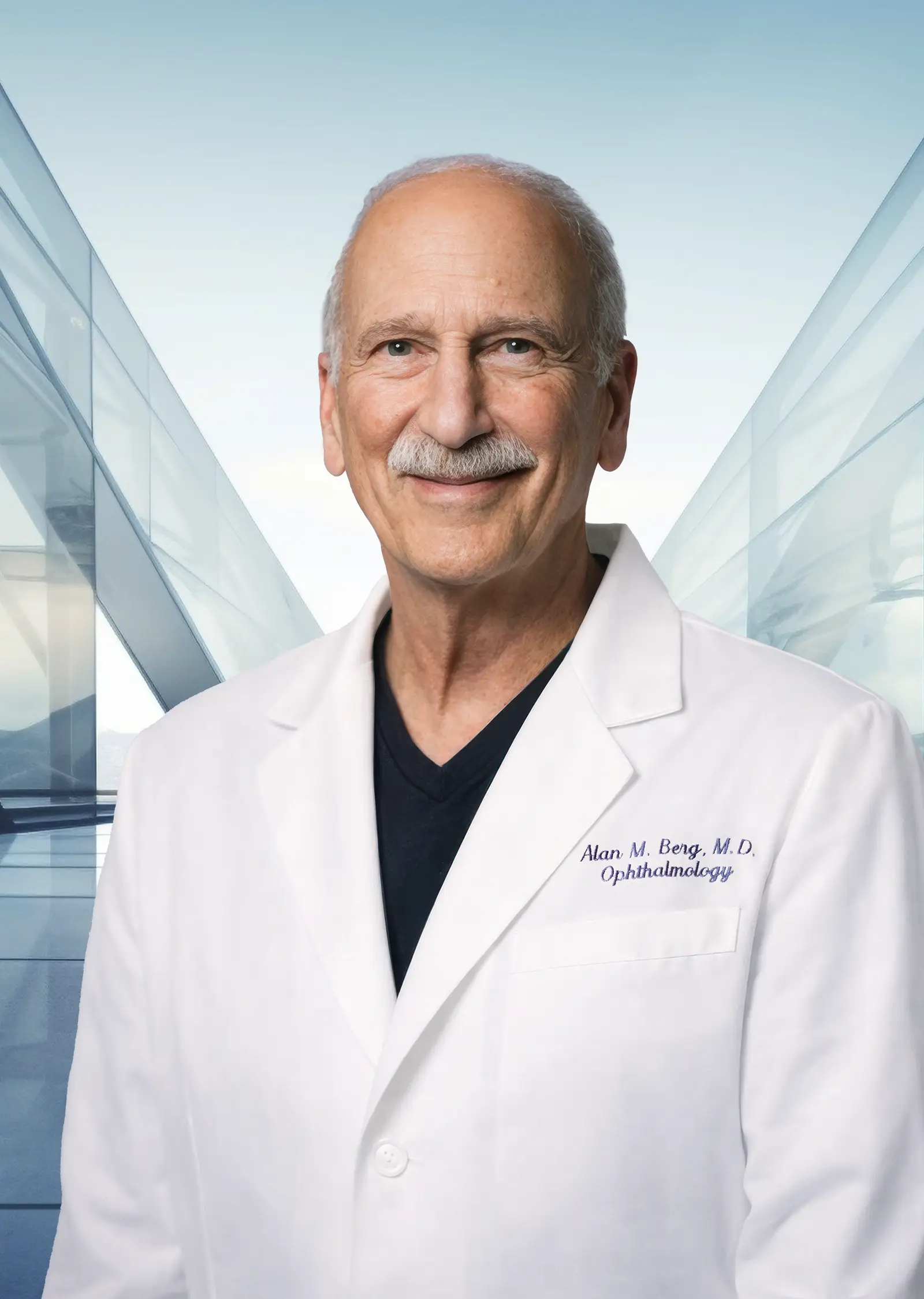
Alan M. Berg, MD
Board-Certified Ophthalmologist & Refractive Surgeon
Dr. Berg has performed more than 50,000 LASIK procedures and was named a VISX Star Surgeon, an honor given to the top 5% of LASIK surgeons in the United States. He was one of 50 U.S. surgeons selected for the Implantable Collamer Lens clinical trials, earned his MD at Bowman Gray School of Medicine, completed his ophthalmology residency at USC, where he teaches residents, and serves as medical director of the Kobe Laser Center in Japan.