You Want a Treatment Built From Your Eye's Map
Wavefront-guided LASIK corrects the subtle irregularities of your individual optics, not just your glasses prescription. SMILE treatments are not wavefront-guided.

LASIK and SMILE are both laser procedures for nearsightedness, but they work differently — and only one can be customized to a 3D map of your eye. Here is an honest comparison from a Los Angeles practice that has performed refractive surgery since 1980.

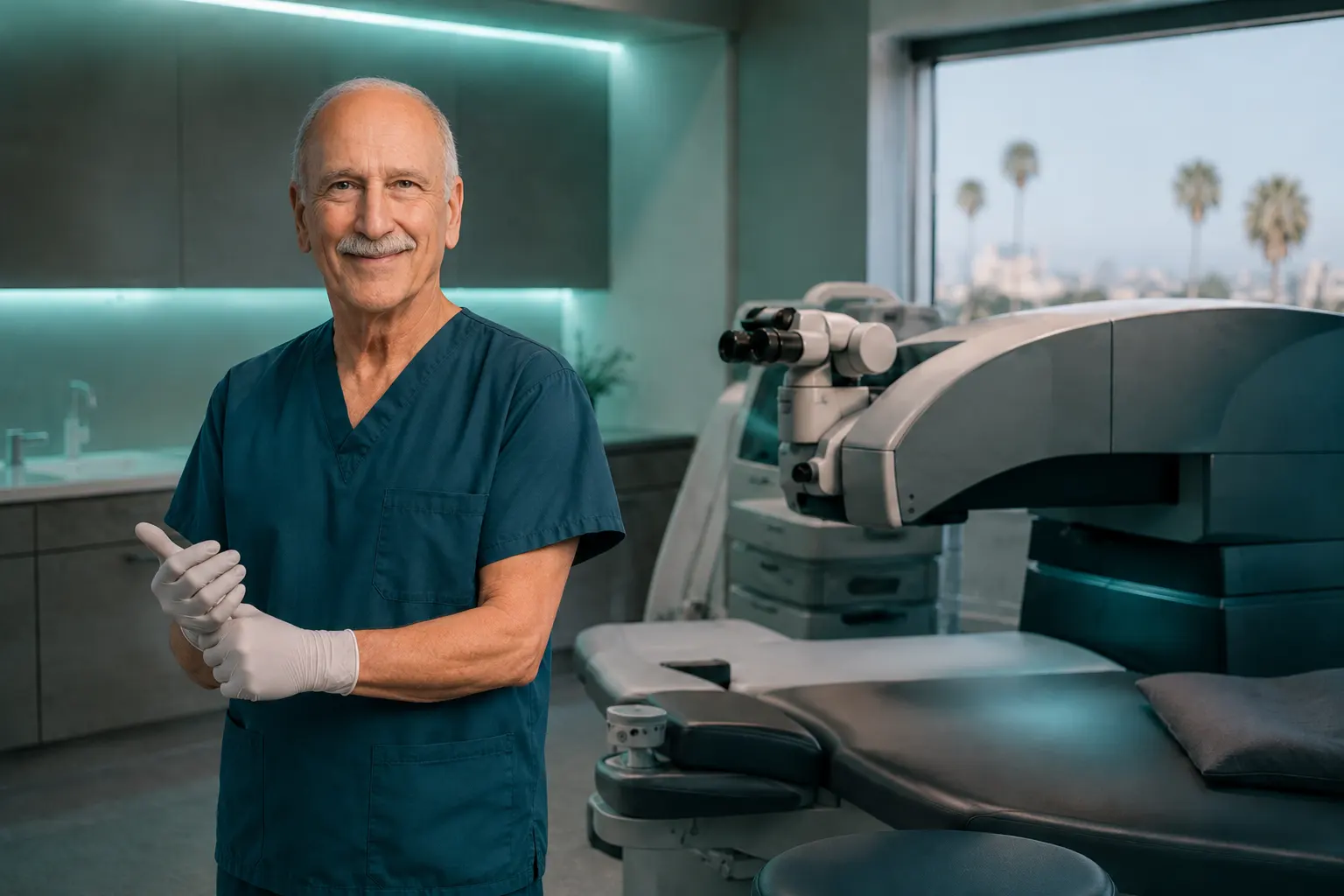
LASIK reshapes the cornea beneath a thin flap with an excimer laser and can be wavefront-guided to your eye's individual map. SMILE (small incision lenticule extraction) uses a single femtosecond laser to cut a thin disc of tissue inside the cornea and removes it through a small incision — no flap.
For most patients, custom all-laser LASIK delivers faster visual recovery, treats a wider range of prescriptions (including farsightedness), and is simpler to fine-tune if an enhancement is ever needed. SMILE's advantage is a flap-free cornea, which some surgeons favor for very active patients or those prone to dry eye. Berg-Feinfield performs custom bladeless LASIK, PRK, and EVO ICL rather than SMILE — here is why, and how to decide which procedure fits your eyes.
Compare Side by SideTwo femtosecond-laser procedures, two different approaches to the cornea. Here is how they compare on the points that matter to patients.
| LASIK | SMILE | |
|---|---|---|
| How the cornea is treated | A femtosecond laser creates a thin flap; an excimer laser reshapes the cornea beneath it, and the flap is repositioned. | A femtosecond laser cuts a thin lenticule inside the cornea, which the surgeon removes through a small incision of a few millimeters. |
| Corneal flap | Yes — a thin, laser-made flap | No flap — a small incision instead |
| Customization | Wavefront-guided treatment built from a 3D map of your eye (iDesign 2 captures 1,200+ measurements) | Based on your glasses prescription; not wavefront-guided |
| Prescriptions treated | Nearsightedness, farsightedness, and astigmatism | Nearsightedness (−1.00 to −10.00 D) with astigmatism up to −3.00 D per FDA labeling; not approved for farsightedness |
| Minimum age (FDA labeling) | 18 | 22 |
| Visual recovery | Sharp for most patients by the next morning | Typically a few days to reach best vision |
| Dry eye | Temporary dryness is common in the first weeks and usually resolves | Some studies report less dryness in the early recovery period |
| Enhancements | The flap can be lifted for a straightforward touch-up | More involved — usually a surface treatment (PRK) over the treated area |
| Track record | FDA-approved since 1999, with decades of long-term outcome data | FDA-approved since 2016 (astigmatism added 2018) |
| Long-term results | Comparable for well-selected candidates — outcomes depend more on candidacy, diagnostics, and surgeon experience than on the procedure name. | |
Neither procedure is "better" in the abstract. The right choice depends on your prescription, corneal thickness and shape, dry-eye status, age, and how quickly you need to be back at work. That is why every recommendation at Berg-Feinfield starts with a complete diagnostic evaluation, not a sales conversation.
For most candidates with healthy corneas, custom all-laser LASIK remains the procedure of choice in Los Angeles — for reasons that go beyond speed.
Wavefront-guided LASIK corrects the subtle irregularities of your individual optics, not just your glasses prescription. SMILE treatments are not wavefront-guided.
SMILE is FDA-approved only for nearsightedness with astigmatism. LASIK treats nearsightedness, farsightedness, and astigmatism.
Most LASIK patients see well by the next morning and are back at work within a day or two. SMILE vision typically takes several days to sharpen.
SMILE's approved range starts at −1.00 D. Low prescriptions, and patients under 22, fall outside its labeling but are routinely treated with LASIK.
If a touch-up is ever needed, a LASIK flap can be lifted and treated. After SMILE, enhancements usually require a separate surface procedure.
LASIK has more than 25 years of FDA-approved outcome data behind it; the platforms we use are the current generation of that lineage.
SMILE is a legitimate, FDA-approved procedure with real advantages for a specific group of patients. Here is who tends to benefit — and what we recommend instead.
SMILE has no flap, which removes the small long-term risk of flap displacement. At Berg-Feinfield, patients with the same concern are usually excellent candidates for PRK, which also has no flap and is wavefront-guided.
Some studies report less early dryness after SMILE. For patients with meaningful dry eye we typically treat the dry eye first, then consider PRK or EVO ICL, which leaves the cornea's surface untouched.
A flap-free cornea is appealing for boxers, martial artists, and first responders. PRK offers the same flap-free advantage with custom treatment, and EVO ICL avoids corneal tissue removal entirely.
SMILE treats up to −10.00 D. For high prescriptions, EVO ICL — an implantable lens that removes no tissue and is reversible — is often the safer, higher-quality option, and Dr. Berg was one of 50 U.S. surgeons in the original ICL trials.
Every practice makes choices about which procedures to offer. Here is the reasoning behind ours.
iDesign 2 Advanced WaveScan maps more than 1,200 points on each eye and the Alcon WaveLight Pro treats to that map. SMILE cannot use a wavefront-guided profile, and we are not willing to give that up.
Patients who want to avoid a flap are offered wavefront-guided PRK; patients with high prescriptions or thin corneas are offered EVO ICL. Nobody is steered into LASIK by default.
Dr. Alan Berg has performed more than 50,000 LASIK procedures and has practiced through every generation of refractive technology since radial keratotomy. That experience shapes who we treat — and who we advise to wait.
If your evaluation shows you are not a good LASIK candidate, we will tell you, and we will explain which alternative fits — even when that means no surgery at all.
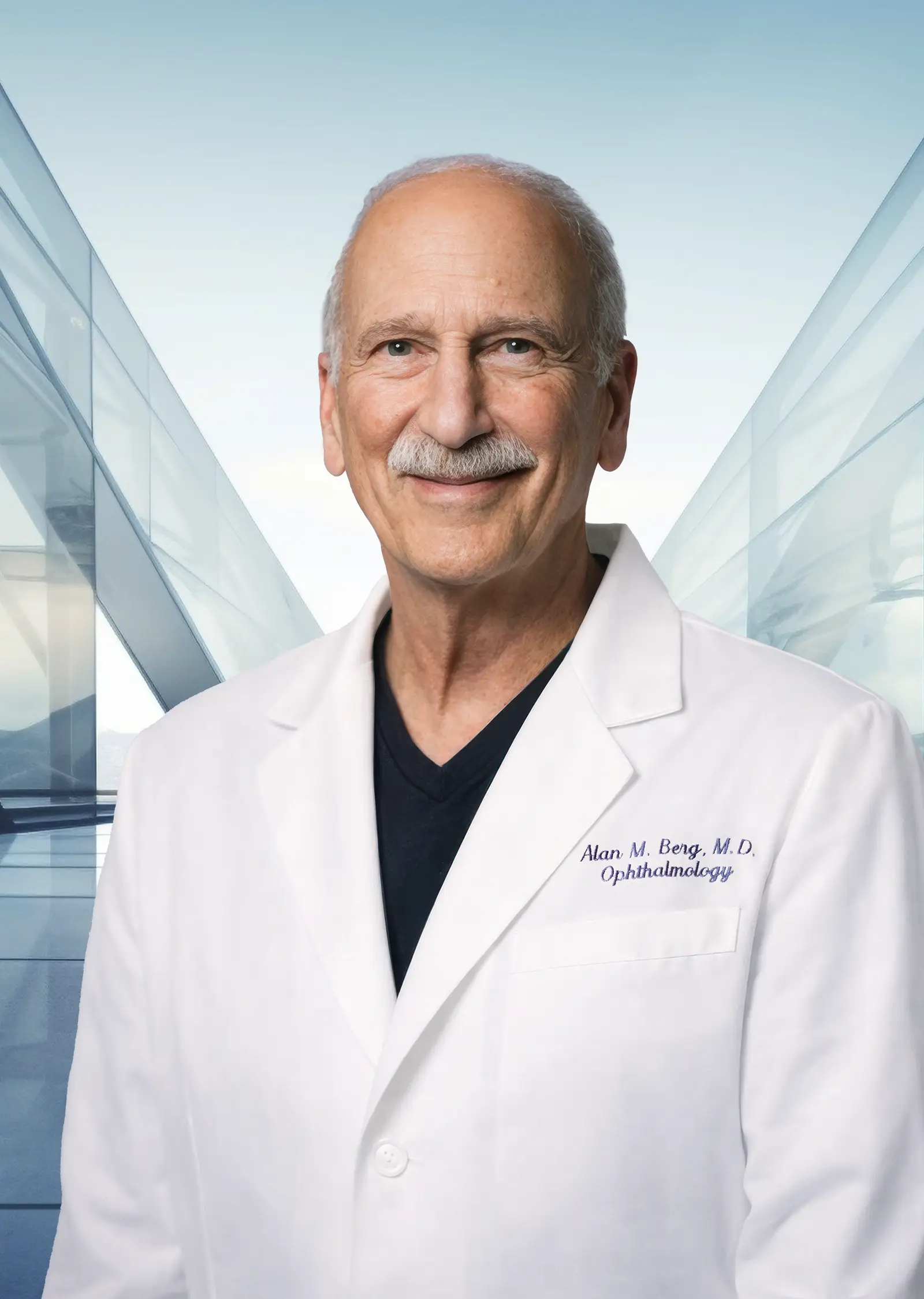
Your free consultation includes corneal mapping, a complete candidacy evaluation, and an honest recommendation — LASIK, PRK, EVO ICL, or none of the above.
BERG-FEINFIELD · AFTER HOURS
Questions about your vision? Talk with our AI assistant about LASIK, cataract surgery, or general eye care.
Talk with ClaireAI assistant for general information, not medical advice or emergency care. AI can make mistakes. Confirm medical information with your eye care professional.