Aqueous-Deficient Dry Eye
The lacrimal glands aren't producing enough tears. Common with age, certain autoimmune conditions, some medications, and after LASIK.

Comprehensive dry eye disease care, available at our Burbank and Sherman Oaks offices — serving Los Angeles, Beverly Hills, Studio City, Encino, Toluca Lake, Pasadena, Arcadia, and Valencia.

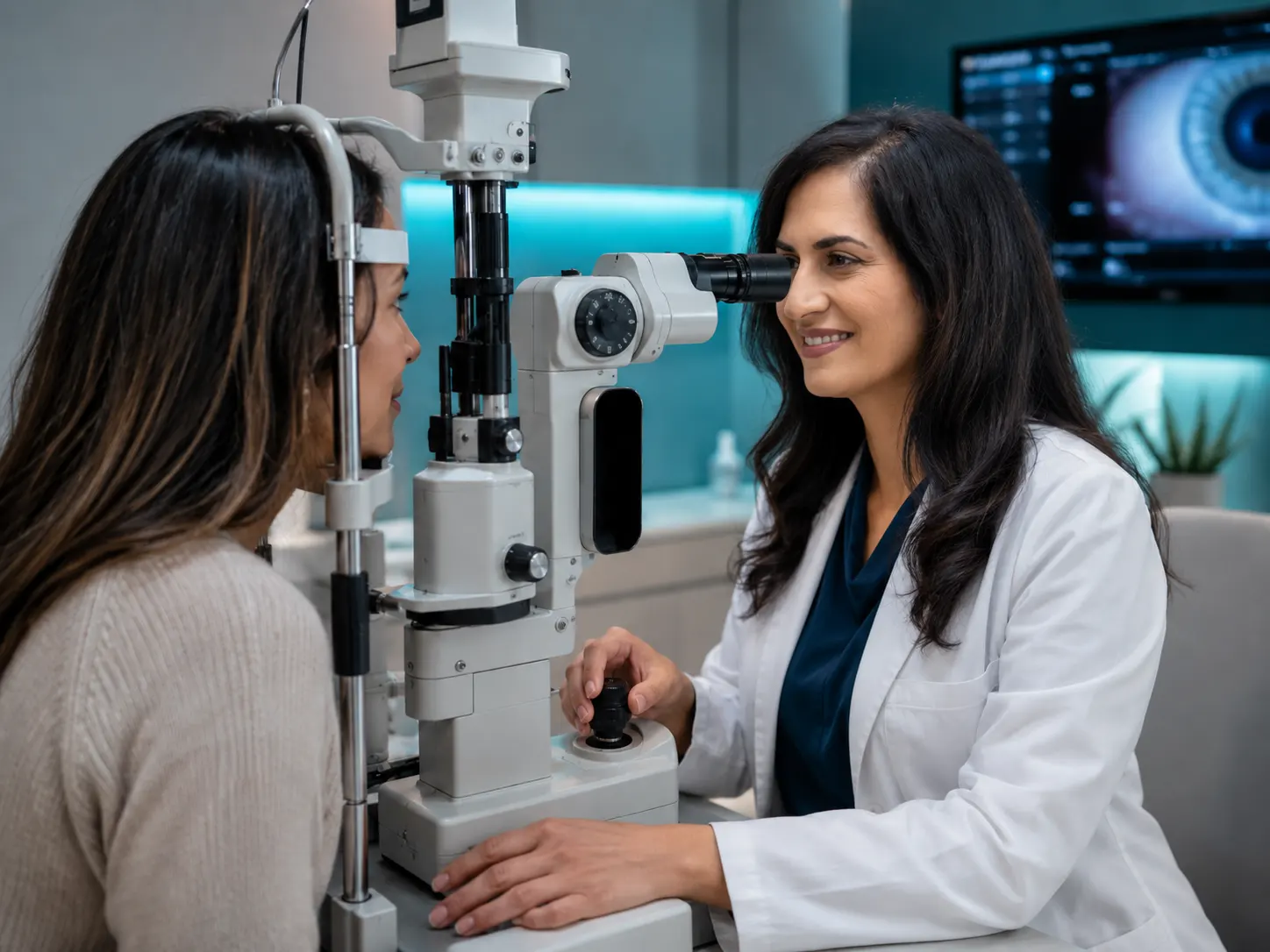
Most patients arrive at our Dry Eye Center after two or three failed attempts elsewhere — a string of artificial tears, six months on a drop with little effect, a warm compress and a sample of something. They're tired of the burning and blurred vision, and tired that no one has explained why it's happening.
Dry eye disease is complicated, and early treatment usually fails because no one has identified which mechanism is actually driving the case. A drop that stimulates tear production won't fix a tear that evaporates in three seconds. Our job is to identify the mechanism first, then match the treatment to it.
See Our TreatmentsDry eye disease is driven by more than one mechanism — and most cases involve a combination. Identifying which one dominates is what determines the right treatment.
The lacrimal glands aren't producing enough tears. Common with age, certain autoimmune conditions, some medications, and after LASIK.
Tears are produced normally but evaporate too fast because the meibomian glands aren't making enough oil to hold the tear film in place. Meibomian Gland Dysfunction is the most common cause of dry eye today.
Most patients have some of each. An anti-inflammatory drop won't help much if your glands are clogged, and a gland-clearing treatment won't help much if inflammation is driving your case. We test for both.
If you recognize three or more of the following, dry eye disease is likely contributing to what you're experiencing.
A burning, stinging, or scratchy feeling, or a gritty sensation like there's something in your eye.
Blurred or fluctuating vision, often worse in the evening or after screen time.
Paradoxical reflex tearing — watery eyes triggered in response to the underlying dryness.
Stringy mucus, redness, or sensitivity to light and wind.
Increasing difficulty wearing contact lenses comfortably.
Eyes that feel tired by mid-afternoon. If several of these sound familiar, a short questionnaire before your visit helps us classify the severity.
A full dry eye evaluation isn't just “you have dry eye, here's a drop.” We combine objective and validated tests to identify which mechanism is driving your case.
The Ocular Surface Disease Index — a validated questionnaire that scores severity and gives us a baseline to track change over time.
A quick, painless point-of-care test that measures the salt concentration in your tears. Elevated osmolarity is one of the most reliable objective markers of dry eye.
Measures how quickly the tear film breaks apart between blinks. A short breakup time points specifically to evaporative dry eye.
Imaging and expression to assess for MGD and the quality of oil production in your eyelid glands.
Using fluorescein and lissamine green to visualize surface damage on the cornea and conjunctiva.
When appropriate, to measure aqueous tear production directly.
We use this combination to identify which mechanism is driving your case, so we choose the right treatment instead of guessing.
Each prescription drop has a different mechanism. Most patients land on one — or a combination — after we identify the dominant problem driving their case.
Cyclosporine 0.05% · anti-inflammatory · twice daily. The original immunomodulator, approved in 2003. Reduces the chronic inflammation behind much of dry eye disease. Effective but slow — 3 to 6 months for full effect — and can sting on instillation.
Cyclosporine 0.09% · nanomicellar · twice daily. A higher-concentration cyclosporine in a nanomicellar formulation. Same mechanism as Restasis, better delivered, and faster-acting in some patients.
Cyclosporine 0.1% · water-free · twice daily. The newest cyclosporine and the most tolerable — water-free and preservative-free, with far less stinging. Onset as early as two weeks. Usually our next try if Restasis failed or burned.
Lifitegrast 5% · LFA-1 blocker · twice daily. A different mechanism from cyclosporine, blocking the LFA-1/ICAM-1 inflammatory pathway. Approved in 2016. Some patients respond after failing cyclosporines, and vice versa.
Acoltremon 0.003% · TRPM8 activator · twice daily. Approved in 2025. A first-in-class drop that activates TRPM8 receptors on the corneal nerves, prompting your body to produce more natural tears. Useful for aqueous-deficient dry eye. Stored refrigerated.
Perfluorohexyloctane · anti-evaporative · four times daily. Approved in 2023 — the first FDA-approved drop targeting tear evaporation. Forms a stable monolayer that keeps water from evaporating. Useful for evaporative and MGD-driven dry eye.
When drops aren't enough — or when the problem is mechanical, like clogged glands — we move to procedures that address the underlying cause directly.
Thermal MGD treatment · 1–2 sessions. Applies controlled heat and gentle compression to the eyelids to liquefy the hardened oil clogging the glands and express them. The handheld device lets the doctor target the specific glands that need it. Improvement is common within a week.
In-office · no anesthesia · reversible. Tiny silicone or collagen plugs placed in the tear drainage openings so your existing tears stay on the eye longer. Placed in minutes. Silicone plugs are removable; collagen plugs dissolve over weeks to months.
Canalicular gel · ~6 months · reversible. A cross-linked hyaluronic acid gel placed in the tear drainage canals. Unlike standard plugs that block only the opening, it fills the entire canalicular system for a more complete block. Lasts about six months and can be irrigated out if needed.
Most patients with moderate to severe dry eye benefit from more than one treatment at a time. We're not trying to put you on a long list of products — we're trying to address every mechanism driving your case so the result is dramatic rather than incremental.
We identify which mechanism dominates before choosing a drop or procedure, so the plan is matched to your case instead of guessed.
A typical combination might be Vevye for inflammation, Miebo for evaporation, an iLux session for MGD, and an artificial tear for breakthrough days.
An ophthalmology practice with 30+ years of experience, treating dry eye as a serious condition rather than dispensing artificial tears and sending people home.
We help navigate prior authorizations and manufacturer copay-assistance programs for newer drops like Vevye, Miebo, and Tryptyr.
We treat dry eye as a primary condition and in patients who developed it after LASIK or cataract surgery, whether performed here or elsewhere.

If you're tired of the burning, grittiness, and blurred vision, a diagnosis-first evaluation is the key to lasting relief. Call us or request a consultation online — Burbank and Sherman Oaks appointments available across our five Los Angeles-area locations.