Tonometry
Eye Pressure Check
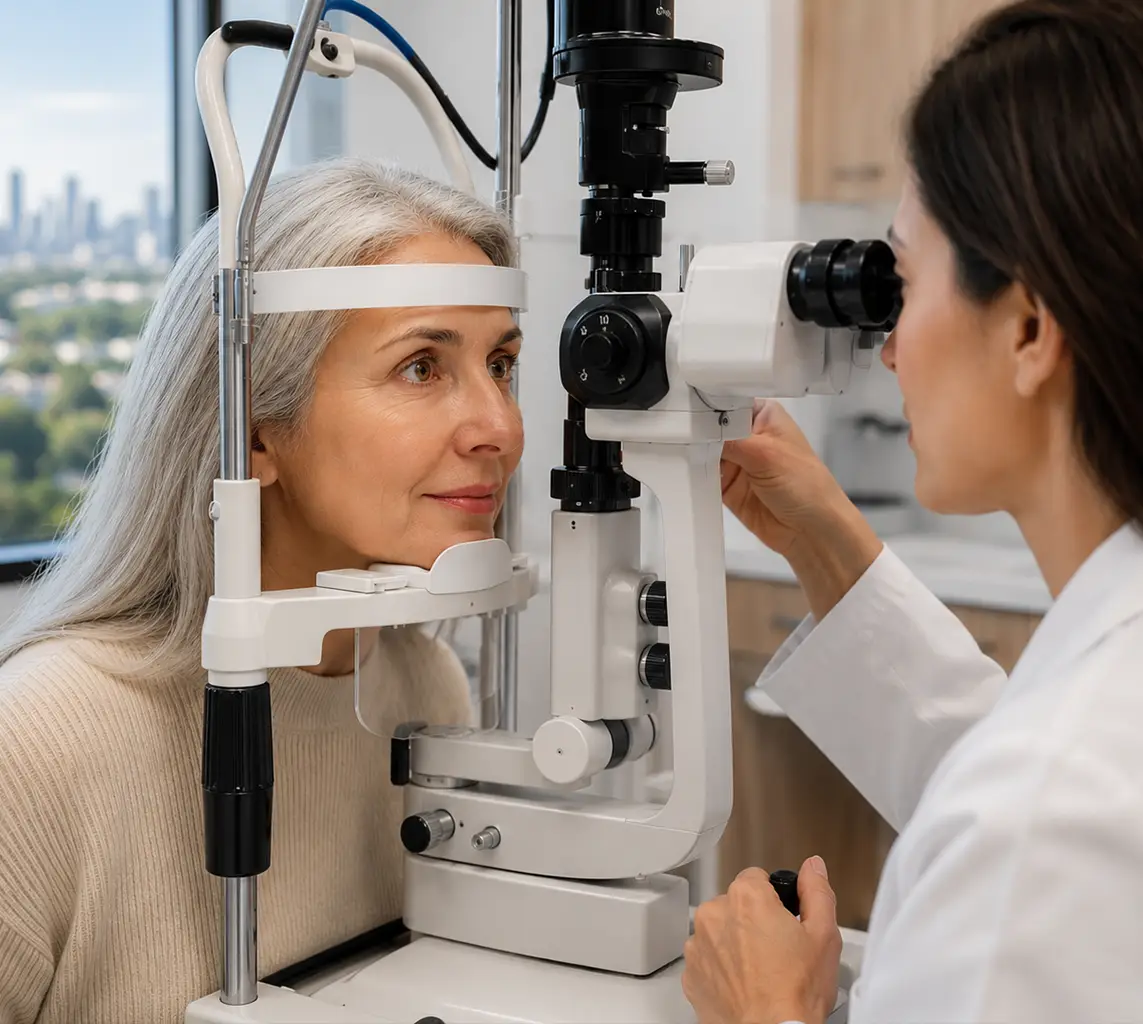
Measures the pressure inside your eye.

Protect your vision with early detection and expert care. Berg-Feinfield Vision Correction offers comprehensive glaucoma care in the Los Angeles area, with services at our Burbank location where Dr. Lilit Minasyan leads glaucoma evaluations and treatment.
Glaucoma is a group of eye conditions that damage the optic nerve — the part of your eye that sends visual information to your brain. Think of it like a cable connecting your eye to your brain: when that cable is damaged, your vision can slowly fade, often without early warning signs.
Glaucoma is often caused by increased pressure inside the eye (intraocular pressure), but it can also occur with normal pressure. Without treatment, it can lead to permanent vision loss.
Because early glaucoma frequently has no symptoms, regular eye exams are the best way to catch it in time. Our focus is on early detection, advanced technology, and personalized care to help preserve your vision.
Glaucoma Causes & Risk FactorsGlaucoma is divided into two broad categories based on the anatomy of the drainage angle where the trabecular meshwork is found: open-angle and angle-closure.
| Feature | Open-Angle Glaucoma | Angle-Closure Glaucoma |
|---|---|---|
| How Common | The most common type of glaucoma. | Less common, but more serious. |
| How It Develops | Happens slowly as the eye's drainage system becomes less efficient, causing pressure to build up over time. | Pressure rises quickly when the eye's drainage angle becomes suddenly blocked. |
| Onset | Gradual; often called the “silent thief of sight” because it usually has no early warning signs. | Sudden; can come on rapidly and is a medical emergency. |
| Possible Symptoms | Gradual loss of peripheral (side) vision, difficulty seeing in low light, blind spots (especially in the sides or corners), and tunnel vision in advanced stages. | Eye pain, severe headache, blurred vision, halos around lights, nausea or vomiting, and redness in the eye. |
| Urgency | Regular exams are essential, since damage can occur before symptoms appear. | Seek immediate medical attention — this is a medical emergency. |
If you experience sudden eye pain, severe headache, or halos around lights, seek emergency care right away.
At Berg-Feinfield, our eye doctors use advanced tools to detect glaucoma as early as possible.
Measures the pressure inside your eye.
Helps us understand how thick your cornea is, which affects pressure readings.
Allows us to see your optic nerve and check for signs of damage.
Looks for peripheral (side) vision loss, often an early sign of glaucoma.
Uses high-resolution scans to examine the nerve fibers and spot early damage.
While glaucoma cannot be cured, its progression can be managed through a range of treatments tailored to your needs.
Prescription eye drops to lower the pressure inside your eye.
Improves fluid drainage in the eye to help lower intraocular pressure.
For advanced cases, options like trabeculectomy or the implantation of glaucoma drainage devices may be necessary.
Dr. Lilit Minasyan leads our glaucoma care team at our Burbank location, providing expert evaluation and treatment.
Our focus is on early detection, advanced technology, and personalized care to preserve your vision. From the first pressure check to long-term management, our team guides you through every step with the goal of protecting your sight.
Meet Dr. Lilit MinasyanGlaucoma often shows no early warning signs, so the best protection is early detection. If it has been a while since your last eye exam, it's time to schedule your appointment today.
Our team of experienced ophthalmologists can help you detect glaucoma early and protect your vision for the future.
Answers to common questions about glaucoma and its care at Berg-Feinfield.
Glaucoma is a group of eye conditions that damage the optic nerve, the part of your eye that sends visual information to your brain. It is often caused by increased pressure inside the eye, but it can also occur with normal pressure. Without treatment, it can lead to permanent vision loss.
Glaucoma cannot be cured, but its progression can be managed through treatments such as prescription eye drops, laser therapy, and, in advanced cases, surgical procedures.
Open-angle glaucoma, the most common type, usually has no early warning signs, though patients may gradually notice loss of peripheral vision, difficulty seeing in low light, blind spots, or tunnel vision in advanced stages. Angle-closure glaucoma can come on suddenly with eye pain, severe headache, blurred vision, halos around lights, nausea or vomiting, and redness in the eye.
Yes. In angle-closure glaucoma, pressure rises quickly when the eye's drainage angle becomes suddenly blocked. This is a medical emergency and requires immediate medical attention.
Our eye doctors use advanced tools including an eye pressure check (tonometry), corneal thickness measurement (pachymetry), a dilated eye exam, a visual field test, and optic nerve imaging (OCT) to detect glaucoma as early as possible.
Ready to protect your vision? Request an appointment or call our team to start your personalized glaucoma evaluation at Berg-Feinfield Vision Correction.
BERG-FEINFIELD · AFTER HOURS
Questions about your vision? Talk with our AI assistant about LASIK, cataract surgery, or general eye care.
Talk with ClaireAI assistant for general information, not medical advice or emergency care. AI can make mistakes. Confirm medical information with your eye care professional.