
Why an Ophthalmologist May Be the Best Botox & Filler Injector in Los Angeles

Why an Ophthalmologist May Be the Best Botox & Filler Injector in Los Angeles
Dr. Robert Feinfield has been working with botulinum toxin since 1986 — sixteen years before it was approved for cosmetic use. Nearly 40 years later, he brings that same surgical precision to every injection at Berg-Feinfield.
In a city where Botox and dermal fillers are available at virtually every medspa, dermatology office, and dental practice within a five-mile radius, the question most patients in Los Angeles never think to ask is the one that matters most: what kind of doctor is actually holding the needle?
At Berg-Feinfield Vision Correction, facial aesthetics — including Botox, Juvéderm, and Restylane — are performed by Dr. Robert Feinfield, a board-certified ophthalmologist who was one of the original FDA investigators for Botox. He has been working with botulinum toxin since 1986 — sixteen years before the drug was approved for cosmetic use. By the time the aesthetics industry caught up, Dr. Feinfield had already spent two decades studying how the drug behaved in the most sensitive tissue on the human face.
That background — surgical training in the periorbital anatomy, thousands of eyelid surgeries, and nearly 40 years of hands-on experience with botulinum toxin — is what separates an ophthalmologist-led aesthetics practice from the volume injection model that dominates Los Angeles.
Who Is Dr. Robert Feinfield?
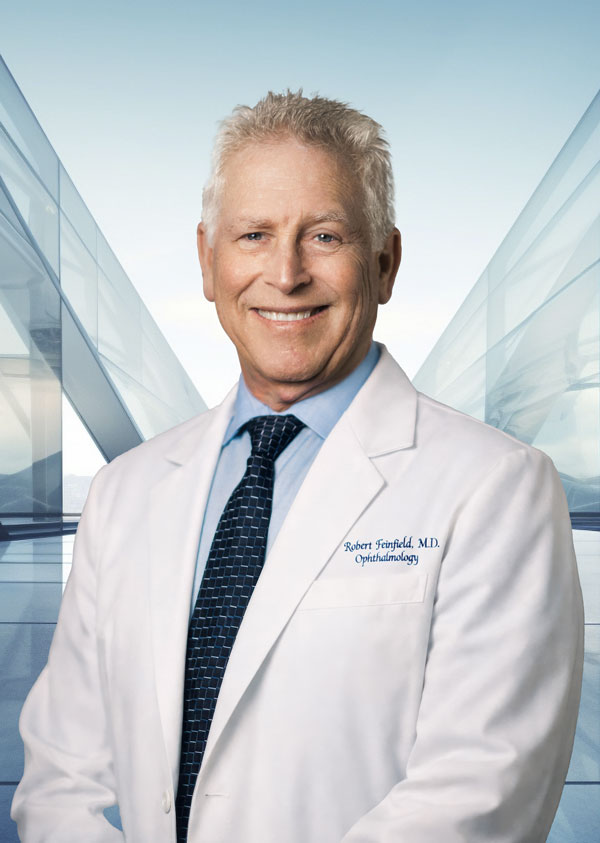
Robert Feinfield, MD
Board-Certified Ophthalmologist · Original FDA Botox Investigator · UCSF School of Medicine
Cataract surgery, cosmetic eyelid surgery (blepharoplasty), Botox, Juvéderm, Restylane, and Latisse. Available in Burbank and Sherman Oaks.
Full BioDr. Robert Feinfield is a board-certified ophthalmologist at Berg-Feinfield Vision Correction in Los Angeles. He graduated with honors from the University of California, San Francisco School of Medicine and magna cum laude from UC San Diego and the University of Bergen, Norway. He completed his ophthalmology residency at the LSU/Ochsner Eye Center in New Orleans — where the first laser vision correction surgery in the world was performed.
Dr. Feinfield has served as Chairman of Ophthalmology at Providence Saint Joseph Medical Center in Burbank and is an appointed Expert Reviewer for the Medical Board of California. He serves on the board of directors for Pacific Surgery Center and has been a consultant and instructor for Alcon Surgical, teaching cataract surgery techniques to residents. He is fluent in English and Spanish.
Beyond vision correction and cataract surgery, Dr. Feinfield is known for his expertise in cosmetic eyelid plastic surgery (blepharoplasty) and non-surgical cosmetic treatments. As one of the original FDA investigators for Botox, he has been working with botulinum toxin longer than most aesthetic injectors in Los Angeles have been practicing medicine. His approach to Botox and fillers is informed by an operating surgeon’s understanding of the facial anatomy — specifically the muscles, nerves, blood vessels, and fascial layers around the eye, brow, and midface.
Why Do Ophthalmologists Make Good Botox Injectors?
Ophthalmologists are uniquely qualified to perform facial aesthetic injections because they spend years training on the exact anatomy most commonly treated with Botox and fillers — the upper face and periorbital region. The forehead, the glabella (between the eyebrows), the crow’s feet area, the brow, the temples, and the under-eyes are the most requested treatment zones for both Botox and dermal fillers, and they are the same structures an ophthalmologist operates on for conditions like blepharospasm, strabismus, ptosis, and eyelid reconstruction.
This isn’t theoretical knowledge. It’s surgical knowledge — acquired under a microscope, refined across thousands of cases, and applied at a level of anatomical precision that most cosmetic injection training programs don’t come close to replicating. An ophthalmologist knows exactly which muscles move the brow, which nerve branches supply sensation across the forehead, and where the blood vessels run that should never be compromised with a needle.
The goal isn’t to remove all expression — it’s to preserve the expressions that make a face look like itself, while quieting the ones that make it look tired or angry. The forehead still moves. The brow stays mobile. Crow’s feet soften without flattening the smile.
What Does Botox Treat?
Botox (onabotulinumtoxinA) is an injectable neuromodulator that temporarily relaxes specific facial muscles to smooth dynamic wrinkles — lines and creases caused by repeated muscle contraction over time. At Berg-Feinfield in Los Angeles, Botox is used to treat:
- Forehead lines — horizontal lines across the forehead caused by the frontalis muscle
- Frown lines — the vertical “11” lines between the eyebrows caused by the procerus and corrugator muscles
- Crow’s feet — fan-shaped lines at the outer corners of the eyes caused by the orbicularis oculi
- Brow asymmetry and brow shaping
- Bunny lines on the nose
- Downturned mouth or “gummy smile”
Botox results typically become visible within three to seven days and last three to four months. Repeat treatments are required to maintain results, and many patients find that with consistent treatment, they need less product over time as the muscles gradually weaken from disuse.
Dr. Feinfield’s injection technique prioritizes preserving natural facial expression. In practical terms, this means the lateral brow stays mobile, the forehead can still express surprise when surprise is the point, and the result looks rested rather than frozen.
What Are Dermal Fillers and What Do They Treat?
Dermal fillers are injectable gels — most commonly hyaluronic acid (HA) — that restore volume, smooth wrinkles, and contour facial structures. Unlike Botox, which relaxes muscles, fillers physically add volume beneath the skin to replace what age, gravity, and bone resorption have taken away.
At Berg-Feinfield’s Los Angeles offices, Dr. Feinfield uses the full Juvéderm and Restylane product families, selecting the specific formulation based on the treatment zone and the patient’s anatomy. Treatment areas include:
- Cheeks and midface — to restore projection and lift that diminishes with age
- Under-eyes and tear troughs — one of the highest-risk and most technically demanding injection zones on the face
- Nasolabial folds — lines running from the nose to the corners of the mouth
- Lips — volume enhancement and border definition
- Jawline and chin — contour and structural support
- Temples — where volume loss creates a hollowed, aged appearance
Results are visible immediately and typically last six months to two years depending on the product used, the treatment area, and the patient’s metabolism.
What Is the Difference Between Botox and Fillers?
Botox and dermal fillers are complementary treatments that address different causes of facial aging.
Botox
Relaxes muscles that cause dynamic wrinkles — the lines created by repeated facial movement such as frowning, squinting, and raising the eyebrows. Results in 3–7 days, lasts 3–4 months.
Juvéderm & Restylane
Replaces volume lost through aging, adding structure and fullness to areas that have deflated or descended. Immediate results, lasts 6–24 months depending on formulation and area.
Many patients in Los Angeles benefit from both. A typical combination at Berg-Feinfield might include Botox to the forehead and crow’s feet to soften expression lines, paired with filler to the cheeks and tear troughs to restore midface volume. The two treatments work on different mechanisms and are often performed in the same visit.
Why Is Under-Eye Filler Risky and Why Does Injector Expertise Matter?
The under-eye and tear trough area is considered one of the highest-risk zones for dermal filler injection. The skin is extremely thin, the tissue has minimal fat between the skin surface and the underlying bone, and the area is dense with blood vessels — including branches of the angular artery and inferior palpebral arteries. Injecting too superficially causes visible lumps and a bluish discoloration (the Tyndall effect). Injecting too deep or in the wrong plane risks vascular occlusion.
This is exactly where an ophthalmologist’s background becomes the most relevant differentiator. Dr. Feinfield has performed thousands of surgical procedures on the eyelids and periorbital region — he knows the tissue planes, the vascular anatomy, and the structural variations between patients at a level that can’t be replicated in a weekend injection course. Under-eye filler at Berg-Feinfield is placed conservatively, in the appropriate tissue plane, by a physician whose primary specialty is operating on this exact anatomy.
Frequently Asked Questions
What facial aesthetics services are available at Berg-Feinfield in Los Angeles?
Berg-Feinfield offers ophthalmologist-led facial aesthetics at their Burbank and Sherman Oaks locations in Los Angeles. Available treatments include Botox for dynamic wrinkles of the upper face, Juvéderm and Restylane dermal fillers for volume restoration and facial contouring, cosmetic eyelid surgery (blepharoplasty) for upper and lower lid rejuvenation, and Latisse for eyelash growth. All injectable treatments are performed personally by Dr. Robert Feinfield — not delegated to a nurse injector, physician assistant, or aesthetician.
How long does Botox last?
Botox results typically become visible within three to seven days after injection and last three to four months. Repeat treatments are needed to maintain the result. Many patients find that with consistent, regular Botox treatment, they gradually need less product as the targeted muscles weaken from disuse over time.
How long do dermal fillers last?
Dermal filler results are visible immediately and typically last six months to two years, depending on the specific product used, the treatment area, and the individual patient’s metabolism. Lip fillers tend to metabolize faster (6–12 months), while cheek and jawline fillers often last 12–24 months.
Can Botox and fillers be done at the same appointment?
Yes. Botox and dermal fillers address different causes of facial aging and are frequently performed in the same visit at Berg-Feinfield. A typical combination might include Botox to the forehead and crow’s feet paired with filler to the cheeks and tear troughs. Dr. Feinfield will recommend the appropriate combination based on your anatomy and goals during your consultation.
Is under-eye filler safe?
Under-eye filler is safe when performed by an injector with advanced knowledge of periorbital anatomy. The tear trough area is considered high-risk because the skin is thin, vasculature is dense, and there is minimal tissue between the surface and the bone. Complications from inexperienced injectors include visible lumps, the Tyndall effect (bluish discoloration), and vascular occlusion. At Berg-Feinfield, under-eye filler is performed by Dr. Feinfield, an ophthalmic surgeon whose primary specialty is operating on this exact anatomy.
Who should consider an ophthalmologist for Botox and fillers in Los Angeles?
A consultation at Berg-Feinfield is particularly appropriate for patients who want Botox or fillers performed by a physician with surgical training in facial anatomy rather than a nurse injector or aesthetician; are interested in under-eye filler, brow treatment, or any periorbital injection; have had a previous result that looked overdone or frozen and want a more conservative, anatomy-first approach; are considering cosmetic eyelid surgery and want to explore injectables first; or simply want the confidence that their injector has been working with these products for nearly 40 years.
