

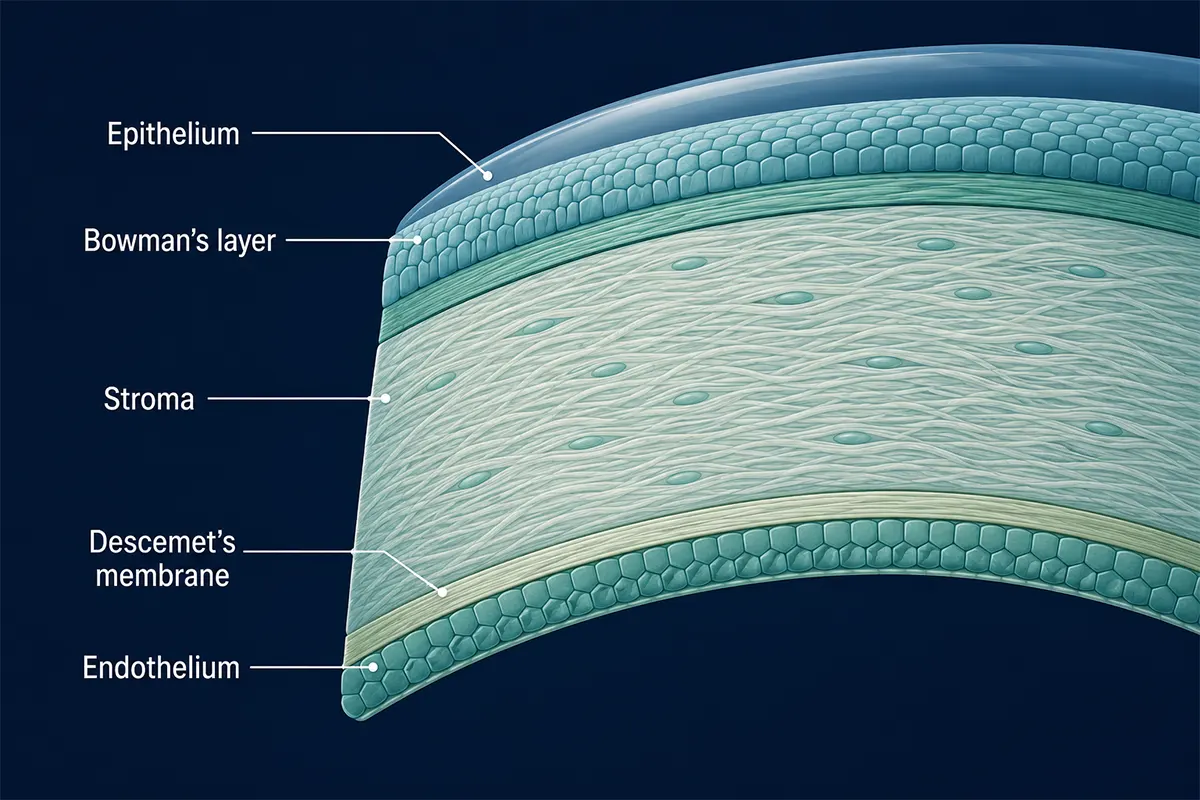
The cornea is the clear front surface of the eye. When it is healthy, light enters the eye cleanly and focuses properly. When the cornea becomes infected, swollen, scarred, irregular, or damaged, vision can become blurry, distorted, painful, or cloudy.
Because the cornea plays such an important role in focusing vision, corneal symptoms should not be ignored. Some conditions develop gradually over years. Others, such as a corneal ulcer, can progress quickly and require urgent care.
At Berg-Feinfield Vision Correction, patients in Los Angeles have access to advanced cornea evaluation and treatment for conditions such as corneal ulcers, pterygium, Fuchs’ dystrophy, corneal scarring, and corneal transplant needs.
What Does the Cornea Do?
The cornea is the transparent, dome-shaped tissue at the front of the eye. It protects the eye and helps focus light onto the retina. Even small changes in the cornea can have a major effect on vision.
When the cornea is damaged, patients may experience symptoms such as blurry vision, glare, halos, redness, pain, tearing, light sensitivity, or a foreign body sensation. In some cases, patients notice a visible spot, haze, scar, or growth on the eye.
A painful red eye should never be ignored.
If you have eye pain, light sensitivity, blurred vision, discharge, or a white spot on the cornea, you should seek prompt evaluation.
Cornea Care with Bonnie Sklar, MD

Bonnie Sklar, MD
Cornea · External Disease · Cataract & Refractive Surgery
Dr. Sklar provides advanced care for corneal disease, including corneal infections, Fuchs’ dystrophy, pterygium, corneal scarring, and corneal transplant evaluation.
Full BioCornea specialists receive advanced training in the diagnosis and treatment of diseases affecting the cornea and the surface of the eye. This includes infections, inflammatory conditions, corneal dystrophies, corneal scars, degenerations, and surgical treatments such as corneal transplantation.
1. Corneal Ulcer: A Serious Eye Emergency
A corneal ulcer is an open sore on the cornea, often caused by infection. It may develop after a scratch, contact lens complication, trauma, severe dry eye, or exposure to bacteria, viruses, fungi, or parasites.
Symptoms may include:
- Eye pain, often moderate to severe
- Redness that does not quickly improve
- Light sensitivity or difficulty keeping the eye open
- Blurred vision or a sudden decrease in vision
- Tearing or discharge
- A white, gray, or cloudy spot on the cornea
Contact lens wearers should be especially cautious. Sleeping in contact lenses, poor lens hygiene, swimming in contacts, or overwearing lenses can increase the risk of corneal infection.
Bottom line: a corneal ulcer can threaten vision if not treated quickly. If you have symptoms of a corneal ulcer, schedule an urgent eye evaluation.
2. Pterygium: A Growth on the Surface of the Eye
A pterygium is a raised, fleshy growth that starts on the white part of the eye and may extend onto the cornea. It is sometimes associated with long-term exposure to sunlight, wind, dust, and dry conditions.
In Southern California, pterygium can be common among people who spend significant time outdoors, including beachgoers, golfers, runners, cyclists, construction workers, and anyone with frequent UV exposure.
A pterygium may cause:
- Chronic redness or irritation
- Burning, dryness, or foreign body sensation
- A visible growth on the eye
- Blurred or distorted vision if it grows onto the cornea
- Cosmetic concern because of the appearance of the eye
Not every pterygium requires surgery. Mild cases may be monitored or treated with lubrication and anti-inflammatory medications. If the growth becomes visually significant, chronically inflamed, or cosmetically bothersome, pterygium surgery may be recommended.
3. Fuchs’ Dystrophy: Cloudy Vision from Corneal Swelling
Fuchs’ dystrophy is a progressive corneal condition that affects the endothelium, the inner layer of cells that helps keep the cornea clear. When these cells weaken, fluid can build up in the cornea, causing swelling and cloudy vision.
Patients with Fuchs’ dystrophy often notice that their vision is worse in the morning and improves as the day goes on. Over time, the cloudy vision may become more constant.
Symptoms may include:
- Cloudy or hazy vision
- Morning blur that gradually improves
- Glare or halos around lights
- Difficulty with night driving
- Fluctuating vision
- Eye discomfort or a gritty sensation
Early Fuchs’ dystrophy may be monitored or managed with medication. More advanced cases may require a partial-thickness corneal transplant procedure that replaces the unhealthy inner layer of the cornea.
4. Corneal Transplant: When the Cornea Cannot Stay Clear
A corneal transplant may be recommended when the cornea is too scarred, swollen, irregular, or damaged to provide clear vision. The goal is to replace diseased corneal tissue with healthy donor tissue.
Modern corneal transplantation is not one single procedure. The right technique depends on which layer of the cornea is affected and how advanced the disease has become.
Endothelial Keratoplasty
Used for conditions affecting the inner corneal layer, such as advanced Fuchs’ dystrophy. These procedures replace the diseased inner layer while leaving healthy corneal tissue intact.
Penetrating Keratoplasty
Used when deeper or more extensive corneal damage requires replacement of the full corneal thickness.
A corneal transplant may be considered for advanced Fuchs’ dystrophy, corneal scarring, severe keratoconus, prior trauma, corneal swelling after surgery, or certain infections after the eye has stabilized.
When Should You See a Cornea Specialist?
You may need to see a cornea specialist if you have symptoms or a diagnosis involving the front surface of the eye. Some patients are referred by their optometrist or general ophthalmologist. Others seek care because their symptoms are persistent, worsening, or interfering with daily activities.
Common reasons to schedule a cornea evaluation include:
- Persistent eye pain, redness, or irritation
- Cloudy, hazy, or fluctuating vision
- Light sensitivity
- A visible growth, white spot, scar, or haze on the eye
- History of contact lens complications
- Known Fuchs’ dystrophy, keratoconus, or corneal scarring
- Need for corneal transplant evaluation
- Second opinion for a corneal diagnosis
Corneal conditions can often be treated more effectively when diagnosed early. A thorough evaluation may include slit-lamp examination, corneal imaging, corneal thickness measurements, tear film evaluation, and other diagnostic testing based on your symptoms.
Frequently Asked Questions
Schedule a Cornea Evaluation
If you have eye pain, redness, cloudy vision, corneal disease, or have been told you may need a corneal transplant, Berg-Feinfield can help.