Low-to-Moderate Prescription
If your nearsightedness, farsightedness, or astigmatism falls in the range LASIK treats well, it's a proven, efficient solution.

LASIK reshapes your cornea with a laser. EVO ICL adds a tiny, reversible lens inside your eye — no corneal tissue removed. Both deliver excellent vision, but they suit different eyes. Berg-Feinfield offers both in Los Angeles, so your recommendation is matched to your eyes, not to the one procedure a clinic happens to sell.


LASIK permanently reshapes the cornea with a laser to correct nearsightedness, farsightedness, and astigmatism. It's the fastest, most familiar option for people with healthy, adequately thick corneas and low-to-moderate prescriptions.
EVO ICL is an implantable collamer lens — a tiny, soft lens placed inside the eye, in front of your natural lens. It removes no corneal tissue, is removable and reversible, and shines for higher prescriptions, thinner corneas, and dry eyes. One important difference: EVO ICL corrects nearsightedness and astigmatism, but not farsightedness. The right choice comes down to your prescription, corneal thickness, tear film, and anatomy.
Compare Side by SideTwo excellent, FDA-approved procedures that reach the same goal by very different routes. Here's how they compare — and what each difference means for you.
| LASIK | EVO ICL | |
|---|---|---|
| How it works | A laser reshapes the cornea | A tiny lens is placed inside the eye, in front of the natural lens |
| Corneal tissue | Reshaped — a permanent change | None removed — the cornea is untouched |
| Reversible? | No — permanent | Yes — the lens can be removed or replaced |
| Corrects | Nearsightedness, farsightedness & astigmatism | Nearsightedness & astigmatism (not farsightedness) |
| Prescription range | Low to moderate | Moderate to very high myopia |
| Best for | Healthy corneas of adequate thickness | Thin corneas, high prescriptions, dry eye |
| Dry eye | Can temporarily increase dryness | Doesn't affect the corneal surface — friendly to dry eyes |
| Procedure | Corneal laser, about 15 minutes | Intraocular lens implant, about 20–30 minutes |
| Visual recovery | Sharp for most by the next morning | Sharp within a day or two |
| Long-term results | Both excellent — EVO ICL adds the option to remove or update the lens if your needs change | |
Neither is “better” in the abstract — the right one depends on your prescription, corneal thickness, tear film, and eye anatomy. A refractive evaluation with corneal mapping is how we determine which fits your eyes. Learn more about EVO ICL.
For many candidates with healthy corneas and moderate prescriptions, LASIK is the fastest, most straightforward path to clear vision.
If your nearsightedness, farsightedness, or astigmatism falls in the range LASIK treats well, it's a proven, efficient solution.
LASIK needs adequate corneal thickness to reshape safely. If your mapping confirms it, you have the full range of options.
LASIK treats hyperopia (farsightedness); EVO ICL does not. If that's your prescription, LASIK is the laser option.
EVO ICL isn't a “backup” to LASIK — for the right eyes it's the superior option, and it's reversible. Learn more about EVO ICL.
EVO ICL corrects a wider range of nearsightedness than LASIK, including very high myopia that lasers can't safely address.
Because no corneal tissue is removed, EVO ICL is an excellent option when your cornea is too thin for LASIK.
EVO ICL doesn't touch the corneal surface or its nerves, so it's often the more comfortable choice for patients prone to dry eye.
The lens can be removed or updated if your vision needs change over time — a flexibility LASIK's permanent reshaping can't offer.
Many EVO ICL patients report crisp, high-quality vision, and the collamer lens blocks UV light.
EVO ICL is designed for adults in this range with a stable prescription — your evaluation confirms candidacy.
Berg-Feinfield's refractive surgery is led by co-founder Dr. Alan M. Berg, who has performed corneal and refractive surgery in Southern California for more than 30 years — and offers both LASIK and EVO ICL.
Because we perform LASIK and EVO ICL — plus PRK and refractive lens exchange — our recommendation is driven by your eyes, not by the one procedure a clinic is set up to sell.
Co-founder of Berg-Feinfield, among the first in Southern California to offer corneal cross-linking, and a surgical educator who has trained ophthalmologists nationally.
Your evaluation includes detailed corneal tomography and pachymetry — the measurements that actually determine whether LASIK or EVO ICL is right for you.
We'll tell you honestly which procedure suits your eyes — or if you're better served by an alternative or by waiting.
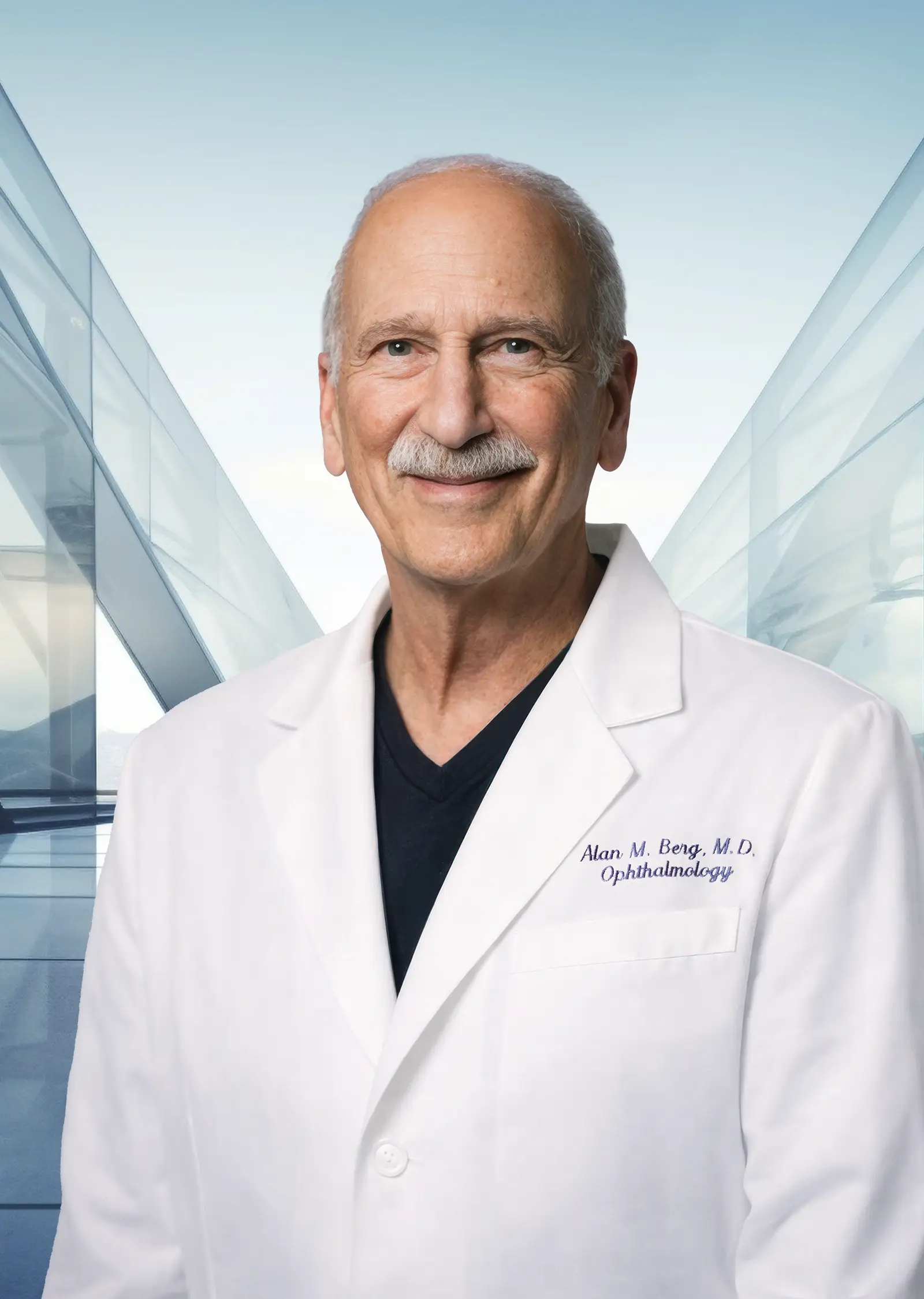
A Berg-Feinfield evaluation measures your eyes and gives you an honest recommendation — LASIK, EVO ICL, or another option. Five Los Angeles-area locations, one straight answer.