If you are experiencing progressive blurriness, extreme light sensitivity, or frustrating changes to your eyeglass prescriptions, you may be living with keratoconus. Specialized care — and a clear path forward — is here.
To understand keratoconus, it helps to first understand the anatomy of the eye. The cornea is the clear, dome-shaped front window of your eye. It is primarily made up of a highly organized matrix of collagen fibers. The cornea’s primary job is to bend, or refract, light rays so that they focus precisely on the retina at the back of the eye, giving you a sharp, clear image.
Keratoconus is a progressive, non-inflammatory eye disease where the collagen fibers in the cornea weaken. As the structural integrity of the cornea breaks down, it gradually thins and bulges outward into an irregular, cone-like shape.
Because the cornea is responsible for focusing light, this newly distorted shape scatters light as it enters the eye, preventing it from focusing properly on the retina. The result is significant visual impairment that cannot be easily corrected with standard eyeglasses.
Early diagnosis of keratoconus is absolutely critical. Because it is a progressive disease, catching it early allows us to implement treatments that can halt the thinning process before severe vision loss occurs.
Keratoconus typically begins to manifest in a person’s late teens or early twenties, though it can start at any age. Symptoms often progress slowly for 10 to 20 years before eventually stabilizing. Common signs include:
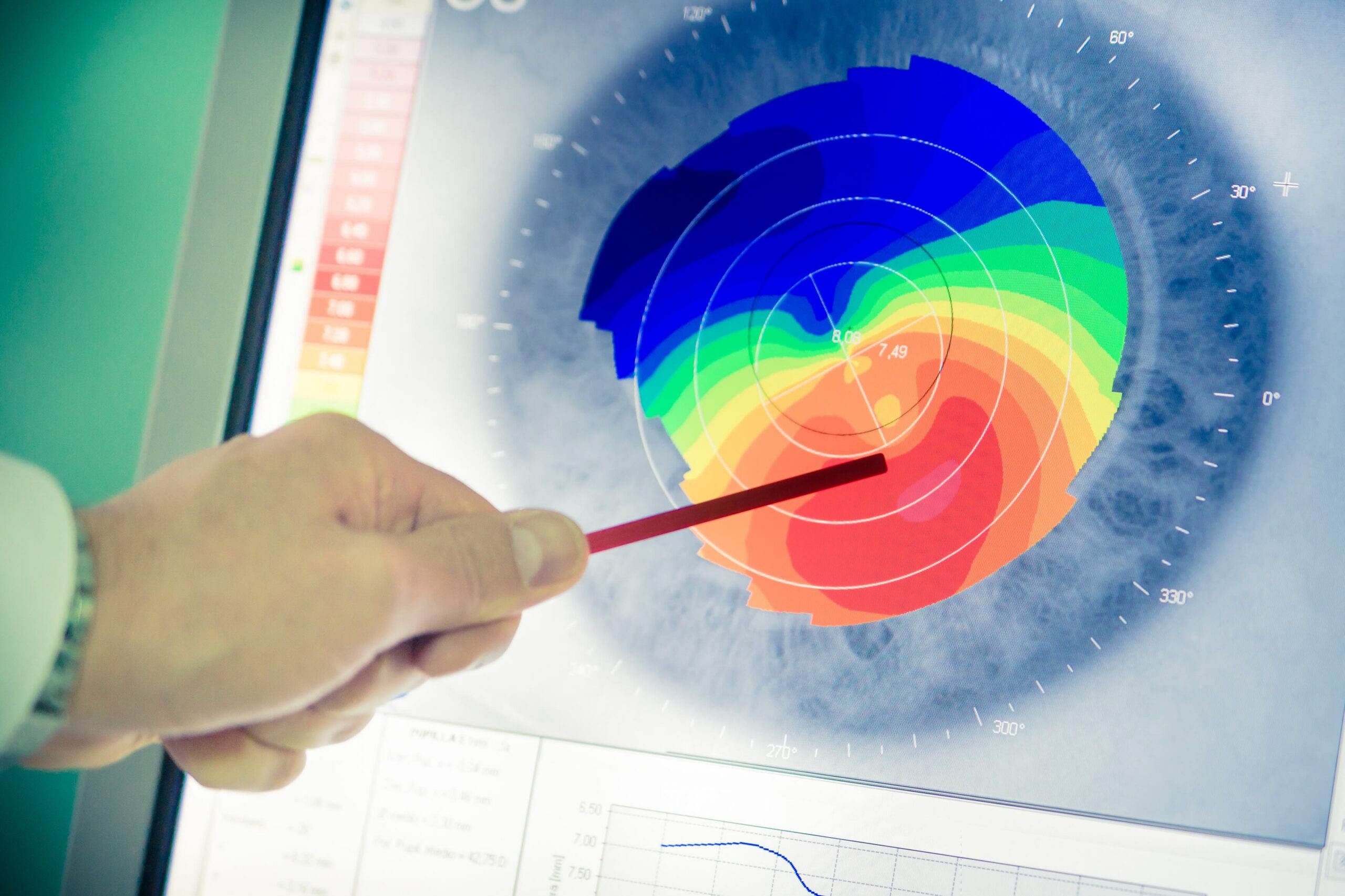
Using advanced corneal mapping technology — corneal topography — our Los Angeles eye specialists can detect the earliest, microscopic signs of the disease long before the patient notices significant vision loss.
Topography creates a highly detailed 3D map of the surface of your eye, allowing us to measure corneal thickness and identify the characteristic steepening of a keratoconic cornea.
While the exact cause remains a subject of ongoing research, clinical studies suggest it is linked to a complex combination of genetic predispositions, cellular imbalances, and environmental factors.
Managing a complex condition like keratoconus requires specialized expertise that goes beyond a standard routine eye exam. Our keratoconus team combines decades of surgical experience with fellowship-level corneal specialization.
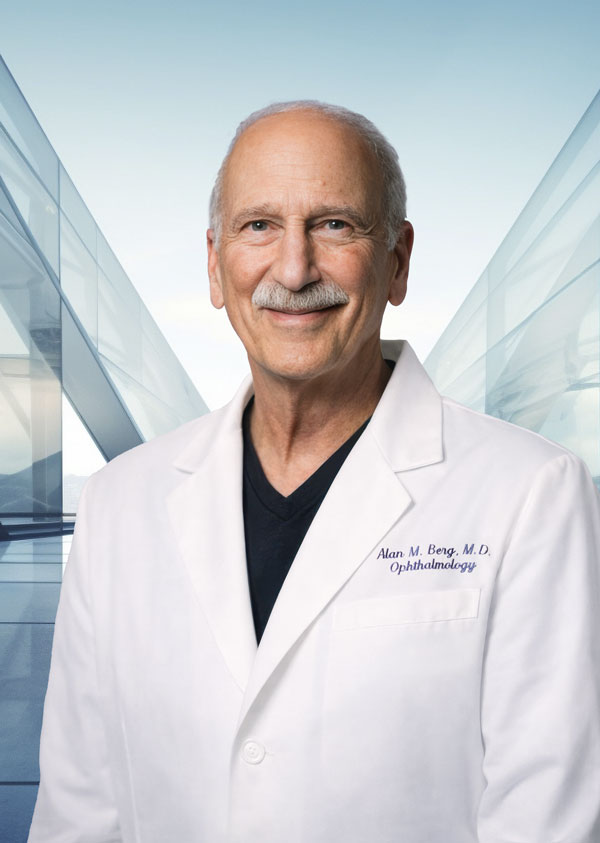
Dr. Alan M. Berg is the co-founder of Berg-Feinfield Vision Correction and the practice’s primary surgeon for corneal cross-linking. Widely recognized as one of the most experienced keratoconus and corneal specialists in the Los Angeles area, Dr. Berg has dedicated decades to the diagnosis, monitoring, and treatment of progressive corneal disease. His expertise spans the full continuum of keratoconus care, from advanced corneal imaging and early topographic surveillance to cross-linking, specialty contact lens guidance, and corneal transplantation for advanced cases.
Dr. Berg was among the first ophthalmologists in Southern California to offer Glaukos’s original iLink CXL platform, and he continues to lead the practice’s cross-linking program with extensive experience in today’s evolving treatment options, including Epioxa epi-on therapy. Over the course of his career, he has also helped train and mentor numerous physicians, residents, and colleagues who have gone on to lead practices and programs of their own across the country.

Dr. Bonnie Sklar is Berg-Feinfield Vision Correction’s fellowship-trained cornea specialist with expertise in the medical and surgical management of complex corneal disease. Her clinical focus includes keratoconus evaluation and co-management, corneal transplantation procedures such as DMEK, DSEK, and PKP, complex anterior segment surgery, ocular surface disease, and cataract surgery with advanced technology lenses. She plays an important role in delivering comprehensive corneal care and helping patients navigate the most appropriate treatment pathway for their condition.
In addition to her clinical work, Dr. Sklar has performed sight-restoring surgeries on humanitarian medical missions in Honduras, Sierra Leone, Kenya, and Mongolia. She has also contributed to the field through peer-reviewed publications and presentations at national ophthalmology conferences, reflecting her ongoing commitment to clinical excellence and academic medicine.
At Berg-Feinfield, we offer the most effective, FDA-approved treatments tailored specifically to the severity of your unique condition. Our goal is twofold: stop the disease from getting worse, and rehabilitate your vision.
From the gold-standard corneal cross-linking procedure — now available in its newest, less invasive epi-on form — to custom specialty contact lenses that restore crisp clarity after your cornea is stabilized, we offer a comprehensive and coordinated approach to your care.
The right treatment depends on your disease severity, corneal thickness, age, and individual profile. Every patient receives a personalized roadmap built around their specific topography and visual goals — not a generic protocol.
For decades, the only solution for severe keratoconus was a highly invasive corneal transplant. Today, we can often stop the disease in its tracks with corneal cross-linking — a revolutionary outpatient procedure designed to strengthen the cornea and prevent further thinning or bulging.
At Berg-Feinfield, we are proud to stay at the cutting edge of eye care by offering the newer, less invasive Epi-On method of CXL. Also known as transepithelial cross-linking, the Epi-On approach offers all the biomechanical benefits of traditional cross-linking — but without the need to surgically scrape away the outer epithelial layer of the cornea. Specialized formulations of Riboflavin penetrate the intact outer layer of the eye on their own.
Berg-Feinfield is the first practice in Los Angeles to offer Epioxa — the FDA-approved epi-on cross-linking treatment for keratoconus. If you’ve been putting off treatment because of concerns about recovery, this changes everything.
Corneal cross-linking is one of the most important advances in keratoconus care because it can stop the disease from getting worse. However, it is not designed to function like LASIK or other vision-correcting procedures. The goal of cross-linking is to stabilize the cornea and protect the vision you have. After treatment, some patients may still need additional visual rehabilitation because standard glasses or soft contact lenses often cannot fully correct the irregular corneal shape caused by keratoconus. Rather than performing specialty contact lens fittings in our office, we partner with multiple trusted optometric and specialty lens practices to help ensure each patient is connected with the most appropriate ongoing visual care.
In the past, Intacs — intrastromal corneal ring segments — were surgically implanted into the eye to physically flatten the cornea and improve vision. For many years, they were a standard part of the keratoconus treatment toolkit.
However, as keratoconus treatments have rapidly advanced, our clinic has phased out Intacs in favor of safer, more predictable methods. Over years of clinical observation, it became clear that Intacs often lacked sustained long-term efficacy and carried unnecessary surgical risks — including ring extrusion, deep ocular infection, and visually disruptive corneal haze.
Today, combining modern Corneal Cross-Linking (to stabilize the eye) with advanced Scleral Lenses (to perfect the vision) provides vastly superior, customizable, and less invasive outcomes for our Los Angeles patients.
The combination of modern Corneal Cross-Linking — particularly the new Epi-On Epioxa approach — with custom Scleral Lens fitting represents the current standard of care for keratoconus management.
This approach addresses both goals simultaneously: stopping the disease from progressing and restoring the vision that has been lost. For the vast majority of patients, it is a dramatically better experience than the surgical approaches that preceded it.
You are not just a set of eyes to us. You are a patient whose quality of life we are dedicated to restoring.
Berg-Feinfield Vision CorrectionLiving with keratoconus can take a toll on your day-to-day life. From the frustration of constantly changing prescriptions to the anxiety of driving at night with severe glare and halos, the condition impacts more than just your eyes — it impacts your independence.
The feeling that no glasses will ever give you a clear image. The hesitation before getting behind the wheel after dark. The concern about what the next eye exam will show. These are real experiences shared by keratoconus patients across Los Angeles every day.
Our team at Berg-Feinfield understands the emotional weight of a keratoconus diagnosis. We take the time to sit down with you, explain your corneal topography in easy-to-understand terms, and build a comprehensive treatment roadmap together. Whether you need monitoring, cross-linking, specialty lenses, or a combination — we will guide you through every decision, every step of the way.
If you have been diagnosed with keratoconus, or if you are experiencing the frustrating symptoms of progressive vision loss, proactive, specialized treatment is the key to preserving your eyesight for the future. With state-of-the-art facilities across five Los Angeles area locations, Berg-Feinfield is your trusted partner for world-class corneal care.