Everything you want to know about LASIK — candidacy, cost, technology, recovery, and how Berg-Feinfield approaches your care from consultation through clarity.
If you are considering LASIK in Los Angeles, you are not alone — it is one of the most commonly performed elective procedures in the world. Here is what you need to know before your consultation.
LASIK stands for Laser-Assisted In Situ Keratomileusis. It is a laser vision correction procedure that permanently reshapes the cornea — the clear dome at the front of your eye — to reduce or eliminate refractive error. By improving the way light focuses on the retina, LASIK can dramatically reduce or eliminate your dependence on glasses or contact lenses.
The procedure works in three steps: a thin corneal flap is created using a femtosecond laser, an excimer laser precisely reshapes the underlying corneal tissue based on your measurements, and the flap is then repositioned to heal naturally — no stitches required.
LASIK is FDA-approved to treat the three most common refractive errors:
At your consultation, your surgeon will evaluate your prescription and eye anatomy to confirm that LASIK is the right fit — or whether another procedure such as PRK or EVO ICL may serve you better.
LASIK primarily corrects distance refractive errors. If you are over 40 and experiencing presbyopia — the age-related loss of near focus — you may still need reading glasses after surgery, even if your distance vision becomes excellent.
That said, your consultation is the right time to discuss your complete visual goals. Options like monovision LASIK — where one eye is corrected for distance and one for near — or Refractive Lens Exchange with a multifocal lens may offer a broader solution depending on your age and lifestyle.
Yes. The lasers and diagnostic technology used at Berg-Feinfield for LASIK are FDA-approved for vision correction procedures. This includes both the femtosecond laser used to create the corneal flap and the excimer laser used to reshape the corneal tissue.
FDA approval means that the technology has gone through rigorous clinical trials demonstrating both safety and effectiveness for the treatment of nearsightedness, farsightedness, and astigmatism.
Not everyone is a LASIK candidate — and that is not a bad thing. Knowing whether LASIK is right for you starts with a comprehensive evaluation of your eyes. Here is what the screening process considers.
Good LASIK candidates are generally adults whose prescriptions have been stable for at least one to two years, with healthy eyes and adequate corneal thickness to support safe treatment. Candidacy criteria typically include:
During your LASIK consultation at Berg-Feinfield, your eyes will be evaluated across a range of important factors:
This data — gathered with advanced diagnostic technology — determines whether LASIK is appropriate and, if so, what treatment parameters will be used. Schedule your evaluation here.
There is no single “perfect” age for LASIK. Most candidates are adults in their 20s, 30s, or 40s whose prescriptions have stabilized, but there is no strict upper age limit. Berg-Feinfield specifically notes that many patients in their 50s, 60s, and beyond can still be strong LASIK candidates when their eyes are otherwise healthy.
For patients over 50, the conversation often expands to include Refractive Lens Exchange (RLE), which addresses both refractive error and the early onset of lens changes that naturally occur with age. Your consultation will help determine which approach fits your stage of life best.
Not qualifying for LASIK is more common than most people realize — and it does not mean you are stuck with glasses or contacts. Berg-Feinfield offers several alternatives depending on why LASIK is not the right fit:
Berg-Feinfield will recommend the procedure that best matches your eye anatomy and visual goals — not simply the one you came in asking about.
The technology used for LASIK matters — for precision, customization, and the quality of your outcome. Berg-Feinfield uses a fully bladeless, all-laser approach with diagnostic and treatment systems that set the standard for modern LASIK.
Yes. Berg-Feinfield performs bladeless, all-laser LASIK as its standard approach. A femtosecond laser is used to create the corneal flap — replacing the mechanical microkeratome blade used in older LASIK techniques.
Bladeless flap creation offers more consistent flap thickness, a more predictable flap edge, and is associated with a lower risk of flap-related complications compared to blade-based methods. For the vast majority of LASIK candidates, it represents the current best practice.
Advanced LASIK technology improves three critical aspects of treatment: diagnostic precision, treatment customization, and execution accuracy. Diagnostic platforms like iDesign 2 capture a far more detailed picture of your eye’s unique optics than standard refraction — meaning the treatment plan is built on richer data. Laser delivery systems with integrated tracking ensure that plan is executed accurately, even if your eye moves during treatment.
Taken together, advanced technology helps optimize outcomes, reduce residual prescription error, and improve the quality of your vision beyond just clarity — including contrast sensitivity, night vision, and glare reduction.
Most patients tell us the procedure was far easier than they expected. Here is an honest, step-by-step look at what happens on the day of your surgery.
The LASIK procedure at Berg-Feinfield follows a consistent, carefully orchestrated sequence — from the moment you sit in the chair to the moment you walk out. Here is exactly what to expect.
Most patients are genuinely surprised by how painless the procedure is. Numbing eye drops eliminate pain during the surgery itself. You may feel mild pressure or a sensation of suction when the femtosecond laser creates the corneal flap — this is normal and lasts only a few seconds.
Immediately after surgery, some patients notice a scratchy sensation, watering, or mild irritation. These symptoms typically peak within the first hour and improve significantly by the next morning.
The laser application itself is remarkably fast — typically 20 to 50 seconds per eye, depending on your prescription. The full treatment for both eyes takes less than 15 minutes of total laser time.
Plan to be in the office for approximately one hour total, which includes pre-operative preparation, the procedure, initial post-op assessment, and discharge instructions.
In most cases, yes. Berg-Feinfield typically treats both eyes on the same day, which minimizes disruption to your schedule and allows both eyes to heal together. The final decision is always made individually based on your specific prescription, eye health, and surgeon recommendation — and will be discussed in detail at your pre-operative consultation.
You can drive yourself to your appointment, but you will need someone to drive you home. Vision can be blurry immediately after the procedure, and some patients receive a mild oral sedative before surgery. Plan to have a friend, family member, or rideshare available for the ride home. Most patients can drive again by the following day after their post-op evaluation confirms adequate vision.
LASIK recovery is one of the fastest in elective surgery. Most patients see dramatically better within 24 hours and return to most activities within days. Here is what the healing timeline looks like.
Most patients notice significantly improved vision within hours of the procedure — often before they even leave the office. By the morning after surgery, the majority of LASIK patients see clearly enough to drive (after their post-op clearance appointment) and return to most normal activities.
Final visual stabilization varies by individual and prescription. Some patients reach their best vision within days; for others, it takes a few weeks for the eyes to fully settle. Mild fluctuations during this period are completely normal.
Many patients return to work within one to two days. Berg-Feinfield asks that you complete your one-day follow-up appointment before resuming work, especially for jobs with high visual demands. If your work involves heavy screen time, dusty or dirty environments, or contact with the public, your surgeon may have specific guidance for your situation.
After LASIK you will typically be prescribed a short course of antibiotic drops to prevent infection and anti-inflammatory drops to support healing — generally used for about one week. Preservative-free artificial tears are also strongly recommended for dry eye management and are often used for several months during the healing process.
Your care team at Berg-Feinfield will provide a complete post-operative drop schedule at discharge and review it at your follow-up visits.
LASIK has one of the strongest long-term safety records of any elective surgical procedure. Understanding potential side effects and how often serious complications occur helps you make a confident, informed decision.
Yes — LASIK is widely regarded as a safe procedure for properly screened candidates, and its safety record has improved significantly over the past two decades alongside advances in diagnostic technology and laser systems. The most important safety factor is thorough pre-operative screening: ruling out conditions like keratoconus, thin corneas, or significant dry eye before proceeding.
Berg-Feinfield uses FDA-approved technology and a fully bladeless, computer-guided approach. Careful candidate selection and adherence to post-operative instructions are the most powerful tools for minimizing risk.
Most side effects are temporary and resolve as the eye heals. Common ones include:
These effects are most prominent in the first days to weeks after surgery and typically improve as healing progresses. Artificial tear use significantly reduces dryness-related discomfort for most patients.
No — serious complications from LASIK are uncommon, particularly when patients are carefully screened beforehand and follow post-operative instructions carefully. The most significant risk reduction comes from pre-operative screening: identifying patients with undiagnosed keratoconus, insufficient corneal thickness, or active dry eye disease, and redirecting them to more appropriate treatment options.
At Berg-Feinfield, patients are closely monitored throughout recovery, and the care team is available to address any concerns that arise during healing. If you have a specific concern based on your eye history, bring it to your consultation — it is exactly the right place to have that conversation.
LASIK is excellent — but it is not the right answer for every patient. Berg-Feinfield offers the full range of refractive options so that the recommendation is always based on your eyes, not on what is simplest to offer.
| Procedure | How It Works | Best For | Learn More |
|---|---|---|---|
| LASIK | Femtosecond laser creates a corneal flap; excimer laser reshapes tissue underneath; flap repositioned to heal | Stable prescription, adequate corneal thickness, no significant dry eye — the broadest candidate pool of all laser procedures | LASIK Los Angeles |
| PRK | No flap created; laser applied directly to the corneal surface after epithelium is removed; surface heals over several days | Thinner corneas, patients with certain contact sports or occupational factors, those who want to avoid any flap-related risk | PRK Surgery |
| EVO ICL | A small corrective lens is implanted inside the eye, in front of the natural lens — no corneal tissue is removed | Higher prescriptions, patients with dry eye concerns, thinner corneas that cannot safely support laser reshaping | EVO ICL |
| Refractive Lens Exchange | The natural lens is removed and replaced with an advanced artificial IOL — similar to cataract surgery, performed electively | Patients over 45–50, those with early lens changes, or anyone seeking to address both refractive error and future cataract risk simultaneously | Refractive Lens Exchange |
Both LASIK and PRK use an excimer laser to reshape the cornea and correct refractive error — the key difference is how the cornea is accessed. LASIK creates a thin flap that is lifted, treated, and repositioned. PRK treats the corneal surface directly after the epithelium (the outermost cell layer) is removed, which then regrows naturally over several days.
PRK recovery takes longer — typically one to two weeks for initial clarity compared to one to two days with LASIK — but outcomes are equivalent for most patients. PRK may be preferred for patients with thinner corneas, certain occupations, or contact sports where a flap poses theoretical risk.
EVO ICL (Implantable Collamer Lens) does not reshape the cornea at all — a small, flexible corrective lens is placed inside the eye between the iris and the natural lens. No corneal tissue is removed, making it a strong option for patients with higher prescriptions, borderline corneal thickness, or significant dry eye that might be worsened by laser surgery.
EVO ICL is also reversible, whereas LASIK permanently alters corneal tissue. For the right candidate, it offers excellent visual quality and a faster return of crisp vision, often with superior performance in low-light conditions compared to laser procedures.
Refractive Lens Exchange (RLE) replaces the eye’s natural lens with a precision artificial intraocular lens (IOL). Because the natural lens is removed, the eye can never develop a cataract — effectively combining refractive correction with lifetime cataract prevention in one procedure.
RLE is typically best suited for patients in their mid-40s and beyond who are beginning to develop presbyopia (difficulty reading) or early lens changes, and who want a comprehensive solution that LASIK alone cannot fully address. Your Berg-Feinfield surgeon will help you understand which approach aligns best with where your eyes are today — and where they are headed.
LASIK is an investment in your long-term vision. Understanding what drives cost — and what options exist for making it accessible — helps you plan with confidence.
The cost of LASIK in Los Angeles varies depending on several factors specific to your case and your chosen provider:
Be cautious of unusually low advertised prices, which often do not include pre-operative evaluation, post-operative visits, or the cost of an enhancement if needed. A complete cost picture should include all of these elements.
For pricing details specific to Berg-Feinfield, visit the LASIK Cost in Los Angeles page.
LASIK is considered an elective procedure and is not covered by most standard health insurance plans. However, patients with FSA (Flexible Spending Account) or HSA (Health Savings Account) benefits can typically use those pre-tax dollars to pay for LASIK — effectively reducing the out-of-pocket cost by whatever your marginal tax rate is.
Some vision insurance plans offer a LASIK discount benefit through contracted providers. It is worth checking your specific plan before your consultation.
Yes. Berg-Feinfield offers patient financing options that allow you to spread the cost of LASIK over time. Financing plans through partners like CareCredit can offer low-interest or deferred interest options for qualified applicants, making it possible to move forward with surgery without paying the full amount upfront.
Details are available on the Patient Financing Options page, and your care coordinator can review options with you at your consultation.
There are many LASIK providers in the Los Angeles area. Here is what separates Berg-Feinfield from the rest.
In a market crowded with high-volume LASIK chains and price-driven advertising, Berg-Feinfield has built its reputation on the opposite model — personalized care, advanced technology, and the clinical depth to offer every refractive option under one roof.
Berg-Feinfield offers complimentary LASIK consultations to evaluate your candidacy, walk through your options, and answer any remaining questions. The consultation includes advanced corneal mapping, a full refractive evaluation, and a discussion of the procedure that makes the most sense for your vision goals.
You can request a consultation online, call us at 866-2-SEE-FAR, or visit any of our five Los Angeles area locations.
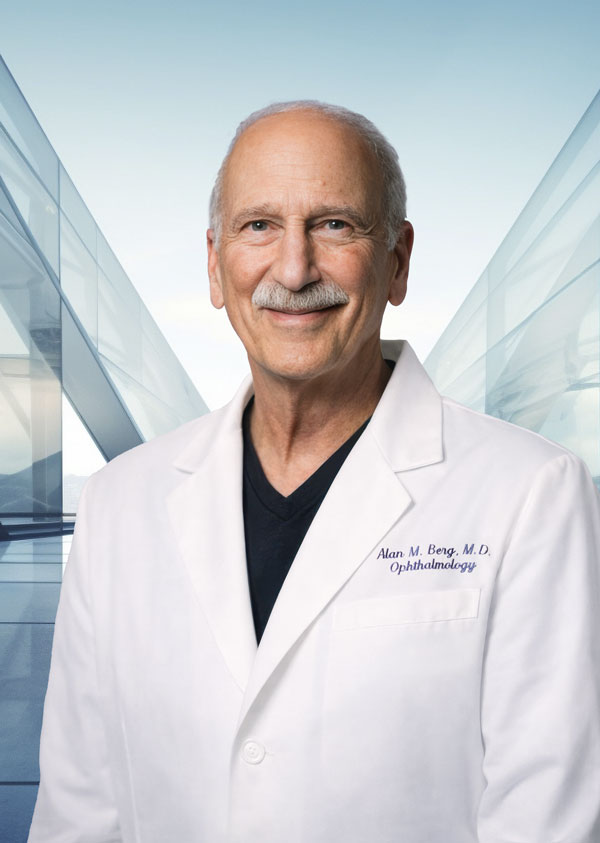
Dr. Alan M. Berg co-founded Berg-Feinfield Vision Correction and is one of the most experienced refractive surgeons in the Los Angeles area. Over the course of his career, he has performed tens of thousands of LASIK and refractive procedures — and has trained other ophthalmologists who have gone on to lead practices across the country.
Dr. Berg has been at the forefront of refractive technology adoption throughout his career — among the first surgeons in Southern California to offer bladeless all-laser LASIK, iDesign wavefront-guided treatment, and the Glaukos iLink corneal cross-linking platform. As a participant in FDA clinical studies, he has contributed to the data that shapes how these technologies are evaluated and approved.
His approach is straightforward: determine the right procedure for each patient’s eyes and visual goals, execute it with precision, and follow the patient closely through recovery. Dr. Berg sees LASIK and refractive surgery patients at our Burbank, Sherman Oaks, and Beverly Hills offices.
A complimentary LASIK consultation at Berg-Feinfield takes about an hour and gives you a complete, honest picture of whether LASIK — or another refractive option — is right for your eyes. No pressure. Just answers.